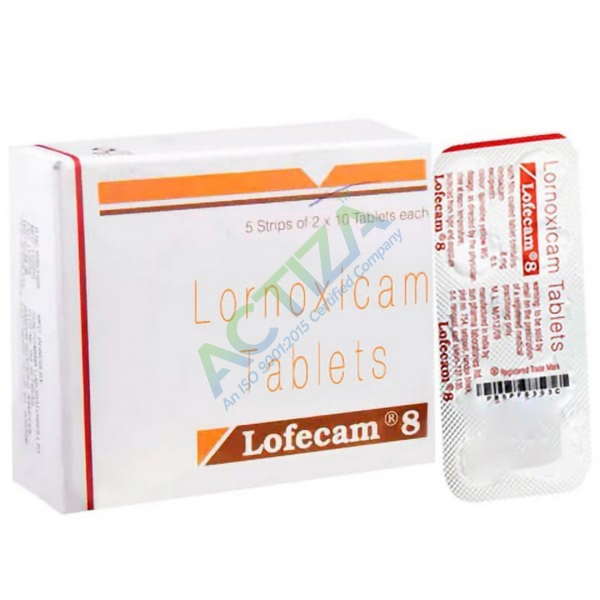
Lofecam 8 Mg (Lornoxicam) Medically reviewed by Sanjay Gangani, B.Pharm, CMO & Pharmacist
Active Ingredient Lornoxicam Indication used for pain relief in conditions like rheumatoid arthritis Manufacturer Sun Pharmaceutical Industries Ltd Strength:- 8mg Packaging 10 tablets in 1 strip
INQUIRE ABOUT Lofecam 8 Mg (Lornoxicam)
What is Lofecam 8 Tablet Lofecam 8 is a prescription tablet from Sun Pharmaceutical Industries Ltd.
Each tablet contains lornoxicam 8 mg.
Lornoxicam is a non-steroidal anti-inflammatory drug, or NSAID.
It belongs to the oxicam family, alongside piroxicam and meloxicam.
Bacloheal 25 mg relieves pain, swelling, stiffness and inflammation.
It is a symptom treatment, not a cure.
It is intended for short courses.
What sets lornoxicam apart from other oxicams Most oxicams have very long half-lives.
Piroxicam, for example, stays in the body for about two days.
Lornoxicam has a short half-life of only 3 to 4 hours.
That means it clears quickly and is dosed two or three times daily.
A short half-life reduces the risk of drug accumulation.
It does not remove the usual NSAID risks.
Rapid clearance also means missed doses cause pain to return sooner.
Lornoxicam is licensed in India, parts of Europe and several other countries.
It is not approved by the United States Food and Drug Administration.
Information written for United States readers may therefore be absent.
One major Indian retail listing reports the brand as discontinued. Please confirm current availability.
How It Works (Mechanism of Action) Tissue injury releases chemicals that trigger inflammation.
Cyclo-oxygenase enzymes convert arachidonic acid into prostaglandins.
Prostaglandins cause pain, swelling, redness and fever.
Voveran 50 mg blocks both COX-1 and COX-2 enzymes.
Blocking COX-2 reduces pain, swelling and fever.
Blocking COX-1 reduces protective stomach prostaglandins.
That loss of protection causes the stomach side effects.
Lornoxicam also reduces platelet clumping.
That is why it can prolong bleeding time.
Injury or arthritis activates inflammatory pathways.
Cyclo-oxygenase enzymes produce prostaglandins.
Prostaglandins sensitise nerve endings and widen blood vessels.
Pain, swelling and heat follow.
Lornoxicam inhibits both cyclo-oxygenase enzymes.
Pharmacokinetic points patients should know Absorption from the gut is rapid and almost complete.
Absolute bioavailability is 90 to 100 per cent.
There is no first-pass liver effect.
Peak blood levels occur about 1 to 2 hours after a dose.
Food reduces the peak level by about 30 per cent.
Food delays the peak from about 1.5 hours to 2.3 hours.
Food can reduce total absorption by up to 20 per cent.
Plasma protein binding is 99 per cent.
The elimination half-life is 3 to 4 hours.
It is broken down by the liver enzyme CYP2C9.
About two-thirds leaves via the liver and one-third via the kidneys.
The breakdown product is inactive.
A genetic point worth knowing CYP2C9 activity varies between individuals for genetic reasons.
Some people are naturally slow metabolisers.
Slow metabolisers can reach markedly higher blood levels.
Higher levels mean a higher risk of side effects.
Report unexpected or severe side effects to your doctor.
Clearance is also reduced by 30 to 40 per cent in older patients.
Dosage Guide (Table) Doses below follow the approved package insert for lornoxicam tablets. Your doctor sets your exact dose and duration.
Indication / Situation Dose Frequency Maximum Short-term pain 8 to 16 mg daily Two or three divided doses 16 mg daily Short-term pain, this strength 8 mg Twice daily 16 mg daily, two tablets Osteoarthritis, initial 12 mg daily Two or three divided doses Needs the 4 mg strength Rheumatoid arthritis, initial 12 mg daily Two or three divided doses Needs the 4 mg strength Osteoarthritis or rheumatoid arthritis, maintenance As prescribed Two or three divided doses 16 mg daily Kidney impairment Reduced dose Three divided doses 12 mg daily , needs 4 mg tabletsLiver impairment Reduced dose Three divided doses 12 mg daily , needs 4 mg tabletsSevere kidney impairment Contraindicated – Do not use Severe liver impairment Contraindicated – Do not use Patients over 65 years See warning below – Confirm with prescriber Patients under 50 kg body weight See warning below – Confirm with prescriber Children and adolescents under 18 Not recommended – Do not use Pregnancy or breastfeeding Contraindicated – Do not use Treatment duration Shortest effective period As prescribed Review regularly Administration Before meals , with sufficient liquid– See food note below
Why 8 mg tablets cannot cover every regimen The daily maximum is 16 mg, which is exactly two 8 mg tablets.
The initial arthritis dose is 12 mg daily, in two or three divided doses.
12 mg cannot be built from 8 mg tablets.
The reduced maximum in kidney or liver impairment is also 12 mg daily.
A 4 mg strength is needed for both of those.
The 8 mg tablet suits 8 mg twice daily, which is the ceiling regimen.
Ask your pharmacist whether this tablet is scored and splittable.
The food question, answered honestly The approved insert says to take the tablet before meals, with sufficient liquid.
The reason is that food reduces how much is absorbed.
However, all NSAIDs irritate the stomach, and food protects it.
The two considerations pull in opposite directions.
Follow the instruction your own prescriber gives.
If you get stomach discomfort taking it before food, tell your doctor.
Do not simply switch the timing yourself, as effectiveness may fall.
Dosage rules that must not be broken Never exceed 16 mg of lornoxicam in one day.
Never exceed 12 mg daily if you have kidney or liver impairment.
Never take this tablet with another NSAID.
Check that no other medicine you take contains an NSAID.
Never take it with aspirin for pain relief.
Use the lowest effective dose.
Use it for the shortest possible time.
Do not continue beyond 3 months without blood tests.
How to Take It Swallow the tablet whole with a sufficient quantity of water.
Do not chew, crush, split or dissolve the tablet.
Take it before meals, unless your doctor directs otherwise.
Space your doses evenly as your doctor directs.
If you forget a dose, take it when you remember.
If the next dose is nearly due, skip the missed one.
Never take a double dose.
Avoid alcohol while taking this medicine.
Stay well hydrated, especially in hot weather.
Stop and seek advice for any stomach or chest symptom.
Stop and seek advice for any rash.
Take it for as short a time as possible.
Practical tips Note the date you started the course.
Pain may return sooner than with longer-acting NSAIDs.
Ask your doctor about a stomach-protecting medicine for longer courses.
Check your blood pressure if you take it regularly.
Watch for ankle swelling and weight gain.
Ask for blood tests if the course exceeds 3 months.
Avoid taking it before major surgery without medical advice.
Tell any dentist, surgeon or pharmacist that you take it.
Do not give your tablets to anyone else.
Precautions Absolute Contraindications Do not take Lofecam 8 if any of these apply.
Known allergy to lornoxicam or any tablet ingredient.
Previous bronchospasm, rhinitis, angioedema or urticaria after aspirin or any other NSAID.
Active peptic ulcer.
Any history of recurrent peptic ulceration, haemorrhage or perforation.
Gastrointestinal bleeding or perforation related to previous NSAID use.
Cerebrovascular bleeding, or any active bleeding.
Bleeding or coagulation disorders.
Thrombocytopenia (low platelet count).
Severe liver impairment.
Severe kidney impairment (serum creatinine above 700 micromol per litre).
Heart failure.
Pregnancy.
Breastfeeding.
Age under 18 years.
Conditions to Disclose to Your Doctor Tell your doctor before the first tablet if you have or have had any of these.
Any history of stomach ulcer, gastritis or reflux.
Any previous gastrointestinal bleeding.
Inflammatory bowel disease, such as ulcerative colitis or Crohn’s disease.
Hiatus hernia or angiodysplasia.
Any previous cerebrovascular haemorrhage.
Any blood-forming or haematopoietic disorder.
Reduced heart function or any heart condition.
High blood pressure.
Any degree of heart failure.
Any kidney disease or reduced kidney function.
Any liver disease, including cirrhosis.
Asthma or any allergic disease.
Dehydration, or recent vomiting, diarrhoea or blood loss.
Any planned major surgery.
Body weight under 50 kg.
Food and Drink Precautions The approved insert says to take the tablet before meals.
Food reduces the peak blood level by about 30 per cent.
Food can reduce total absorption by up to 20 per cent.
However, taking any NSAID without food increases stomach irritation.
Follow the instruction your own prescriber gives.
Avoid alcohol. Alcohol sharply raises the risk of stomach bleeding and ulcers.
Alcohol also adds to liver strain.
Drink enough fluids. Dehydration increases kidney risk.
Take each dose with a sufficient quantity of liquid.
Reduce salt intake if your ankles swell.
Reduce salt intake if your blood pressure rises.
Grapefruit does not need to be avoided.
No tyramine restriction applies.
Avoid herbal products that thin blood, such as ginkgo, garlic and high-dose fish oil.
Before-Use Safety Checklist Confirm each point before your first tablet.
I have a valid doctor’s prescription for lornoxicam 8 mg.
I know my dose and how many times a day to take it.
I know the maximum is 16 mg, or two tablets, per day.
I know the shortest course my doctor intends.
I know whether to take it before or with food.
I have never had asthma or hives from aspirin or an NSAID.
I have no current or past recurrent stomach ulcer or bleeding.
I have no bleeding or clotting disorder.
I have no low platelet count.
I have no severe liver or kidney impairment.
I have discussed my age with my prescriber if I am over 65.
I have discussed my weight with my prescriber if under 50 kg.
I am not taking any other NSAID or aspirin for pain.
I have told my doctor about all my current medicines.
I will avoid alcohol during treatment.
I am not pregnant or breastfeeding.
I have checked the expiry date on the strip.
Monitoring Requirements Situation Monitoring Mild kidney impairment (creatinine 150 to 300 micromol/L) Renal function every 3 months Moderate kidney impairment (creatinine 300 to 700 micromol/L) Renal function every 1 to 2 months Any worsening of kidney function Discontinue treatment Coagulation disorder Clinical and laboratory monitoring, including PTT Treatment longer than 3 months Haemoglobin, creatinine and liver enzymes regularly Major surgery, blood loss or dehydration Renal function Heart failure or diuretic use Renal function Concurrent nephrotoxic drugs Renal function
Side Effects (Table) Common side effects Gastrointestinal effects are the most common.
Side Effect What to Do Abdominal pain Report promptly Indigestion or dyspepsia Report if persistent Nausea Report if persistent Vomiting Report if persistent Diarrhoea Maintain fluids; report if severe Constipation Increase fibre and fluids Dry mouth Sip water Headache Report if persistent Dizziness Avoid driving if affected Drowsiness or somnolence Avoid machinery Appetite change Report significant weight change Weight change Monitor Sweating Report if marked Fluid retention and oedema Report; reduce salt Raised blood pressure Have it checked regularly Weakness or debility Rest; report if severe Raised liver enzymes on blood tests Blood monitoring on longer courses Bruising (ecchymosis) Report unusual bruising
Serious side effects Side Effect What to Do Peptic ulceration Stop and seek urgent care Gastrointestinal bleeding Seek emergency care Gastrointestinal perforation Seek emergency care Prolonged bleeding time Report any unusual bleeding Thrombocytopenia (low platelets) Report bleeding or bruising Anaemia Report tiredness and pallor Heart failure Seek urgent care Palpitations or fast heart rate Report promptly Hypertension Report high readings Reduced kidney function Report low urine output Raised liver enzymes with jaundice Stop and seek urgent care Allergic reaction Stop and seek medical advice Bronchospasm or breathlessness Call emergency services Exfoliative dermatitis Seek emergency care Stevens-Johnson syndrome Seek emergency care Toxic epidermal necrolysis Seek emergency care Bullous (blistering) skin reactions Seek emergency care Depression or insomnia Report to doctor Migraine, tremor or tingling Report to doctor Tinnitus or taste disturbance Report to doctor Vision disorders or conjunctivitis Do not drive; have eyes checked Hair loss Report to doctor Leg cramps or muscle pain Report if persistent Urinary difficulty Report to doctor Upper airway irritation Report if persistent
Notes on specific risks Serious skin reactions, some fatal, have been reported.
Stop at the first sign of rash, mucosal lesion or hypersensitivity.
Gastrointestinal bleeding risk rises with higher doses and older age.
It also rises with any previous ulcer history.
Stop treatment if gastrointestinal bleeding or ulceration occurs.
Fluid retention and reduced kidney function may occur in heart failure or hypertension.
Older patients have more frequent NSAID adverse reactions.
Those reactions include bleeding and perforation, which may be fatal.
Risk-reduction measures Always take the lowest effective dose.
Always take it for the shortest time needed.
Avoid alcohol completely.
Ask about a stomach-protecting medicine for longer courses.
Have blood pressure and kidney checks as advised.
Have blood tests if the course exceeds 3 months.
Report any stomach pain or black stools at once.
Report any chest pain, breathlessness or weakness at once.
Report any rash at once.
Drug Interactions – Avoid or Use With Cautio Other CYP2C9 inhibitors, such as fluconazole, warrant the same caution.
Tell your doctor about every medicine you take, including antifungals.
Many over-the-counter cold and pain products contain NSAIDs.
Always read the label of any new medicine.
Ask a pharmacist before buying any painkiller.
Paracetamol is usually the safer alternative, within normal limits.
Tell every prescriber that you take lornoxicam.
Name the molecule, not just the brand.
Emergency Warning Signs Stop the tablet and seek urgent medical care if any of these occur.
Chest pain, pressure or tightness.
Sudden breathlessness.
Sudden weakness or numbness on one side.
Sudden difficulty speaking or understanding speech.
Sudden severe headache or visual loss.
Black, tarry or bloody stools.
Vomiting blood, or vomit that looks like coffee grounds.
Severe or persistent stomach pain.
Yellowing of the eyes or skin.
Rapid swelling of both legs with breathlessness.
Wheezing or difficulty breathing.
Any new rash, blistering or peeling skin.
Unusual bruising or bleeding.
Bleeding gums or nosebleeds that will not stop.
Overdose warning Overdose can cause nausea, vomiting and dizziness.
Other signs are unsteadiness, cramps and confusion.
Severe overdose can cause coma.
It can also cause liver damage, kidney damage and clotting problems.
There is no specific antidote.
The medicine must be stopped at once.
Go to hospital immediately and take the strip or carton.
Treatment is symptomatic and supportive.
When to call your doctor the same day Any new indigestion or stomach discomfort.
Any new ankle swelling or weight gain.
Any rise in blood pressure readings.
Any new rash, however mild.
Any new bruising or bleeding.
Any planned surgery or dental extraction.
Any pregnancy, or suspected pregnancy.
Any need to continue beyond the planned course.
Why Choose This Medicine Clinical advantages of lornoxicam Short half-life. At 3 to 4 hours, it clears far faster than other oxicams.
Less accumulation risk. Rapid clearance reduces build-up over days.
Near-complete absorption. Bioavailability is 90 to 100 per cent.
No first-pass effect. The full dose reaches the bloodstream.
Rapid onset. Peak levels occur within 1 to 2 hours.
Inactive metabolite. The breakdown product has no activity of its own.
Potent anti-inflammatory effect. Effective in osteoarthritis and rheumatoid arthritis.
Flexible dosing. Two or three divided doses are both permitted.
Two strengths exist. 4 mg and 8 mg allow 12 mg and 16 mg daily totals.
Honest limitations you should know Food reduces absorption, so the insert says to take it before meals.
That conflicts with the usual advice to take NSAIDs with food.
The short half-life means pain returns sooner between doses.
Gastrointestinal bleeding can occur at any time, without warning.
It can raise blood pressure and cause fluid retention.
It prolongs bleeding time.
Slow CYP2C9 metabolisers can reach much higher blood levels.
Clearance falls by 30 to 40 per cent in older patients.
Serious skin reactions, some fatal, have been reported.
It is not approved by the United States FDA.
One major listing reports the brand as discontinued.
It treats symptoms only and does not modify disease.
Storage Instructions Store below 25°C in a dry place.
Keep the tablets in the original strip until use.
Protect from direct sunlight and heat.
Protect from moisture and humidity.
Do not store in a bathroom cabinet.
Do not store in a car dashboard or glovebox.
Keep out of reach of children.
Do not transfer tablets to an unlabelled container.
Check the strength on every new strip.
Check the expiry date before every new strip.
Do not use a tablet that is cracked, chipped or discoloured.
Do not use a strip with torn or broken foil.
Return unused or expired tablets to a pharmacy for disposal.
Do not keep leftover tablets for a future episode.
Do not share your tablets with anyone else.
Sanjay Gangani
B.Pharm, CMO & Pharmacist
Licensed pharmacist (B.Pharm) with 12+ years in clinical pharmacy and patient care. Reviews every article for evidence-based accuracy before it is published on ACTIZA Store.



Reviews
There are no reviews yet.