Nokrono 500 Mg (Disulfiram) Medically reviewed by Sanjay Gangani, B.Pharm, CMO & Pharmacist
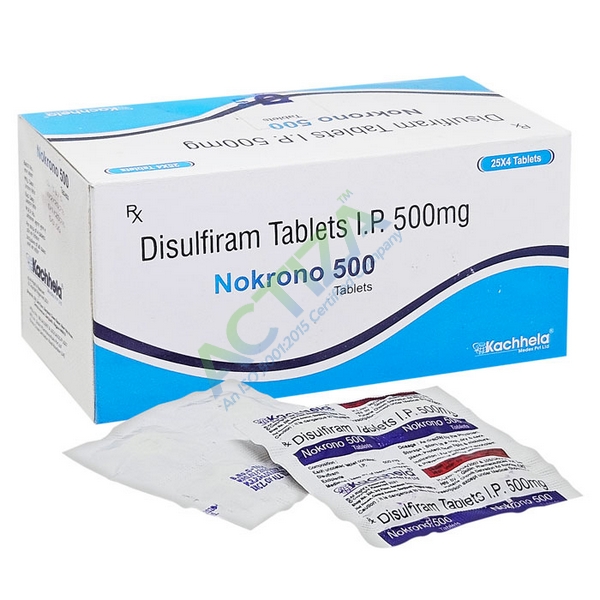
Active Ingredient Disulfiram Indication Alcohol dependence Manufacturer Kachhela Medex Pvt. Ltd. Strength:- 500mg Packaging 4 Tablets in 1 strip Dosage Form:- Tablet Country of Origin India
INQUIRE ABOUT Nokrono 500 Mg (Disulfiram)
What is Nokrono 500 Tablet? Nokrono 500 is a prescription tablet containing disulfiram.
Each tablet contains 500 mg of disulfiram.
Disulfiram 250 is known as an alcohol deterrent.
The original brand name is Antabuse.
It is sold as a strip of 4 tablets.
Helping selected patients stay away from alcohol.
It supports a period of enforced sobriety.
That period allows counselling and therapy to work.
It does not cure alcohol dependence.
It does not reduce the craving for alcohol.
Used alone, it is unlikely to change a drinking pattern.
It works only alongside motivation and support.
How Disulfiram Works (Mechanism of Action) The action happens in five simple steps:
The body normally breaks alcohol down in two stages.
The first stage turns alcohol into acetaldehyde.
An enzyme then clears that acetaldehyde away.
Disulfiram blocks that enzyme.
Acetaldehyde builds up and causes the unpleasant reaction.
How large that build-up is:
Acetaldehyde rises five to ten times above normal.
That is what produces flushing, sickness and palpitations .
The reaction is the intended deterrent effect.
Disulfiram leaves the body slowly.
Its effects may persist for one to two weeks after stopping.
So alcohol must be avoided for up to 14 days afterwards.
Dosage Guide Doses below come from approved disulfiram labelling.
Situation Dose How Often Key Note Before the first tablet No alcohol for 12 hours Not applicable This rule is absolute First phase of treatment A maximum of 500 mg Once daily for 1 to 2 weeks This tablet matches that dose Usual maintenance 250 mg daily Once daily Half of this tablet strength Maintenance range 125 mg to 500 mg Once daily Set by the prescriber Maximum 500 mg Per day Never exceed this Time of day Usually the morning Once daily Bedtime if it causes drowsiness With food With or without food Either way Per approved labelling Length of treatment Months, or even years Ongoing Until self-control is established Liver impairment Use with extreme caution As prescribed No specific dose is recommended Stopping Alcohol still barred 14 days After the last tablet The effect persists
Where this 500 mg tablet sits:
500 mg is the maximum daily dose in approved labelling.
It is used in the first one to two weeks of treatment.
The usual maintenance dose is half of that.
One clinical fact sheet suggests starting lower still.
It suggests 125 mg, rising to 250 mg after several days.
Only the prescriber decides which schedule applies.
Treatment is started in a hospital or a doctor’s rooms.
A complete physical examination comes first.
Baseline liver function tests are recommended.
How to Take Nokrono 500 Confirm no alcohol has been taken for at least 12 hours.
Swallow the tablet whole with water.
Take it once daily, usually in the morning.
Take it at bedtime instead if it makes you drowsy.
It may be taken with or without food.
Take it every day, without missing doses.
Do not stop it without speaking to your doctor.
Attend every follow-up appointment arranged for you.
Avoiding every source of alcohol:
Beer, wine and spirits, obviously.
Mouthwash and aftershave lotion.
Vinegar, cider, sauces and some desserts.
Cough syrups, tonics and liquid medicines.
Any medicine solution labelled as an elixir.
Some extracts used in cooking.
Check every label before you use a product.
Carry a card or bracelet naming this medicine.
It should list the symptoms of the reaction.
It should give a contact number for your doctor.
Precautions Contraindications in the Approved Labelling Severe disease of the heart muscle.
Blockage of a coronary artery.
Psychosis.
Allergy to disulfiram.
Allergy to related thiuram compounds.
Those compounds are used in pesticides and rubber.
Current or recent treatment with metronidazole.
Current or recent treatment with paraldehyde.
Any recent alcohol or alcohol-containing preparation.
That includes cough syrups and tonics.
Tell Your Doctor Before Use If You Have: Liver disease of any kind.
Kidney disease.
Heart disease, high blood pressure, or a past heart attack.
A past stroke.
Diabetes.
A head injury or brain damage.
An underactive thyroid.
Epilepsy or seizures.
Any mental health condition.
Every other medicine you take.
Serious Risks Beyond the Alcohol Reaction Liver injury has been reported, including hepatitis.
Some cases led to transplantation or to death.
That can happen with or without previous liver problems.
Liver function should be monitored.
Nerve damage has been reported with prolonged use.
That includes optic neuritis affecting the eye.
It includes peripheral neuropathy in the limbs.
Rare psychotic episodes have been reported.
It is not recommended in pregnancy or breastfeeding.
Before-Use Checklist Does the patient know exactly what this medicine does?
Has the reaction been explained in full to them?
Have at least 12 hours passed since any alcohol?
Has a physical examination been done?
Have baseline liver tests been arranged?
Do they take metronidazole or paraldehyde?
Do they have heart disease or psychosis?
Do they know about hidden alcohol in everyday products?
Will they carry identification naming this medicine?
Is counselling or psychotherapy in place alongside it?
Side Effects These occur without any alcohol being taken.
Side Effect Category What It Feels Like What to Do Drowsiness Most common Daytime sleepiness Take the dose at bedtime instead Fatigue Most common Persistent tiredness Report if severe Metallic or garlic taste Most common An odd taste in the mouth Usually settles over time Headache Most common Head pain Report if persistent Skin eruptions Most common Acne or an itchy rash Often controlled with an antihistamine Impotence Most common Difficulty with erections Discuss with your doctor Severe hepatitis Serious but rare Jaundice, dark urine, tiredness Emergency – stop and seek care Liver failure Serious but rare As above, worsening rapidly Emergency – seek care Optic neuritis Rare Blurred or lost vision Stop and seek urgent assessment Peripheral neuropathy Rare Numbness or tingling in limbs Report to your doctor Psychotic episode Rare Confusion, unusual beliefs Seek medical advice urgently
What the Indian listing lists:
It names headache among the common effects.
It describes the reaction with alcohol in the same terms.
Both cholestatic and fulminant hepatitis have been reported.
Some patients needed a liver transplant.
Some died.
Report jaundice, dark urine or unusual tiredness at once.
Drug Interactions Must not be combined:
Metronidazole, an antibiotic, because of psychotic reactions.
Paraldehyde.
Any preparation containing alcohol.
That includes topical products applied to the skin.
Warfarin, whose blood-thinning effect increases.
Phenytoin, whose blood levels rise.
Isoniazid, which can cause unsteadiness or psychosis.
Theophylline, used for breathing conditions.
A related point:
Some other medicines cause a similar reaction with alcohol.
Those include certain older diabetes tablets.
Tell every prescriber that you take disulfiram.
Keep telling them for two weeks after stopping.
Emergency Warning Signs – Seek Urgent Medical Help Call for emergency help if the patient has:
Chest pain or a pounding, irregular heartbeat.
Severe breathlessness or rapid breathing.
Collapse, fainting or loss of consciousness.
A seizure.
Severe vomiting with weakness and confusion.
Any of these after taking alcohol while on this medicine.
Yellowing of the skin or eyes.
Dark urine or pale stools.
Unusual tiredness or loss of appetite.
Any change in vision.
Numbness or tingling in the hands or feet.
Confusion or unusual thoughts.
That the patient takes disulfiram.
Whether any alcohol has been taken, and when.
The dose and the time of the last tablet.
What This Medicine Offers, and Its Limits Where it can help:
It creates a strong deterrent against drinking.
That can protect a period of early recovery.
It allows counselling and therapy time to work.
It is taken as one tablet once a day.
It has been in clinical use for many decades.
Same-composition brands are widely available in India.
Honest balance for the buyer:
It does not reduce craving at all.
It works only if the patient genuinely wants to stop.
Missing doses removes the deterrent entirely.
The reaction with alcohol can be severe or fatal.
Hidden alcohol in everyday products can trigger it.
Liver injury and nerve damage have been reported.
It must never be given to anyone without their knowledge.
500 mg is the first-phase dose, not the usual maintenance.
Storage Instructions Store below 30°C, per the Indian listing.
Keep the tablets in their strip until use.
Protect them from moisture and direct sunlight.
Keep out of the sight and reach of children.
Never leave them where they could be taken by accident.
Check the expiry date before use.
Return unused tablets to a pharmacy take-back scheme.
Sanjay Gangani
B.Pharm, CMO & Pharmacist
Licensed pharmacist (B.Pharm) with 12+ years in clinical pharmacy and patient care. Reviews every article for evidence-based accuracy before it is published on ACTIZA Store.



Reviews
There are no reviews yet.