Doxolin 200 Mg (Doxofylline) Medically reviewed by Sanjay Gangani, B.Pharm, CMO & Pharmacist
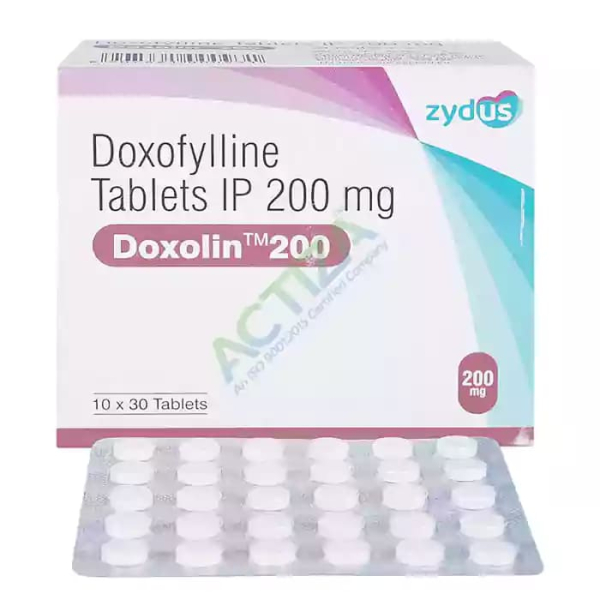
Active Ingredient Doxofylline Indication Asthma prevention, Chronic obstructive pulmonary disease (COPD) Manufacturer Zydus Lifesciences Strength:- 200mg Packaging 30 tablets in 1 strip
INQUIRE ABOUT Doxolin 200 Mg (Doxofylline)
What is Doxolin 200? Doxolin 200 is a prescription tablet for long-term breathing problems.
Each tablet contains 200 mg of the active ingredient doxofylline.
Doxofylline belongs to the xanthine class of bronchodilators.
It is made by Zydus Healthcare Ltd. in Ahmedabad, India.
It treats bronchial asthma and chronic obstructive pulmonary disease.
COPD covers chronic bronchitis and emphysema.
The tablet relaxes the muscle around the airways.
Relaxed airways widen, so air moves more easily.
This reduces wheezing, coughing and breathlessness over time.
It is taken regularly to prevent symptoms, not to stop an attack.
It is a bronchodilator, not a cough syrup or antitussive.
It does not cure asthma or COPD.
This is the lower of the two main Doxolin strengths.
Zydus also sells Doxolin 400 mg and a sustained-release version.
200 mg is the recommended dose for older adults.
The originator brand of doxofylline is Ansimar, made in Italy.
Use Doxolin 200 mg only for the condition your doctor prescribed.
How Doxolin 200 Works (Mechanism of Action) The action happens in five simple steps:
An enzyme called phosphodiesterase breaks down a messenger named cAMP.
Doxofylline blocks that enzyme inside airway muscle cells.
Levels of cAMP therefore rise inside those cells.
Higher cAMP relaxes the smooth muscle wrapped around the airways.
The airways widen and air flows in and out more freely.
Wider airways reduce resistance to airflow.
Breathing requires less effort during normal activity.
Wheezing, chest tightness and cough become less frequent.
The benefit builds with regular daily use.
A single tablet will not open airways during an attack.
How doxofylline differs from theophylline:
Both belong to the same xanthine drug family.
Doxofylline carries an extra dioxolane group at position 7.
It has much weaker activity at adenosine A1 and A2 receptors.
That difference is thought to explain its better safety profile.
Studies show less heart stimulation than with theophylline.
Arrhythmia-related effects also appear less pronounced.
Doxofylline is absorbed rapidly after an oral dose.
Peak blood levels occur about one hour after an oral dose.
The therapeutic blood level is around 10 micrograms per millilitre.
Levels near 20 micrograms per millilitre border on toxicity.
Standard doses do not usually exceed that upper figure.
Routine blood level testing is therefore not usually needed.
Blood levels should be checked if the dose is increased.
Dosage Guide Always follow the dose written on your prescription.
Patient Situation Typical Doxofylline Dose Timing Key Note Older adults 200 mg two or three times daily With food, at the same times daily Doxolin 200 is one tablet per dose Adults needing a reduced dose 200 mg per dose as directed With food, at the same times daily Set by your doctor, not by you Liver disease Reduced dose such as 200 mg As prescribed Clearance of xanthines is slower Congestive heart failure Reduced dose such as 200 mg As prescribed Clearance of xanthines is slower Severe COPD or a chest infection Reduced dose such as 200 mg As prescribed Clearance of xanthines is slower Adults, usual standard dose 400 mg two or three times daily With food, at the same times daily That is the Doxolin 400 strength Adults, usual maximum Up to 1,200 mg per day Spread across the day as prescribed Do not exceed the prescribed amount Sustained-release form 400 mg once daily Usually in the evening with food Only if a 400 mg daily total is prescribed Kidney disease Use with caution under review As prescribed Tell your doctor before starting Heavy smokers May clear the drug faster As prescribed Dose may need review if you stop smoking Children and adolescents Only on specialist direction As prescribed Weight-based dosing differs entirely Breastfeeding women Do not use Not applicable This is a contraindication Anyone after a recent heart attack Do not use Not applicable This is a contraindication
The first five rows cover the situations this strength is made for.
How to read this table:
Every dose shown comes from published doxofylline product information.
Your exact dose depends on your condition and other medicines.
Several conditions slow how quickly the body clears the drug.
In those cases a lower dose avoids side effects.
Never switch yourself from 200 mg to 400 mg tablets.
Never raise your own dose if breathing feels worse.
Worsening breathing needs medical review, not more tablets.
Take a missed dose as soon as you remember.
Skip it entirely if the next dose is almost due.
Never take two doses close together to catch up.
Do not take any other xanthine medicine at the same time.
Overdose can cause severe irregular heartbeats.
Overdose can also cause tonic-clonic seizures.
These are medical emergencies needing hospital treatment.
Call emergency services immediately after a suspected overdose.
How to Take Doxolin 200 Take the dose exactly as your doctor has prescribed it.
Swallow the tablet whole with a glass of water.
Take it with or just after food to reduce stomach upset.
Keep to the same times each day for steady blood levels.
Many people take the evening dose after their meal.
Do not crush or chew a sustained-release tablet.
Keep taking it daily even when your breathing feels fine.
Continue using your other inhalers as prescribed.
Always carry your fast-acting reliever inhaler.
Use the reliever, not this tablet, during sudden breathlessness.
Do not stop the tablet suddenly without medical advice.
Attend reviews so your doctor can check your lung function.
Practical usage tips:
Limit coffee, tea, cola, energy drinks and dark chocolate.
Caffeine is closely related to this drug and adds side effects.
Tell your doctor if you start or stop smoking.
Smoking changes how quickly your body clears the medicine.
Keep a record of how often you need your reliever inhaler.
Rising reliever use is an early sign of poor control.
Report any rapid or irregular heartbeat to your doctor.
Precautions Absolute Contraindications – Do Not Use Doxolin 200 If You: Are allergic to doxofylline or any tablet ingredient.
Are allergic to any other xanthine medicine.
That includes theophylline, aminophylline and similar drugs.
Have recently had a heart attack (acute myocardial infarction).
Have low blood pressure (hypotension).
Are breastfeeding a baby.
Are already taking another xanthine bronchodilator.
Conditions You Must Disclose to Your Doctor Any heart disease, angina or previous heart attack.
Any irregular heartbeat or palpitations.
Congestive heart failure.
High blood pressure or low blood pressure.
Liver disease, hepatitis or cirrhosis.
Kidney disease or reduced kidney function.
An overactive thyroid gland (hyperthyroidism).
A stomach or duodenal ulcer.
Epilepsy or any history of seizures.
Low blood oxygen levels (hypoxaemia).
Any current chest infection or fever.
Diabetes, since xanthines can raise blood sugar.
Pregnancy, planned pregnancy or breastfeeding.
Whether you smoke, and any plan to quit.
All prescription, herbal and over-the-counter products you use.
Food and Drink Precautions Take the tablet with or just after food.
Food reduces the chance of stomach upset.
Limit coffee, tea, cola and energy drinks.
Limit dark chocolate, which also contains related compounds.
Caffeine adds to tremor, restlessness and fast heartbeat.
Avoid alcohol, which can worsen dizziness and stomach irritation.
A very high protein diet may speed up drug clearance.
Tell your doctor about major changes to your diet.
Do not take herbal stimulants such as guarana or ephedra.
Before-Use Safety Checklist Do you hold a valid prescription for Doxolin 200?
Has your doctor confirmed the strength and number of daily doses?
Do you understand this is a preventer, not a reliever?
Do you have a fast-acting reliever inhaler with you?
Do you know what to do during a sudden attack?
Have you confirmed you take no other xanthine medicine?
Have you disclosed any heart, liver or kidney disease?
Have you disclosed any seizures or stomach ulcers?
Have you listed all your medicines for the doctor or pharmacist?
Have you checked the expiry date on the strip?
Do you know the emergency warning signs in Section 8?
Common and Less Common Side Effects Most reported effects are those typical of xanthine medicines.
Side Effect Frequency What It Feels Like What to Do Nausea Common Queasy or unsettled stomach Take with food; report if persistent Vomiting Common Being sick after a dose Contact your doctor if it repeats Upper stomach pain Common Burning or ache below the ribs Take with food; report if severe Headache Common Dull or throbbing head pain Rest and drink water; report if severe Insomnia Common Difficulty falling or staying asleep Avoid late doses and caffeine; tell your doctor Irritability Common Feeling tense, restless or on edge Report if it continues Fast heartbeat (tachycardia) Common Racing or pounding pulse Contact your doctor promptly Dizziness Common Light-headed feeling Stand slowly; avoid driving until clear Extra heartbeats (extrasystoles) Less common Skipped or fluttering beats Seek medical review Rapid breathing (tachypnoea) Less common Breathing faster than usual at rest Contact your doctor promptly Tremor Less common Shaky hands Reduce caffeine; report to your doctor Loss of appetite Less common Not wanting to eat Report if weight falls Diarrhoea Less common Loose or frequent stools Keep hydrated; report if persistent Raised blood sugar Rare Thirst, frequent urination, tiredness Important if you have diabetes; tell your doctor Protein in the urine Rare No symptoms; found on a urine test Your doctor will advise on monitoring Skin rash or itching Rare Red or itchy patches on the skin Stop use and contact your doctor Severe irregular heartbeat Rare Chaotic pulse, chest pain, faintness Emergency — call for help immediately Seizure or convulsion Rare Loss of consciousness with shaking Emergency — call for help immediately Severe allergic reaction Rare Swelling of face, lips or throat Emergency — call for help immediately
Severe arrhythmia and seizures can be the first signs of toxicity.
They usually indicate blood levels have risen too high.
Treatment may need to stop until symptoms settle.
A doctor may then restart it at a lower dose.
Doxofylline generally causes fewer heart effects than theophylline.
This list is not complete; report any unusual symptom.
Report suspected reactions to your national pharmacovigilance programme.
Drug Interactions – Avoid or Use With Caution Never combine Doxolin 200 with these:
Theophylline, aminophylline or any other xanthine tablet.
Any other doxofylline product, including the sustained-release form.
Combination cough or cold products containing a xanthine.
These may raise doxofylline levels and side effects:
Erythromycin, troleandomycin and other macrolide antibiotics.
Lincomycin and clindamycin.
Allopurinol, used for gout.
Cimetidine, used for stomach acid.
Propranolol and related beta-blockers.
Influenza vaccination, which can slow clearance temporarily.
Phenytoin and other anticonvulsant medicines.
Cigarette smoking, which speeds up clearance.
Rifampicin and similar enzyme-inducing drugs.
Ephedrine and other sympathomimetic medicines.
Salbutamol and other reliever bronchodilators.
Ciprofloxacin and other quinolone antibiotics.
Caffeine tablets or high-caffeine supplements.
Interaction outcomes to understand:
Beta-blockers can narrow airways and oppose this medicine.
Two xanthines together sharply raise the risk of toxicity.
Higher levels bring arrhythmias, tremor and seizures.
Lower levels allow asthma or COPD symptoms to return.
Stopping smoking can raise levels and may need a dose review.
Tell every prescriber that you take a xanthine bronchodilator.
Emergency Warning Signs – Seek Urgent Medical Help Call emergency services immediately if you or someone else has:
Breathlessness that is getting rapidly worse.
Difficulty speaking a full sentence in one breath.
A reliever inhaler that is no longer working.
Lips, face or fingertips turning blue or grey.
Drowsiness, confusion or exhaustion while struggling to breathe.
A silent chest, where wheezing suddenly stops.
Chest pain or a chaotic, racing heartbeat.
A seizure or convulsion.
Repeated vomiting with a racing pulse.
Swelling of the face, lips, tongue or throat.
Contact your doctor the same day if you have:
Needing your reliever inhaler more often than usual.
Waking at night because of coughing or wheezing.
Symptoms interfering with normal daily activity.
A new or worsening chest infection.
Persistent palpitations, tremor or severe insomnia.
Use your fast-acting reliever inhaler straight away.
Do not take an extra Doxolin tablet instead.
Tell every treating doctor you take a xanthine bronchodilator.
State the dose and the time you last took it.
Mention any recent antibiotic or new medicine.
Bring the pack with you if that is possible.
Why Choose Doxolin 200? Benefits of doxofylline as a maintenance bronchodilator:
It is taken as a tablet, which suits people who struggle with inhalers.
It works alongside inhaled treatments rather than replacing them.
It causes fewer heart effects than theophylline.
It has weaker adenosine receptor activity than theophylline.
Routine blood level monitoring is not usually required.
Standard doses stay below the toxic threshold in most people.
It treats both asthma and COPD in adults.
The lower strength suits older adults and reduced-dose cases.
Two strengths let a doctor adjust treatment precisely.
Zydus is one of India’s largest pharmaceutical manufacturers.
A sustained-release version allows once-daily dosing.
Generic pricing keeps long-term therapy affordable.
Honest balance for the buyer:
Doxofylline does not cure asthma or COPD.
It is never a substitute for a reliever inhaler.
Inhaled therapies remain the foundation of asthma treatment.
Tablets act throughout the body, not just in the lungs.
That means more systemic side effects than an inhaler.
Doxofylline is not approved by the US FDA.
200 mg may not control symptoms in every adult.
Only a doctor should decide on any move to 400 mg.
Several conditions require a reduced dose or careful review.
Worsening symptoms always need medical assessment.
Stopping smoking helps more than any tablet in COPD.
Storage Instructions Store below 25°C in a cool, dry place.
Keep tablets in the original strip or blister until use.
Protect from direct sunlight, heat and moisture.
Do not store in the bathroom or near a sink.
Do not refrigerate or freeze the tablets.
Keep the pack out of sight and reach of children.
Keep away from pets at all times.
Check the expiry date printed on the strip and carton.
Order refills early so daily therapy is never interrupted.
A gap in treatment can allow symptoms to return.
Do not use tablets that are chipped, discoloured or damp.
Do not transfer tablets into unlabelled containers.
Do not flush unused tablets down the toilet.
Return expired medicine to a pharmacy take-back scheme.
Sanjay Gangani
B.Pharm, CMO & Pharmacist
Licensed pharmacist (B.Pharm) with 12+ years in clinical pharmacy and patient care. Reviews every article for evidence-based accuracy before it is published on ACTIZA Store.



Reviews
There are no reviews yet.