...

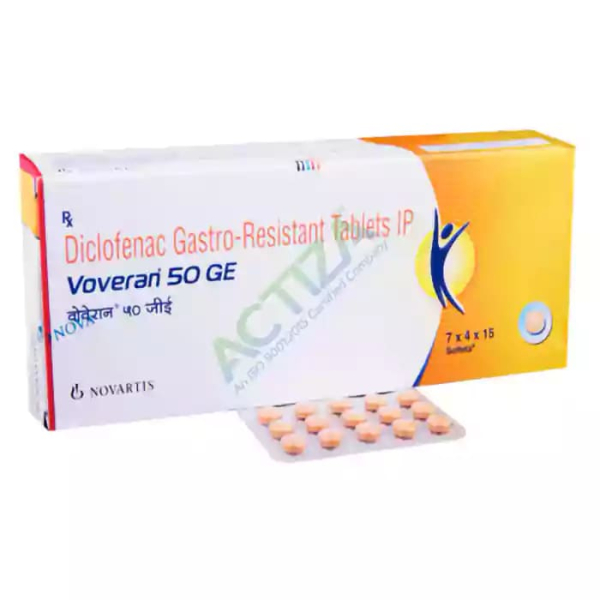
Voveran 50 Mg (Diclofenac)

Medically reviewed by Sanjay Gangani, B.Pharm, CMO & Pharmacist

Active Ingredient Diclofenac
Indication Musculo-skeletal pain, Rheumatic pain, Pain relief
Manufacturer Novartis India Ltd
Strength:- 50 mg
Packaging Strip of 15 tablet SR

Voveran 50 Mg (Diclofenac)

Pack Size Price Price/unit Quantity Add To Cart
60 Tablet/s $11 $0.18/Tablet
90 Tablet/s $16 $0.18/Tablet
120 Tablet/s $21 $0.18/Tablet

What is Voveran 50 mg?

  • Voveran 50 mg contains diclofenac sodium 50 mg per tablet.

  • Diclofenac is a non-steroidal anti-inflammatory drug (NSAID).

  • Voveran SR 75 belongs to the acetic acid derivative group of NSAIDs.

  • It reduces pain, swelling, stiffness and fever.

  • Voveran is a Novartis trademark.

  • Dr. Reddy’s Laboratories distributes it in India under an exclusive agreement.

  • It is a prescription-only medicine.

  • The underlying infection must still be treated with anti-infectives.

  • Fever on its own is not an indication for Voveran TPM Gel.

Important regulatory history

  • In June 2013 the MHRA added new contraindications for diclofenac.

  • These followed a Europe-wide review by the EMA’s PRAC.

  • The review found diclofenac’s clot risk similar to selective COX-2 inhibitors.

  • A 2013 Lancet meta-analysis quantified the risk.

  • For every 1,000 patients treated for a year, three extra major vascular events occurred.

  • Diclofenac is now contraindicated in several established heart and circulation conditions.

  • In 2015 the UK reclassified oral diclofenac from pharmacy to prescription-only.

  • Naproxen and low-dose ibuprofen have more favourable clot-risk profiles.

How Voveran Works (Mechanism of Action)

Step-by-step mechanism

  • Injured or inflamed tissue releases arachidonic acid.

  • Cyclo-oxygenase (COX) enzymes convert it into prostaglandins.

  • Prostaglandins sensitise nerve endings and drive swelling.

  • They also raise body temperature during inflammation.

  • Diclofenac inhibits prostaglandin synthesis.

  • It blocks both COX-1 and COX-2 enzymes.

  • Pain, swelling, stiffness and fever all fall.

  • The short half-life explains why doses are divided through the day.

  • The long synovial dwell time explains the sustained joint effect.

Pharmacokinetics

PropertyValue
AbsorptionComplete after the tablet passes the stomach
Peak plasma level after 50 mgAbout 1.5 µg/mL at around 2 hours
Effect of foodDelays gastric passage; amount absorbed unchanged
First-pass lossAbout half of the dose
Plasma protein binding99.7%, mainly to albumin
Synovial fluidLevels stay above plasma for up to 12 hours
MetabolismGlucuronidation and hydroxylation in the liver
Plasma half-life1 to 2 hours
ExcretionAbout 60% in urine as conjugates
Excreted unchangedLess than 1%
Age-related differencesNone relevant

Dosage Guide

Only a prescriber may set the dose. These figures reproduce the approved label and are reference only.

Adult dosing

SituationDaily doseDivided into
Starting dose100 to 150 mg/day2 or 3 doses
Mild cases or long-term therapy75 to 100 mg/day2 or 3 doses
Primary dysmenorrhoea, usual50 to 150 mg/dayDivided doses
Primary dysmenorrhoea, maximumUp to 200 mg/dayDivided doses
Nocturnal pain or morning stiffnessAdd a bedtime suppositoryTotal still 150 mg/day

Stopping treatment

  • Stop immediately if gastrointestinal bleeding or ulceration occurs.

  • Stop at the first sign of a rash or mucosal lesion.

  • Stop if liver tests become persistently abnormal.

  • No taper is required; diclofenac causes no withdrawal.

  • Reassess the need for treatment at least every four weeks.

How to Take Voveran 50 mg

  • Swallow the tablet whole with a glass of water or other liquid.

  • Do not divide, crush or chew the tablet.

  • Follow the timing printed on your own pack insert.

  • The Novartis SmPC advises taking it preferably before meals.

  • Many Indian listings advise taking it with food or milk.

  • Food delays absorption but does not reduce it.

  • Space doses evenly, usually two or three times daily.

  • Keep to the same times each day.

  • Do not exceed the prescribed dose or duration.

  • Attend review appointments for monitoring.

Missed dose

  • Take the missed dose when you remember it.

  • Skip it if the next dose is almost due.

  • Never take two tablets together.

  • Seek emergency medical help immediately.

  • Symptoms include vomiting, diarrhoea, dizziness and tinnitus.

  • Gastrointestinal bleeding can occur.

  • Convulsions have been reported.

  • Severe poisoning can cause acute kidney failure and liver damage.

  • Activated charcoal may help after a potentially toxic dose.

  • Dialysis and forced diuresis are unlikely to help.

Realistic expectations

  • Pain relief typically begins within a few hours.

  • Full anti-inflammatory benefit may take several days.

  • Voveran Emulgel controls symptoms; it does not halt joint destruction.

  • Benefit does not increase above the maximum daily dose.

  • Risk increases with higher dose and longer duration.

Precautions

Absolute contraindications

  • Known hypersensitivity to diclofenac or any tablet excipient.

  • Active gastric or intestinal ulcer.

  • Active gastrointestinal bleeding or perforation.

  • Previous gastrointestinal bleeding or perforation caused by an NSAID.

  • Recurrent peptic ulcer or haemorrhage, with two or more proven episodes.

  • Asthma, angioedema, urticaria or acute rhinitis after any NSAID or aspirin.

  • Established congestive heart failure, NYHA class II to IV.

  • Established ischaemic heart disease.

  • Established peripheral arterial disease.

  • Established cerebrovascular disease.

  • Hepatic failure.

  • Renal failure with GFR below 15 mL/min/1.73 m².

  • Last trimester of pregnancy.

  • Breastfeeding.

  • Rare hereditary galactose intolerance or lactase deficiency, as the tablet contains lactose.

Food and drink precautions

ItemAdvice
FoodFollow your own pack insert; see section 4
MilkCommonly advised in India to reduce stomach upset
High-fat mealsDelay absorption; do not reduce it
AlcoholAvoid. It sharply raises ulcer and bleeding risk
Spicy or strongly acidic foodsMay worsen stomach irritation
FluidsStay well hydrated to protect the kidneys
Fasting or low fluid intakeRaises kidney injury risk
Salt intakeKeep moderate; diclofenac retains fluid
Potassium supplements and salt substitutesAvoid unless the doctor advises
Herbal blood thinners (ginkgo, garlic, fish oil)Avoid; additive bleeding risk
Cholestyramine or colestipolSeparate doses; see section 7

Before-use safety checklist

  • I have a valid prescription for this medicine.

  • I have no established heart, artery or stroke disease.

  • I do not have congestive heart failure of class II or worse.

  • I have never had a stomach ulcer or gastrointestinal bleed.

  • I have never reacted badly to aspirin or another NSAID.

  • I am not taking any other NSAID, gel or aspirin.

  • I am not taking a blood thinner.

  • My kidney and liver function are known to my prescriber.

  • I am not pregnant and not in the third trimester.

  • I am not breastfeeding.

  • I am not trying to conceive.

  • I know my maximum daily dose and how to divide it.

  • If I have cardiovascular risk factors, my dose is capped at 100 mg daily.

  • I know to stop at the first sign of any rash.

  • I know the warning signs of stomach bleeding.

Side Effects

Common side effects (up to 1 in 10)

Side effectSystemPractical guidance
NauseaGastrointestinalFollow your pack’s food advice
VomitingGastrointestinalReport if persistent
DiarrhoeaGastrointestinalMaintain hydration
Indigestion (dyspepsia)GastrointestinalReport if persistent
Abdominal painGastrointestinalReport if severe
FlatulenceGastrointestinalUsually self-limiting
Reduced appetiteGastrointestinalMonitor weight
HeadacheNervous systemReport if severe
DizzinessNervous systemAvoid driving
VertigoEarMove slowly; avoid heights
Raised liver enzymesLiverNeeds blood test review
RashSkinStop and seek advice

Uncommon side effects (up to 1 in 100)

Side effectNote
Heart attack (myocardial infarction)Rate reflects long-term use at 150 mg/day
Heart failureEmergency
PalpitationsMedical review
Chest painEmergency

Facts the label makes explicit

  • Gastrointestinal bleeding, ulceration and perforation can occur at any time.

  • They may be fatal, and are more serious in the elderly.

  • Arterial clot events are associated with diclofenac.

  • The association is strongest at 150 mg/day and with long-term use.

  • Serious skin reactions usually appear in the first month.

  • Hepatitis can occur without any warning symptoms.

  • Diclofenac temporarily inhibits platelet aggregation.

  • Visual disturbances are an NSAID class effect and usually reversible.

  • Diclofenac may impair female fertility.

  • It can mask the signs of infection.

Drug Interactions – Avoid or Use With Caution

High-risk combinations requiring monitoring

DrugRisk
Warfarin or acenocoumarolSerious bleeding; monitor INR
Heparin or low molecular weight heparinSerious bleeding risk
Antiplatelets, including low-dose aspirinHigher gastrointestinal bleeding risk
SSRIs and SNRIsHigher gastrointestinal bleeding risk
CorticosteroidsMarkedly higher ulcer risk
ACE inhibitors, ARBs and beta-blockersReduced effect; kidney failure risk
DiureticsReduced effect; kidney failure risk
Potassium-sparing diuretics and potassium saltsHyperkalaemia risk
TrimethoprimHyperkalaemia risk
Ciclosporin and tacrolimusNephrotoxicity; use lower NSAID doses
LithiumLevels rise; monitor serum lithium
DigoxinLevels rise; monitor serum digoxin
MethotrexateToxicity rises, especially within 24 hours
PhenytoinLevels rise; monitor
Metformin and other antidiabeticsMonitor glucose; rare metabolic acidosis
Quinolone antibioticsRare reports of convulsions
CYP2C9 inhibitors (voriconazole, sulfinpyrazone)Diclofenac levels rise
CYP2C9 inducers (rifampicin)Diclofenac levels fall
Colestyramine or colestipolReduced absorption

Emergency Warning Signs

The label specifically instructs patients to seek immediate help for cardiac and stroke symptoms.

Call emergency services immediately

  • Chest pain or pressure.

  • Breathlessness at rest or on minimal effort.

  • Sudden weakness on one side of the body.

  • Sudden difficulty speaking or slurred speech.

  • Sudden facial droop.

  • Vomiting blood, or vomit resembling coffee grounds.

  • Black, tarry or bloody stools.

  • Severe or sudden stomach pain.

  • Swelling of the face, lips, tongue or throat.

  • Sudden wheeze or severe asthma attack.

  • Widespread rash with blistering or peeling skin.

  • Seizures or loss of consciousness.

  • Severe headache with neck stiffness and fever.

  • Collapse or fainting.

Stop the tablet and seek same-day review

  • Any new rash or mucosal sore, however mild.

  • Yellowing of the eyes or skin.

  • Dark urine or pale stools.

  • Persistent nausea with fatigue and itching.

  • Pain in the upper right abdomen.

  • Marked reduction in urine output.

  • Blood or froth in the urine.

  • New or rapidly worsening leg swelling.

  • Sudden unexplained weight gain.

  • Unusual bruising or bleeding gums.

  • Repeated infections, fever or mouth ulcers.

  • Persistent indigestion or stomach discomfort.

  • New ringing in the ears or hearing change.

  • Blurred or double vision.

  • Confusion, disorientation or mood change.

Why Choose Voveran 50 mg

Clinical advantages

  • Diclofenac is one of the most widely studied NSAIDs worldwide.

  • It covers a broad range of licensed indications.

  • It has four useful actions: anti-inflammatory, analgesic, antipyretic and antirheumatic.

  • Absorption is complete once the tablet leaves the stomach.

  • It concentrates in synovial fluid, where joint inflammation sits.

  • Joint levels stay above plasma levels for up to 12 hours.

  • The short plasma half-life allows flexible divided dosing.

  • A coated tablet reduces direct stomach contact.

  • Voveran is an established Novartis trademark.

  • It is widely available and inexpensive in India.

  • Dosing can be stepped down to 75 mg daily for maintenance.

  • No dose change is needed for age alone.

Why the 50 mg strength is used

  • 50 mg allows the standard 100 to 150 mg daily range.

  • It divides neatly into two or three daily doses.

  • It supports the 100 mg daily cap for cardiovascular risk patients.

  • It suits short courses for gout, injury and dental pain.

  • Lower strengths exist for children and smaller adults.

Honest limitations you must weigh

  • Diclofenac’s clot risk resembles that of selective COX-2 inhibitors.

  • A Lancet meta-analysis found 3 extra major vascular events per 1,000 patient-years.

  • It is contraindicated in established ischaemic heart disease.

  • It is contraindicated in peripheral arterial and cerebrovascular disease.

  • It is contraindicated in congestive heart failure NYHA class II to IV.

  • Naproxen and low-dose ibuprofen have better clot-risk profiles.

  • Fatal gastrointestinal bleeding can occur without warning.

  • Gastrointestinal side effects are common, not rare.

  • Fulminant hepatitis and liver failure have been reported.

  • Acute kidney injury and nephrotic syndrome have been reported.

  • The 50 mg tablet is not recommended under 14 years.

  • It is contraindicated in the third trimester and in breastfeeding.

  • It may impair female fertility.

  • The UK made oral diclofenac prescription-only in 2015.

Storage Instructions

  • Store below 30°C and protect from heat.

  • Keep the tablets in the original blister and carton.

  • Protect from moisture, especially the lower strengths.

  • Protect from direct sunlight.

  • Do not store in a bathroom or near a kitchen stove.

  • Keep well out of sight and reach of children and pets.

  • Do not transfer tablets to unlabelled containers.

  • Do not break the coating during storage or handling.

  • Check the expiry date before each dose.

  • Do not use chipped, discoloured or damp tablets.

  • Typical shelf life is 3 years from manufacture.

  • Return unused tablets to a pharmacy for safe disposal.

  • Never share the tablets with another person.

Sanjay Gangani

Sanjay Gangani

B.Pharm, CMO & Pharmacist

Licensed pharmacist (B.Pharm) with 12+ years in clinical pharmacy and patient care. Reviews every article for evidence-based accuracy before it is published on ACTIZA Store.

Reviews

There are no reviews yet.

Be the first to review “Voveran 50 Mg (Diclofenac)”

Your email address will not be published. Required fields are marked *

This site uses Akismet to reduce spam. Learn how your comment data is processed.

All Categories

Shopping Cart

0
×

Loading cart...