Ketoforce 200 Mg (Ketoconazole) Medically reviewed by Sanjay Gangani, B.Pharm, CMO & Pharmacist
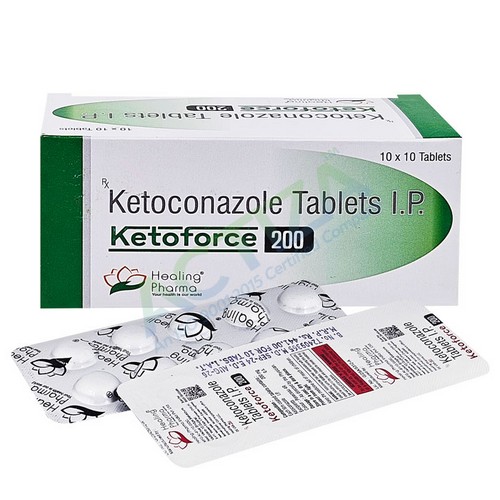
Active Ingredient Ketoconazole Indication Fungal infections Manufacturer Healing Pharma, India Strength:- 200mg Dosage Form:- Tablet Packaging 10 Tablets in Strip Country of Origin India
INQUIRE ABOUT Ketoforce 200 Mg (Ketoconazole)
What is Ketoforce 200 mg? Ketoforce 200 is a tablet containing ketoconazole 200 mg .
Healing Pharma India markets it. It comes as a strip of ten.
Ketoconazole is an imidazole antifungal medicine.
It kills fungi that grow deep inside the body.
Doctors now reserve it for a short list of infections.
The only infections it is approved to treat
Blastomycosis.
Coccidioidomycosis.
Histoplasmosis.
Chromomycosis.
Paracoccidioidomycosis.
Even then, two conditions must both be met.
Other antifungal medicines must have failed already.
Or the patient cannot tolerate those other medicines.
How Ketoforce 200 mg Works (Mechanism of Action) Fungal cells need a fat called ergosterol.
Ergosterol builds and strengthens the fungal cell membrane.
Fungi make ergosterol using an enzyme called 14-alpha-demethylase.
Ketoconazole blocks that enzyme.
Ergosterol production then falls sharply.
The fungal membrane becomes leaky and weak.
Contents escape and the fungal cell dies.
Why the same action causes side effects
Human bodies use similar enzymes to build steroid hormones.
Keto Cream also blocks some of those human enzymes.
This can lower the body’s own steroid hormone output.
It mainly happens at doses of 400 mg and above.
It also blocks a liver enzyme called CYP3A4.
CYP3A4 clears many other medicines from the blood.
Blocking it makes those other medicines build up.
That build-up causes most of its dangerous interactions.
Dosage Guide Only a doctor may set the dose. This table is for reference.
Patient Group Dose Frequency Key Note Adult, starting dose 200 mg Once daily This is one whole tablet. Adult, poor response 400 mg Once daily Two tablets. Do not exceed this. Child over 2 years 3.3 to 6.6 mg per kg Once daily Specialist supervision only. Child under 2 years Not studied Not applicable Safety is unknown in this group. Acute or chronic liver disease Must not be used Not applicable This is an absolute bar. Taking a contraindicated drug Must not be used Not applicable See Section 7 for the list. Usual course, systemic infection As prescribed Daily Typically about 6 months. Missed dose Take when remembered Once daily Skip it if the next dose is near.
How to Take Ketoforce 200 mg Swallow the tablet whole with a glass of water.
Always take it with food.
Food reduces stomach upset and helps absorption.
Take it at the same time each day.
Do not crush or chew the tablet.
Finish the full course your doctor prescribed.
Do not stop early, even if you feel better.
Attend every blood test your doctor orders.
The stomach acid rule Ketoconazole needs stomach acid to dissolve properly.
Medicines that reduce acid will block its absorption.
Take antacids at least one hour before this tablet.
Or take antacids at least two hours after it.
Tell your doctor if you take a proton pump inhibitor.
Examples are omeprazole, pantoprazole and esomeprazole.
Tell your doctor about H2 blockers such as ranitidine.
Your doctor may advise taking it with an acidic drink.
A non-diet cola is the usual example given.
Precautions Absolute contraindications – never use Any acute or chronic liver disease .
Known allergy to ketoconazole or any tablet ingredient.
Taking dofetilide, quinidine, disopyramide or dronedarone.
Taking cisapride or pimozide.
Taking methadone or ranolazine.
Taking any ergot medicine for migraine.
Taking oral midazolam, triazolam or alprazolam.
Taking simvastatin or lovastatin.
Taking colchicine with kidney or liver impairment.
Taking irinotecan, lurasidone, tolvaptan or eplerenone.
Taking felodipine or nisoldipine.
Breastfeeding. The drug passes into breast milk.
Conditions to disclose to your doctor Any past liver problem, jaundice or hepatitis.
Any heart rhythm problem or long QT syndrome.
A family history of sudden cardiac death.
Low potassium or low magnesium in the blood.
Adrenal gland problems, or borderline adrenal function.
Recent major surgery, serious illness or prolonged stress.
Kidney disease of any kind.
Pregnancy, or any plan to become pregnant.
Heavy or regular alcohol use.
Every other medicine, including herbal and over-the-counter ones.
Food and drink precautions Do not drink alcohol during the whole course.
Alcohol can trigger flushing, rash, nausea and headache.
Alcohol also adds to the strain on the liver.
Always take the tablet with a meal.
Keep antacids one hour before or two hours after.
Ask your doctor before changing any acid medicine.
Before-use safety checklist A doctor has confirmed a severe internal fungal infection.
Other antifungal medicines have failed or cannot be used.
Baseline liver blood tests have been taken.
Baseline tests include ALT, AST, bilirubin and clotting.
An ECG has been considered for heart rhythm risk.
Every current medicine has been checked for interactions.
A weekly blood test plan is in place.
The patient knows the warning signs in Section 8.
The patient has agreed to avoid alcohol completely.
Common and Less Common Side Effects Side Effect How Common What To Do Nausea Common Take with food. Tell your doctor if severe. Vomiting Common Seek advice if you cannot keep food down. Abdominal pain Common Take after a meal. Report severe pain. Headache Common Usually mild. Report if it persists. Abnormal liver blood test Common Your doctor will decide whether to stop. Diarrhoea Less common Drink fluids. Report if it lasts. Dizziness Less common Do not drive until it settles. Itching or rash Less common Report any spreading or blistering rash. Constipation or indigestion Less common Usually settles. Mention at review. Drowsiness or tingling Less common Report if it affects daily activity. Hair thinning Less common Usually reverses after stopping. Hives or urticaria Less common Stop and seek advice. It may be allergy. Serious liver injury Rare but serious Stop at once. Get urgent medical help. Adrenal insufficiency Rare but serious Report extreme tiredness and dizziness. QT prolongation Rare but serious Report palpitations or fainting at once.
Drug Interactions – Avoid With Ketoconazole blocks the liver enzyme CYP3A4. Many drugs then build up.
Never combine – contraindicated Drug Group Examples Why It Is Dangerous Heart rhythm drugs Dofetilide, quinidine, disopyramide, dronedarone Risk of fatal heart rhythm disturbance. Gut and antipsychotic drugs Cisapride, pimozide, lurasidone Risk of QT prolongation and arrhythmia. Strong painkiller Methadone Risk of fatal heart rhythm disturbance. Angina drug Ranolazine Blood levels rise. QT risk increases. Migraine ergot drugs Ergotamine, dihydroergotamine, ergometrine Risk of severe blood vessel narrowing. Sedatives Oral midazolam, triazolam, alprazolam Heavy, prolonged sedation can follow. Statins Simvastatin, lovastatin Risk of severe muscle breakdown. Gout drug Colchicine Barred in kidney or liver impairment. Cancer drug Irinotecan Toxic levels can build up. Water tablet Eplerenone Potassium can rise to unsafe levels. Blood pressure drugs Felodipine, nisoldipine Blood pressure can fall sharply. Sodium drug Tolvaptan Blood levels rise. Sodium shifts become unsafe.
Not recommended – avoid unless a doctor insists
Tamsulosin, used for prostate symptoms.
Rifabutin, an antibiotic.
Rivaroxaban, a blood thinner.
Repaglinide and saxagliptin, for diabetes.
Praziquantel, for worm infections.
Everolimus, sirolimus and temsirolimus.
Salmeterol, an inhaled asthma medicine.
Use only with close medical supervision Fentanyl, oxycodone and similar strong painkillers.
Warfarin and other coumarin blood thinners.
Cilostazol and dabigatran.
Carbamazepine, used for epilepsy.
Aripiprazole, buspirone and haloperidol.
Ciclosporin and tacrolimus.
Sildenafil, tadalafil and other erectile dysfunction tablets.
Drugs that stop Ketoforce working Antacids, H2 blockers and proton pump inhibitors.
Rifampicin and isoniazid, used for tuberculosis.
Carbamazepine and phenytoin, used for epilepsy.
Efavirenz and nevirapine, used for HIV.
Emergency Warning Signs Stop the tablet and seek urgent medical help for any of these.
Signs of liver injury Yellow skin or yellow whites of the eyes.
Dark or tea-coloured urine.
Pale or clay-coloured stools.
Unusual tiredness or weakness.
Loss of appetite that lasts.
Nausea or vomiting that will not settle.
Pain in the upper right side of the abdomen.
Itching all over the body.
Signs of a heart rhythm problem Fast, pounding or irregular heartbeat.
Fainting, or feeling about to faint.
Sudden dizziness or chest discomfort.
Unexplained seizure.
Severe and lasting tiredness.
Dizziness when standing up.
Muscle weakness and weight loss.
Nausea with low blood pressure.
Swelling of the face, lips, tongue or throat.
Difficulty breathing or swallowing.
Widespread rash with blistering or peeling skin.
Why Choose This Medicine? – An Honest Assessment This section is deliberately cautious. The reasons follow.
The narrow case for using it
It treats five severe internal fungal infections.
It is taken by mouth, so no injection is needed.
It is far cheaper than newer antifungal medicines.
It helps when other antifungal drugs have already failed.
It remains useful in some hormone and cancer conditions.
The case against listing it as a general antifungal
Country or Region Action Taken Year France Suspended oral use 2011 European Union Recommended suspension of all oral forms 2013 United States Restricted to last-resort use only 2013 Australia Withdrew oral ketoconazole 2013 Canada Restricted oral use 2013 China Withdrew the oral form 2015 United States Repeated warning against skin and nail use 2016 India No equivalent restriction found Still marketed
Storage Instructions Store below 30 degrees Celsius, per the Indian listing.
The reference label states 15 to 25 degrees Celsius.
Keep the tablets in a tightly closed container.
Protect them from moisture and damp places.
Keep them away from direct sunlight.
Do not store them in a bathroom cabinet.
Keep the strip in its original carton until use.
Keep well out of the reach of children.
Check the expiry date before every dose.
Return unused tablets to a pharmacy for disposal.
Do not flush them or put them in household waste.
Sanjay Gangani
B.Pharm, CMO & Pharmacist
Licensed pharmacist (B.Pharm) with 12+ years in clinical pharmacy and patient care. Reviews every article for evidence-based accuracy before it is published on ACTIZA Store.



Reviews
There are no reviews yet.