...

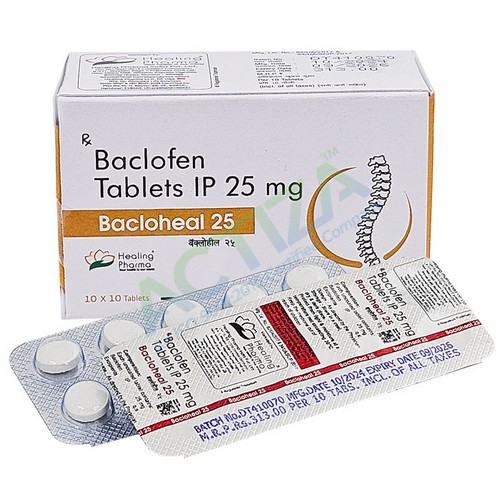
Bacloheal 25 Mg

Medically reviewed by Sanjay Gangani, B.Pharm, CMO & Pharmacist

Active Ingredient Baclofen
Indication Muscle relaxation
Manufacturer Healing Pharma, India
Strength:- 25mg
Packaging 10 tablets in 1 strip

Bacloheal 25 Mg

Pack Size Price Price/unit Quantity Add To Cart
100 Tablet/s $40 $0.40/Pill
200 Tablet/s $70 $0.35/Pill
300 Tablet/s $94.5 $0.32/Pill

WHAT IS BACLOHEAL 25 MG

  • Bacloheal 25 mg is a baclofen tablet.

  • Each tablet contains 25 mg of baclofen.

  • Baclofen is a prescription antispastic medicine.

  • Spasticity means muscles that are stiff, tight and hard to control.

  • Bacloheal 10 mg is caused by damage to the brain or spinal cord.

  • Baclofen reduces that stiffness and the painful spasms with it.

  • Its main use is spasticity from multiple sclerosis.

  • It is also used for spasticity from spinal cord injury or disease.

  • That includes spinal tumours, syringomyelia and transverse myelitis.

  • It is also used in motor neurone disease.

  • It is taken several times a day, every day.

  • The dose is built up slowly over weeks.

  • It must never be stopped suddenly.

HOW IT WORKS (MECHANISM OF ACTION)

Step by step

  • Spasticity comes from overactive spinal reflex circuits.

  • Those circuits keep firing because the brain can no longer damp them.

  • Baclofen is a chemical relative of the neurotransmitter GABA.

  • GABA is the main inhibitory, or calming, signal in the nervous system.

  • Baclofen activates GABA-B receptors in the spinal cord.

  • Those receptors sit mainly at the nerve endings before the synapse.

  • Activating them reduces the release of excitatory chemicals.

  • Both single and multi-synapse reflexes are inhibited.

  • The stretch reflex therefore quietens.

  • Muscle tone falls and flexor spasms reduce.

  • Clonus and muscular rigidity improve with it.

Why the main side effects follow from the mechanism

  • GABA-B receptors are also present in the brain.

  • Activating them there causes sedation and drowsiness.

  • That is why drowsiness is the commonest side effect.

  • Reducing muscle tone can also cause general weakness.

  • Too much tone reduction can make standing harder, not easier.

  • That is why the label warns where spasticity supports posture.

  • Baclofen is excreted mainly unchanged by the kidneys.

  • So kidney impairment causes accumulation and toxicity.

  • The liver plays no significant role in its metabolism.

  • Even so, it can raise liver enzymes, so monitoring is advised.

DOSAGE GUIDE

Baclofen is always titrated from a low dose. A doctor sets and adjusts the dose. These figures are from the reference labels, not from a package insert for this brand.

Adult titration

StepDoseHold for
Starting total15 mg a day in divided dosesSee step 1
Step 15 mg three times a day3 days
Step 210 mg three times a day3 days
Step 315 mg three times a day3 days
Step 420 mg three times a day3 days
LimitFigureSource
Usual effective daily range40 to 80 mg a dayUS FDA label
Usual symptom control reached byUp to 60 mg a dayUK SmPC
Maximum outpatient daily dose80 mg a day, as 20 mg four times dailyUS FDA label
Above 100 mg a dayNot advised unless in hospital under supervisionUK SmPC
Review pointDecide whether to continue if no effect in 6 weeks at maximumUK SmPC
  • A 25 mg tablet is not one of the titration steps.

  • It is used once a patient is established at a high dose.

  • Start with 10 mg tablets, not with this strength.

  • Take the tablets during meals with a little liquid.

  • Some patients take a night-only dose for painful flexor spasm.

  • Some take a single dose an hour before washing or physiotherapy.

  • Never stop baclofen suddenly.

  • Taper over about one to two weeks under medical supervision.

  • Treatment should not start until the spastic state has stabilised.

  • Take it as soon as you remember, if it is not nearly time.

  • Skip it if the next dose is nearly due.

  • Never take two doses together.

  • Tell your doctor if you miss doses often.

  • Repeated missed doses risk withdrawal effects.

HOW TO TAKE IT

Taking the tablet

  • Take it only on a doctor’s prescription.

  • Swallow the tablet with a little liquid.

  • Take it during a meal, which the SmPC advises.

  • Take it at the times your doctor set, usually three times a day.

  • Space the doses evenly through the waking day.

  • Keep taking it every day, even on good days.

  • Do not change the dose yourself.

  • Expect benefit to build over weeks, not hours.

Living with the first two weeks

  • Drowsiness is very common when starting or increasing the dose.

  • It is usually temporary and settles as the body adjusts.

  • Do not drive while you feel drowsy.

  • Do not operate machinery or work at height.

  • Tell your doctor if weakness makes walking harder.

  • Some people rely on stiffness to stand or transfer.

  • Reducing that stiffness too far can cause falls.

  • Report any new difficulty with balance.

  • Never stop the tablets suddenly.

  • Never run out of supply; reorder in good time.

  • Never drink alcohol with baclofen.

  • Never combine it with opioids without medical advice.

  • Never combine it with another muscle relaxant without advice.

  • Never take it for ordinary back pain or a sports injury.

  • Never share your tablets with anyone else.

  • Never give an adult tablet to a small child.

PRECAUTIONS

Absolute contraindications

  • Hypersensitivity to baclofen or any excipient.

  • Active peptic ulceration.

  • Wheat allergy, where the tablet contains wheat starch.

  • Muscle spasm from rheumatic disorders; it is not indicated.

  • Stroke, where the US label says it has not meaningfully helped.

  • The US label also notes it was poorly tolerated after stroke.

  • Cerebral palsy, where US efficacy is not established.

  • Parkinson’s disease, where US efficacy is not established.

Conditions to disclose to your doctor

  • Any kidney disease, or dialysis.

  • Any stomach or duodenal ulcer, past or present.

  • Epilepsy or any history of seizures.

  • Any psychotic, schizophrenic or confusional illness.

  • Depression or mania.

  • Parkinson’s disease.

  • Any breathing problem or respiratory disease.

  • Any heart or circulation problem.

  • Treatment for high blood pressure.

  • Liver disease.

  • Diabetes.

  • Difficulty passing urine, or sphincter problems.

  • Any history of drug or alcohol misuse.

  • Pregnancy or planned pregnancy.

  • Breastfeeding.

  • Whether your stiffness helps you stand or transfer.

Warnings behind that list

  • Baclofen may worsen seizure control and the EEG.

  • Epilepsy needs supervision and continued anticonvulsant treatment.

  • Reversible encephalopathy has occurred at therapeutic doses.

  • Its features include somnolence, confusion, myoclonus and coma.

  • Acute urinary retention can occur with sphincter hypertonia.

  • Use extreme care alongside antihypertensive treatment.

  • Suicide and suicide-related events have been reported.

  • Monitor for misuse, abuse or dependence.

  • Ovarian cysts were found in about 4% of treated MS patients.

  • Most of those resolved while treatment continued.

Food, drink and lifestyle precautions

  • Take the tablets during meals, as the SmPC advises.

  • Avoid alcohol completely; sedation and weakness add up.

  • Avoid sedatives and sleeping tablets unless prescribed.

  • Do not drive while drowsy or if your vision is affected.

  • Rise slowly, since blood pressure can fall.

  • Keep up physiotherapy; the drug supports it, not replaces it.

  • Tell your physiotherapist the dose and timing.

  • Watch for constipation and keep fluids up.

  • Have liver and blood sugar tests if your doctor advises.

Before-use safety checklist

  • Do you have a prescription for baclofen?

  • Has the cause of the spasticity been diagnosed?

  • Has the spastic state stabilised before starting?

  • Has your kidney function been measured?

  • Is 25 mg the right strength for your kidney function?

  • Have you already titrated up through 10 mg tablets?

  • Do you have a peptic ulcer?

  • Do you have epilepsy, and is it controlled?

  • Do you need the stiffness to stand or transfer safely?

  • Do you know never to stop the tablets suddenly?

  • Do you have enough supply to avoid a gap?

  • Do you know which symptoms need emergency care?

SIDE EFFECTS

  • Occasional rises in the liver enzyme SGOT, also called AST.

  • Occasional rises in alkaline phosphatase.

  • Occasional rises in blood sugar.

  • Test patients with liver disease or diabetes.

  • Vomiting and muscle floppiness.

  • Drowsiness progressing to reduced consciousness or coma.

  • Respiratory depression.

  • Focusing problems and ringing in the ears.

  • Convulsions, low or high blood pressure, slow or fast heart rate.

  • Low body temperature, myoclonus and rhabdomyolysis.

  • Patients with kidney impairment can overdose on low doses.

  • Alcohol, diazepam or tricyclics taken with it worsen the picture.

  • There is no specific antidote; care is supportive.

  • Haemodialysis may help in severe poisoning with renal failure.

DRUG INTERACTIONS – AVOID WITH

  • List every painkiller, including any opioid.

  • List every sleeping or anti-anxiety tablet.

  • List every blood pressure tablet.

  • List any Parkinson’s medicine.

  • List lithium or any mood stabiliser.

  • List any anti-inflammatory tablet, which can affect the kidneys.

  • Mention how much alcohol you drink, honestly.

EMERGENCY WARNING SIGNS

Get emergency medical help for any of these.

Signs of withdrawal after a missed or stopped dose

  • A seizure, or repeated seizures.

  • Sudden severe confusion or delirium.

  • Hallucinations or loss of touch with reality.

  • Severe agitation, paranoia or mania.

  • A high temperature with muscle rigidity.

  • A sudden large increase in muscle stiffness or spasms.

  • Dark or cola-coloured urine with muscle pain.

  • A racing heartbeat with any of the above.

  • Being very hard to wake, or unresponsive.

  • Very slow or shallow breathing.

  • Blue or grey lips or fingertips.

  • Severe floppiness or inability to hold the head up.

  • Repeated vomiting with drowsiness.

  • New confusion, twitching or jerking movements.

  • A body temperature that is unusually low.

Other urgent signs

  • Being unable to pass urine at all.

  • Severe abdominal pain, or vomiting blood.

  • Passing black stools.

  • Yellowing of the eyes or skin.

  • Fainting or collapse.

  • Swelling of the lips, tongue, face or throat.

  • Difficulty breathing or wheezing.

  • New or worsening thoughts of self-harm or suicide.

  • A fall caused by new weakness.

  • Say that the patient takes baclofen, and the dose.

  • Say when the last dose was taken.

  • Say whether any doses have been missed.

  • Mention any kidney problem or dialysis.

  • Missed doses point to withdrawal; extra doses point to overdose.

  • The two look different and are treated differently.

WHY CHOOSE THIS MEDICINE

Points in its favour

  • Baclofen is a long-established first-line antispastic medicine.

  • It acts on the spinal cord, where spasticity is generated.

  • It relieves flexor spasms and the pain that comes with them.

  • It reduces clonus and muscular rigidity.

  • It can make physiotherapy and daily care easier.

  • It can be dosed flexibly, including a night-only dose.

  • It can also be timed before washing, dressing or therapy.

  • Tablets are inexpensive and widely stocked in India.

  • A 25 mg strength reduces the tablet count at high doses.

  • That can improve adherence for someone on 75 mg a day.

Points to be honest about

  • Drowsiness is reported in up to 63% of patients.

  • Dizziness and weakness each affect up to 15%.

  • It can reduce the stiffness some people need to stand.

  • It accumulates dangerously in kidney impairment.

  • It must never be stopped suddenly.

  • Misuse and dependence need monitoring.

  • It is not a treatment for ordinary musculoskeletal pain.

  • Do not describe it as a painkiller.

  • Do not describe it as a treatment for back pain or strain.

  • Do not describe it as a general muscle relaxant for sprains.

  • Do not claim it is safe to stop when symptoms improve.

  • Do not claim efficacy in stroke, cerebral palsy or Parkinson’s.

  • Do not name a manufacturer you have not verified.

STORAGE INSTRUCTIONS

  • Store below 25 C, following the reference brand label.

  • Keep the tablets in the original packaging.

  • The original pack protects them from moisture.

  • Do not store them in a bathroom cabinet.

  • Do not transfer them into an unlabelled container.

  • Keep them out of the sight and reach of children.

  • A baclofen overdose in a child is a medical emergency.

  • Do not use after the expiry date on the pack.

  • Return unused or expired tablets to a pharmacy.

  • Do not pass unused tablets to anyone else.

  • Keep enough stock to avoid a gap in the patient’s supply.

  • Flag this product for proactive reorder reminders.

  • Tell buyers to reorder before the last strip is finished.

  • Explain that a supply gap risks withdrawal effects.

  • Do not list a brand you cannot source consistently.

Sanjay Gangani

Sanjay Gangani

B.Pharm, CMO & Pharmacist

Licensed pharmacist (B.Pharm) with 12+ years in clinical pharmacy and patient care. Reviews every article for evidence-based accuracy before it is published on ACTIZA Store.

Reviews

There are no reviews yet.

Be the first to review “Bacloheal 25 Mg”

Your email address will not be published. Required fields are marked *

This site uses Akismet to reduce spam. Learn how your comment data is processed.

All Categories

Shopping Cart

0
×

Loading cart...