

Loading cart...
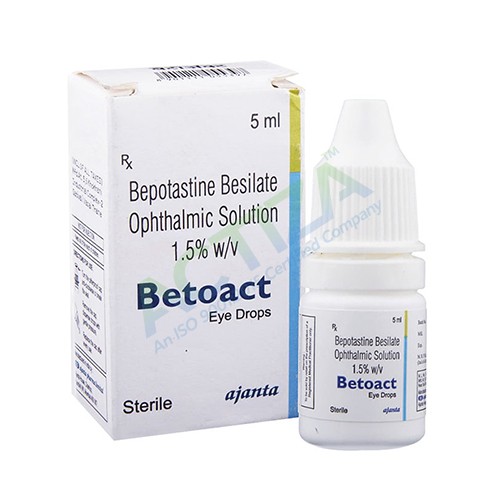
Betoact Eye Drop (Bepotastine)
Medically reviewed by Sanjay Gangani, B.Pharm, CMO & Pharmacist
| Active Ingredient | Bepotastine |
|---|---|
| Indication | Redness and Swelling |
| Manufacturer | Ajanta Pharma Ltd |
| Packaging | 5 ml in 1 packet |
| Strength:- | 1.5% |
Betoact Eye Drop (Bepotastine) | ||||
|---|---|---|---|---|
| Pack Size | Price | Quantity | Add To Cart | |
| 1 Eye Drop/s | $11 | |||
| 3 Eye Drop/s | $26 | |||
| 6 Eye Drop/s | $48 | |||
1. What is Betoact Eye Drop?
Betoact is an ophthalmic solution containing bepotastine besilate 15 mg per mL, which is 1.5% w/v.
Bepotastine belongs to a group of medicines called histamine H1 receptor antagonists — antihistamines.
It is a second-generation H1 antihistamine, of the benzylether derivative chemical class.
It is indicated in the treatment of eye itching associated with allergic conjunctivitis.
It is made by Ajanta Pharma in India.
The standard formulation also contains benzalkonium chloride 0.01% w/v as a preservative in a sterile aqueous vehicle.
It is not habit forming.
Unlike oral antihistamines, topical administration means the medicine acts directly on the affected site, with minimal systemic absorption.
It is a prescription medicine in India.
2. How It Works (Mechanism of Action)
In allergic conjunctivitis, the eye encounters an allergen — pollen, dust mite, animal dander.
Mast cells in the conjunctiva release histamine.
Histamine is the primary chemical responsible for allergy symptoms in the eye.
It binds to H1 receptors, causing itching, redness, swelling and watering.
Bepotastine is a selective H1-receptor antagonist. It blocks and prevents the action of histamine.
With the receptors blocked, histamine cannot trigger the reaction.
Itching, redness and swelling subside.
Why a drop rather than a tablet: applying the antihistamine directly to the eye provides targeted relief with minimal systemic absorption — it works where the problem is, without the drowsiness and dry mouth that can accompany oral antihistamines.
Bepotastine also has mast cell stabilising activity, meaning it reduces the release of histamine as well as blocking its effect. That combination is why second-generation agents of this type give fast and long-lasting relief rather than brief symptomatic cover.
3. Dosage Guide
Point | Guidance |
|---|---|
Dose | One drop in the affected eye |
Frequency | Twice daily |
Route | Ophthalmic — into the eye only |
Timing relative to meals | Either; food is not relevant |
Which eye | The affected eye, or both if both are affected |
Course duration | As directed by your doctor |
Contact lenses | Remove first; wait 10 minutes before reinserting |
Other eye drops | Wait at least 5 minutes between different drops |
Missed dose | Use it when you remember; do not double up |
Do not use more often than prescribed. More frequent dosing does not improve relief and increases preservative exposure.
If your symptoms have not improved after a few days, or are worsening, see your doctor.
4. How to Use It
Wash your hands thoroughly.
Remove contact lenses.
Shake the bottle gently if the label directs.
Tilt your head back and look up.
Gently pull down the lower eyelid to form a small pocket.
Hold the bottle above the eye without touching it, and squeeze one drop into the pocket.
Close your eye gently for about a minute.
Press lightly on the inner corner of the eye near the nose — this reduces drainage into the throat.
Wipe away any excess with a clean tissue.
Replace the cap immediately.
Wash your hands again.
Wait at least 10 minutes before reinserting contact lenses.
Wait at least 5 minutes before using any other eye drop.
Repeat twice daily as directed.
Do not share the bottle with anyone.
Practical advice for allergic eyes:
Do not rub your eyes — rubbing releases more histamine and worsens the itching.
A cold compress gives useful additional relief.
Rinse your face and hair after being outdoors in pollen season.
Keep windows closed on high pollen days.
5. Precautions
5a. Do Not Use If You
Are allergic to bepotastine or any ingredient in the drops.
Have an eye infection, unless your doctor has advised otherwise.
Have eye pain or any change in vision — these need assessment first.
5b. Tell Your Doctor Before Using If You
Wear contact lenses.
Have dry eyes, or have reacted to preserved eye drops before.
Have glaucoma or raised eye pressure.
Have had recent eye surgery.
Have any other eye condition.
Use any other eye drops.
Are pregnant, might be, or are breastfeeding.
Are using this for a child.
5c. Practical Precautions
Item | Consideration |
|---|---|
Contact lenses | Remove before use; wait 10 minutes |
Benzalkonium chloride | Absorbed by soft lenses; may cause irritation |
Dropper hygiene | Do not touch the eye or any surface |
Sharing | Never share an eye drop bottle |
Other eye drops | Separate by at least 5 minutes |
Driving | Vision may blur briefly after instillation; wait until clear |
Eye rubbing | Worsens symptoms; avoid |
In-use shelf life | Discard as directed after opening |
5d. Pregnancy and Breastfeeding
One Indian listing states Betoact is generally considered safe to use during pregnancy.
Treat that with appropriate caution — systemic absorption from eye drops is low, but data specific to pregnancy is limited.
Ask your doctor or pharmacist before using it if you are pregnant or breastfeeding.
5e. Before-Use Checklist
☐ A doctor has advised this for my symptoms.
☐ My main symptom is itching, consistent with allergy.
☐ I have no eye pain, discharge or vision change.
☐ I have removed my contact lenses.
☐ I know to wait 10 minutes before putting them back in.
☐ I know not to touch the dropper to my eye.
☐ I will not share the bottle.
☐ I know to space other eye drops by 5 minutes.
☐ I have told my doctor if I am pregnant or breastfeeding.
☐ I know to see a doctor if symptoms do not improve.
6. Side Effects
Topical antihistamine eye drops are generally well tolerated, and systemic absorption is minimal.
Side Effect | Notes |
|---|---|
Mild stinging or burning on instillation | Most common; usually brief |
Eye irritation | May reflect the preservative; consider the BAK-free version |
Temporary blurred vision | Immediately after instillation; wait before driving |
A bitter or unusual taste | Common with eye drops that drain into the throat; pressing the inner corner reduces it |
Dry eye sensation | Reported |
Eye redness | Report if worsening |
Headache | Reported |
Sore throat or nasal irritation | From drainage |
Allergic reaction to the drops | Stop and seek advice |
Mild stinging on instillation is normal. Stinging or irritation that worsens over days, rather than settling, may indicate sensitivity to the preservative or to the medicine, and is a reason to stop and seek advice.
7. When to Seek Medical Advice
Stop using the drops and seek medical advice if you develop:
Eye pain — not itching, but genuine pain.
Any change or loss of vision.
Increasing redness or swelling.
Thick yellow or green discharge, which suggests bacterial infection.
Sensitivity to light.
A feeling that something is stuck in the eye.
Severe burning or stinging that worsens.
Swelling of the face, lips or tongue.
Difficulty breathing.
Contact your doctor if:
Symptoms do not improve after a few days.
Only one eye is affected — allergy usually affects both.
Symptoms keep returning once you stop.
You need the drops continuously for long periods.
The key distinction: allergic conjunctivitis itches. Bacterial conjunctivitis produces sticky discharge. Anything that hurts, or affects vision, needs prompt assessment rather than antihistamine drops.
If you wear contact lenses and develop a painful red eye, remove the lenses and seek same-day assessment. Contact lens wearers are at risk of corneal infection, which can threaten sight.
8. Why Bepotastine Eye Drops Are Used
Genuine advantages:
Targeted relief at the site of symptoms, with minimal systemic absorption.
Fast and long-lasting relief from itching, redness and watering.
A second-generation antihistamine, without the sedation associated with older oral antihistamines.
Twice-daily dosing, which is convenient.
Not habit forming.
A BAK-free version is available for those who need it.
No established drug interactions reported for this product.
Honest limitations:
It treats allergic symptoms only — not infection, dry eye or any other cause of red eye.
The standard version contains benzalkonium chloride, which can irritate with prolonged use.
Contact lenses must be removed, with a 10-minute wait.
It does not address the underlying allergy — avoiding the trigger still matters.
Relief lasts while you use it; symptoms return on exposure.
What helps alongside:
Identifying and avoiding the trigger where possible.
Cold compresses, which relieve itching well.
Not rubbing the eyes.
Preservative-free artificial tears to wash out allergen.
An oral antihistamine if you also have nasal symptoms — discuss with your pharmacist rather than combining blindly.
Bottom line: an effective, well-tolerated treatment for itchy allergic eyes. The main things to get right are the contact lens rule, dropper hygiene, and recognising when red eye is something other than allergy.
9. Storage Instructions
Store below 30°C in a cool, dry place.
Keep the bottle tightly closed.
Protect from direct sunlight.
Do not freeze.
Do not store in a hot car.
Do not touch the dropper tip to any surface.
Keep out of the sight and reach of children.
Check the expiry date before use.
Do not use after the expiry date.
Discard the bottle after the in-use period stated on the pack once opened.
Never share an eye drop bottle with anyone else.
Return unused drops to a pharmacy for disposal.

B.Pharm, CMO & Pharmacist
Licensed pharmacist (B.Pharm) with 12+ years in clinical pharmacy and patient care. Reviews every article for evidence-based accuracy before it is published on ACTIZA Store.
Reviews
There are no reviews yet.