...

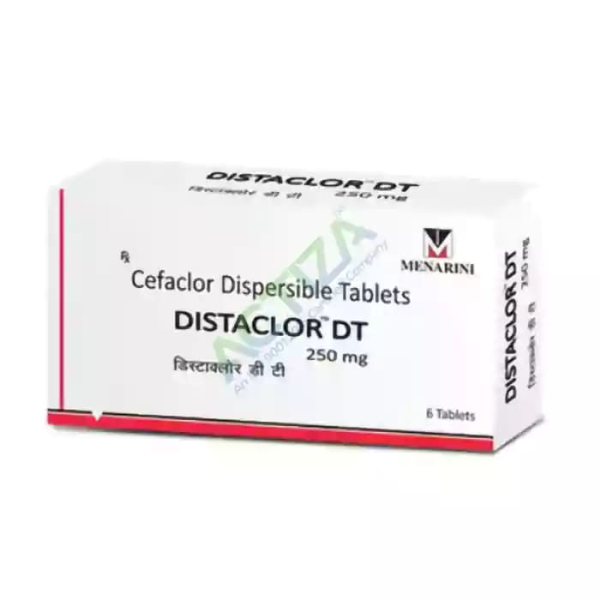
Distaclor DT 250 Mg (Cefaclor)

Medically reviewed by Sanjay Gangani, B.Pharm, CMO & Pharmacist

Indication bacterial infections
Manufacturer Menarini India Pvt Ltd
Strength:- 250mg
Packaging 10 Tablets in a strip
Dosage Form:- Tablet
Country of Origin India
Active Ingredient Cefaclor

Distaclor DT 250 Mg (Cefaclor)

Pack Size Price Price/unit Quantity Add To Cart
30 Tablet/s $38 $1.27/Pill
60 Tablet/s $73 $1.22/Pill
90 Tablet/s $108 $1.20/Pill

What is Distaclor DT 250 mg?

  • Distaclor DT 250 is a prescription antibiotic tablet.

  • Each tablet contains 250 mg of cefaclor.

  • Distaclor DT 125 mg stands for dispersible tablet.

  • A. Menarini India Pvt Ltd markets it.

  • Cefaclor is a second-generation cephalosporin.

  • Cephalosporins are chemically related to penicillins.

  • The originator brand of cefaclor internationally is Ceclor.

  • Distaclor CD 750 is designed to be dropped into water, where it breaks apart.

  • The resulting liquid is then swallowed.

  • This suits children who cannot swallow a whole tablet.

  • It also suits adults with swallowing difficulty.

  • It allows a dose to be given more easily and more completely.

  • It is not the same as a standard tablet and should be used as intended.

What it does not treat

  • Common colds. These are viral.

  • Influenza. Also viral.

  • Most sore throats, which are more often viral than bacterial.

  • Most coughs.

  • Viral fevers of any kind.

  • Fungal infections.

  • Taking it for any of these gives no benefit and causes real harm.

  • It exposes you to side effects and contributes to resistance.

How It Works (Mechanism of Action)

  • Bacteria are surrounded by a rigid outer shell called a cell wall.

  • That wall holds the cell together against internal pressure.

  • Human cells have no cell wall, which is why the drug is selective.

  • Bacteria constantly build and repair that wall as they grow and divide.

  • They use enzymes called penicillin-binding proteins to link the wall together.

  • Cefaclor binds to those enzymes and blocks them.

  • The wall cannot be completed or repaired.

  • The bacterial cell then bursts under its own internal pressure.

  • Cephalosporins are grouped into generations by their range of activity.

  • First-generation agents mainly cover gram-positive bacteria.

  • Second-generation agents extend that cover to more gram-negative organisms.

  • Cefaclor sits in the second group.

  • That makes it useful for common ear, sinus and chest infections.

  • Later generations cover more again, but are reserved for more serious infections.

  • Reserving them is a deliberate stewardship choice, not an oversight.

Why bacteria become resistant

  • Bacteria can produce enzymes that destroy the antibiotic before it works.

  • They can alter the target enzymes so the drug no longer binds.

  • They can pump the drug back out of the cell.

  • These abilities spread between bacteria, including between species.

  • Every antibiotic course selects for bacteria that already carry them.

  • Unnecessary courses apply that selection pressure for no benefit at all.

  • That is the entire argument for taking antibiotics only when needed.

Dosage Guide

A doctor sets the dose and the duration. The table gives the standard regimens for reference only.

SituationTypical doseIntervalNotes
Adults, usual infection250 mgEvery 8 hoursThree times a day
Adults, more severe infection500 mgEvery 8 hoursAs judged by the doctor
Children, usualCalculated by body weightDivided across the dayA doctor must calculate this
Children, ear infectionHigher weight-based doseDivided across the dayA doctor must calculate this
Streptococcal throat infectionAs prescribedAs prescribedUsually 10 days to prevent complications
Kidney impairmentMay need adjustmentMay be extendedTell the doctor about kidney problems
Missed doseTake when rememberedThen resume normallySkip it if the next dose is near. Never double.

How to Take It

  • Check the strip carries the red vertical line and that you have a prescription.

  • Drop the dispersible tablet into a small amount of water.

  • Wait for it to break apart and stir it.

  • Drink the whole amount.

  • Rinse the glass with a little more water and drink that too.

  • Space the doses evenly, usually every eight hours.

  • Set alarms. Even spacing keeps the drug level steady.

  • Complete the full course your doctor prescribed.

  • Do not stop early because the symptoms have gone.

  • Do not save any tablets for a future illness.

Food and absorption

  • Cefaclor can be taken with or without food.

  • Taking it with food may reduce stomach upset.

  • Food can slow absorption somewhat but the total amount absorbed is adequate.

  • Antacids may reduce absorption. Separate them by a couple of hours.

  • Be consistent, and follow any specific instruction on your own leaflet.

  • The drug needs to stay above a certain level to keep killing bacteria.

  • Cefaclor is cleared relatively quickly from the body.

  • Taking three doses close together then a long gap leaves a window.

  • In that window bacteria recover and multiply.

  • Survivors of that cycle are the ones most likely to be resistant.

  • Eight-hourly means eight-hourly, including overnight if prescribed that way.

If you feel better after two days

  • That is expected and is a good sign.

  • It does not mean the infection is gone.

  • It means the bacterial numbers have fallen enough to relieve symptoms.

  • The remaining bacteria are typically the hardest to kill.

  • Stopping now selects for exactly those.

  • This is the single most common way antibiotic courses are wasted.

Precautions

Absolute contraindications

  • Known allergy to cefaclor or to any cephalosporin antibiotic.

  • A previous severe allergic reaction to a penicillin, such as anaphylaxis.

  • Any previous serious skin reaction to a beta-lactam antibiotic.

Tell your doctor about

  • Any allergy to any antibiotic, and what the reaction was.

  • Any previous reaction to cefaclor specifically.

  • How many courses of cefaclor the patient has had before.

  • Any kidney problem.

  • Any history of bowel disease, particularly colitis.

  • Any previous episode of severe diarrhoea after an antibiotic.

  • Pregnancy, planned pregnancy or breastfeeding.

  • Diabetes, because some urine sugar tests can read falsely high.

  • Every other medicine being taken.

  • The child’s weight, if the patient is a child.

Food, drink and daily life

  • It may be taken with or without food.

  • Separate antacids from the dose by a couple of hours.

  • Alcohol does not interact directly with cefaclor.

  • Alcohol does not help recovery from an infection either.

  • Drink plenty of fluid, particularly with a urinary infection.

  • Probiotic foods such as curd may help with digestive upset.

  • Report diarrhoea that is severe, watery or bloody immediately.

Before-use checklist

  • Do I have a genuine prescription for this antibiotic?

  • Does the pack carry the red vertical line?

  • Has a doctor confirmed the infection is bacterial?

  • Do I know how many days the course should run?

  • Do I have enough tablets to complete it?

  • Have I declared any antibiotic allergy?

  • If this is for a child, has the dose been calculated by weight?

  • Has the child had cefaclor before, and how many times?

  • Do I know the signs of the reaction described in Section 6?

  • Do I know to finish the course even when I feel better?

  • Do I know not to share or save any tablets?

  • Do I know the emergency signs in Section 8?

Side Effects

Common effects

  • Diarrhoea.

  • Nausea.

  • Vomiting.

  • Indigestion or stomach discomfort.

  • Loss of appetite.

  • Headache.

  • Thrush, meaning fungal overgrowth in the mouth or vagina.

  • Most of these are mild and settle when the course finishes.

Antibiotic-associated diarrhoea and colitis

  • All antibiotics disturb the normal bacteria in the bowel.

  • That commonly causes mild diarrhoea, which settles.

  • Occasionally a bacterium called Clostridioides difficile overgrows.

  • That causes severe, watery, sometimes bloody diarrhoea.

  • It can appear during treatment or weeks after it ends.

  • It needs urgent medical attention and specific treatment.

  • Do not take an anti-diarrhoeal medicine for it without advice.

  • Those medicines can make this particular problem worse.

Drug Interactions – Avoid With

SeveritySubstanceWhat happens
CAUTIONProbenecidSlows removal of cefaclor, raising its blood level
CAUTIONWarfarin and other anticoagulantsBleeding risk may increase. Monitor INR.
SEPARATE DOSESAntacids containing aluminium or magnesiumMay reduce absorption
CAUTIONMetforminLevels may rise with some cephalosporins
CAUTIONNephrotoxic drugs such as aminoglycosidesKidney monitoring may be advisable
TEST INTERFERENCECopper-based urine sugar testsMay read falsely positive
TEST INTERFERENCEDirect Coombs testMay become falsely positive
CONSIDERLive bacterial vaccines such as oral typhoidAntibiotics may reduce their effect
  • Cefaclor has fewer interactions than many antibiotics.

  • It is not a significant inhibitor or inducer of liver enzymes.

  • The anticoagulant interaction is the one most worth monitoring.

  • Tell your doctor and pharmacist about everything you take.

  • The urine sugar point matters for anyone with diabetes testing at home.

Emergency Warning Signs

Signs of a severe allergic reaction

  • Swelling of the face, lips, tongue or throat.

  • Difficulty breathing or a tight chest.

  • A widespread rash appearing rapidly.

  • Feeling faint with a racing pulse.

  • These need emergency care immediately.

  • A rash that blisters or peels.

  • Sores in the mouth, eyes or genital area.

  • A rash with fever and feeling generally unwell.

  • These can progress quickly and need urgent assessment.

  • A rash together with joint pain or swelling.

  • Often with fever, up to three weeks after starting.

  • A young child who refuses to walk or use an arm.

  • Stop the antibiotic and contact a doctor the same day.

Signs of serious bowel infection

  • Severe or persistent watery diarrhoea.

  • Blood or mucus in the stool.

  • Abdominal cramps with fever.

  • This can occur weeks after the course has finished.

  • Mention the recent antibiotic when you seek help.

  • Yellowing of the skin or eyes.

  • Unusual bruising or bleeding.

  • A marked reduction in how much urine you pass.

  • Symptoms that worsen rather than improve after two to three days.

  • That last point may mean the bacteria are not susceptible to this drug.

Why Choose Distaclor DT 250 mg

What holds up

  • Cefaclor covers a useful range of common community bacteria.

  • It is well established, having been in use for decades.

  • The dispersible format genuinely helps children and anyone with swallowing difficulty.

  • It is taken by mouth, avoiding injections for many infections.

  • A. Menarini is a substantial international pharmaceutical company.

  • It has fewer drug interactions than many antibiotics.

  • It is generally well tolerated in adults.

What must be said alongside that

  • It is prescription-only by law, and one trade listing says otherwise.

  • It does nothing for colds, flu or other viral infections.

  • It carries a distinctive reaction risk in young children.

  • That risk is many times higher than with amoxicillin or cephalexin.

  • The risk rises with repeat courses.

  • Standard strips may be shorter than a full course.

  • Every unnecessary course contributes to antimicrobial resistance.

Storage Instructions

  • Store below 30 °C, as the pack specifies.

  • Protect from moisture. This is stated explicitly on this product.

  • Dispersible tablets absorb water readily by design.

  • A tablet that has absorbed moisture may not disperse properly.

  • Keep tablets sealed in the strip until the moment of use.

  • Gujarat monsoon humidity is a genuine concern for this format.

  • Do not refrigerate and do not freeze.

  • Bathrooms are the worst storage place, because of steam.

  • Keep out of the reach of children.

  • Do not use tablets that are damp, crumbling or discoloured.

  • Do not use after the printed expiry date.

  • Return any leftover tablets to a pharmacy. Do not keep them.

  • Never share this medicine with anyone else.

Sanjay Gangani

Sanjay Gangani

B.Pharm, CMO & Pharmacist

Licensed pharmacist (B.Pharm) with 12+ years in clinical pharmacy and patient care. Reviews every article for evidence-based accuracy before it is published on ACTIZA Store.

Reviews

There are no reviews yet.

Be the first to review “Distaclor DT 250 Mg (Cefaclor)”

Your email address will not be published. Required fields are marked *

This site uses Akismet to reduce spam. Learn how your comment data is processed.

All Categories

Shopping Cart

0
×

Loading cart...