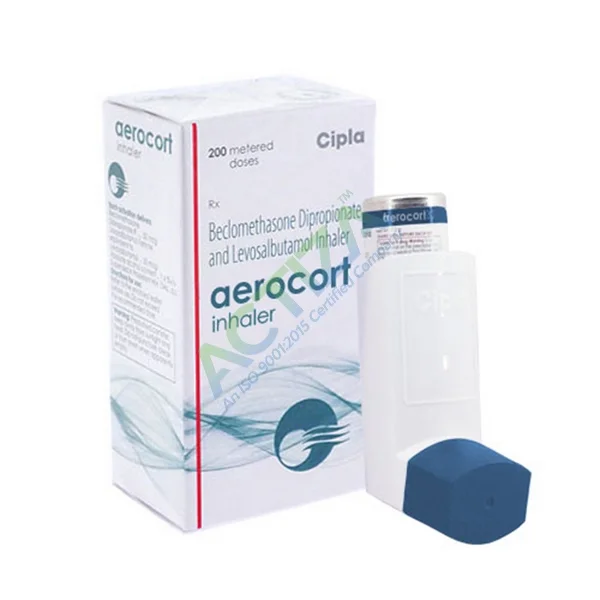
What is Aerocort Inhaler? Aerocort Inhaler is a prescription inhaler for asthma.
Each puff delivers two different medicines together.
It contains beclometasone dipropionate 50 micrograms.
It also contains levosalbutamol 50 micrograms.
Beclometasone is an inhaled corticosteroid, or preventer.
It reduces swelling and inflammation inside the airways.
Aerocort Forte Rotacaps is a short-acting beta-2 agonist, or reliever.
It relaxes the muscle around the airways within minutes.
It is the active half of the more familiar drug salbutamol.
It is made by Cipla Ltd. in Mumbai, India.
One inhaler holds 200 metered doses.
It treats asthma and other reversible airway narrowing.
It does not cure asthma and does not remove the cause.
It is not a rescue inhaler for a severe attack.
Cipla also sells a 100 microgram beclometasone version.
Use Aerocort only exactly as your doctor has prescribed.
How Aerocort Inhaler Works (Mechanism of Action) The two ingredients work on different problems in the airway.
How beclometasone works, in five steps:
Asthma involves ongoing inflammation of the airway lining.
Beclometasone enters airway cells and binds a steroid receptor.
That changes which inflammatory genes are switched on.
Production of inflammatory chemicals falls over days and weeks.
The airway lining becomes less swollen and less twitchy.
How levosalbutamol works, in five steps:
Beta-2 receptors sit on the muscle around the airways.
Levosalbutamol binds to and activates those receptors.
That raises cyclic AMP inside the muscle cell.
Higher cyclic AMP makes the airway muscle relax.
The airways open within minutes of a dose.
Why the timescales differ so much:
The reliever acts within minutes and lasts a few hours.
The steroid acts over days and works best taken regularly.
Missing steroid doses allows inflammation to build again.
Extra reliever puffs do nothing for that inflammation.
This is why the two are usually managed separately.
What this inhaler does not do:
The steroid does not open airways quickly.
It is not indicated for the relief of acute bronchospasm.
It must not be the primary treatment of status asthmaticus.
A separate short-acting reliever is needed for emergencies.
Dosage Guide Your doctor decides the number of puffs and the timing.
Situation Typical Approach Timing Key Note Adults, scheduled use Doses set individually by the prescriber Usually morning and evening Ask whether it is scheduled or as needed Children Lower doses; specialist direction advised As prescribed Growth should be monitored on steroids Poor inhaler coordination Use a spacer device With every dose A spacer improves delivery markedly After every dose Rinse the mouth and spit out Immediately after inhaling Reduces thrush and hoarseness Worsening asthma Do not simply take more puffs Seek review promptly Needing more signals losing control Acute attack Use a separate fast-acting reliever Immediately This inhaler is not the rescue treatment Higher steroid doses Thrush risk rises above 400 mcg daily As prescribed Beclometasone total daily dose matters Surgery, injury or severe illness Tell the treating team you use a steroid inhaler Before any procedure Extra steroid cover may be considered Transferring from steroid tablets Requires slow, supervised tapering As directed Adrenal recovery can take months Pregnancy or breastfeeding Discuss with your doctor first As prescribed Asthma control matters in pregnancy
How to read this table:
Inhaler dosing is individualised more than tablet dosing.
Your written prescription is the authority, not this page.
Never increase the number of puffs on your own judgement.
Never stop the inhaler suddenly because you feel well.
Keep using it during a chest infection unless told otherwise.
Missed dose and overdose rules:
Take a missed scheduled dose when you remember.
Skip it if the next dose is almost due.
Never take two doses together to catch up.
Excess reliever causes tremor, fast heartbeat and low potassium.
Excess steroid over time can suppress the adrenal glands.
A single large inhaled dose may briefly suppress adrenal function.
Seek medical advice after any substantial overdose.
How to Use Aerocort Inhaler Shake the inhaler well before each dose.
Remove the cap and check the mouthpiece is clear.
Prime a new inhaler as the leaflet directs.
Breathe out gently, away from the inhaler.
Place the mouthpiece between your lips and seal them.
Start to breathe in slowly and press the canister once.
Keep breathing in slowly and deeply.
Hold your breath for about ten seconds if you can.
Breathe out gently away from the inhaler.
Wait about thirty seconds before a second puff.
Rinse your mouth with water and spit it out.
Do not swallow the rinsing water.
Replace the cap and store the inhaler safely.
Using a spacer:
A spacer helps if you cannot coordinate breath and press.
It delivers more medicine to the lungs and less to the mouth.
Less mouth deposition means less thrush and hoarseness.
Spacers are particularly useful for children and older adults.
Clean the spacer as the manufacturer directs.
Practical usage tips:
Keep your separate reliever inhaler with you at all times.
Count how often you need reliever doses each week.
Rising reliever use is the earliest sign of losing control.
Check the dose counter so you do not run out.
Tell your dentist and doctor that you use a steroid inhaler.
Precautions Absolute Contraindications – Do Not Use Aerocort If You: Are allergic to beclometasone or levosalbutamol.
Are allergic to any other ingredient in the inhaler.
Need primary treatment for status asthmaticus.
Need treatment for an acute episode requiring intensive measures.
Have previously had paradoxical bronchospasm with this inhaler.
This inhaler is never the rescue treatment for an attack.
Conditions You Must Disclose to Your Doctor Any current infection, including a chest infection.
Tuberculosis, past or present.
Any fungal, viral or parasitic infection .
Ocular herpes simplex infection of the eye.
Whether you are immune to chickenpox and measles.
Any heart condition, angina or irregular heartbeat.
High blood pressure.
An overactive thyroid gland.
Diabetes, since beta-agonists can raise blood sugar.
Low blood potassium or any reason it might fall.
Glaucoma or cataracts.
Osteoporosis or any history of fractures.
Any current or recent course of steroid tablets.
Any diuretic or xanthine medicine you take.
Pregnancy, planned pregnancy or breastfeeding.
A child’s growth, if the inhaler is for a child.
Food and Drink Precautions No food needs to be avoided with an inhaler.
Rinse the mouth with water after every dose.
Spit the water out rather than swallowing it.
Brushing teeth after a dose also helps reduce thrush.
Limit caffeine, which adds to tremor and fast heartbeat.
Ensure adequate calcium and vitamin D on long-term steroids.
Ask your doctor about potassium if you take diuretics.
Keep well hydrated during a chest infection.
Before-Use Safety Checklist Do you hold a valid prescription for Aerocort Inhaler?
Has your doctor said whether to use it daily or as needed?
Do you still have a separate fast-acting reliever inhaler?
Do you know this inhaler will not stop an acute attack?
Has your inhaler technique been checked by a professional?
Do you have a spacer if you need one?
Do you know to rinse and spit after every dose?
Have you disclosed any infection or tuberculosis history?
Do you know whether you are immune to chickenpox?
Have you disclosed any heart or thyroid condition?
Have you checked the dose counter and expiry date?
Do you know the emergency warning signs in Section 8?
Common and Less Common Side Effects Effects come from both the steroid and the reliever.
Side Effect Frequency What It Feels Like What to Do Oral thrush (candidiasis) Common White patches in the mouth or throat Rinse after doses; antifungal treatment works Hoarse voice (dysphonia) Common Croaky or weakened voice Rinse after doses; consider a spacer Sore throat Common Scratchy or irritated throat Rinse after doses; report if persistent Cough Common Tickly cough just after inhaling Report if breathing worsens Headache Common Dull ache after dosing Rest and drink water; report if severe Tremor Common Shaky hands after a dose Usually settles; report if troublesome Fast heartbeat Common Racing or pounding pulse Report to your doctor promptly Palpitations Less common Awareness of forceful heartbeats Report to your doctor promptly Dizziness or restlessness Less common Light-headed or jittery feeling Report if it repeats Muscle cramps Less common Cramping, often in the legs May signal low potassium; seek advice Low blood potassium Less common Weakness, cramps, palpitations Needs a blood test; seek advice Raised blood sugar Less common Thirst, frequent urination, tiredness Important in diabetes; seek advice Rash, itching or hives Less common Red or itchy patches on the skin Stop and contact your doctor Bruising or thin skin With long-term use Easy bruising on arms and hands Report to your doctor Irregular heart rhythm Uncommon Chaotic or very fast pulse Seek prompt medical advice Paradoxical bronchospasm Rare Wheeze worsens right after a dose Use a reliever, stop and seek urgent help Adrenal suppression Rare Weakness, dizziness, especially when ill Never stop abruptly; seek advice Cushingoid features Rare Rounded face, changed fat distribution Discuss with your doctor Growth suppression in children Rare Slower than expected growth Requires monitoring by a specialist Reduced bone density Rare No symptoms until a fracture occurs Discuss bone protection if long-term Cataract or glaucoma Rare Blurred vision or eye pain Arrange an eye examination Severe allergic reaction Rare Swelling of face, lips or throat Emergency — call for help immediately
A note on steroid-related effects:
Mouth and throat effects are the most common problems.
Thrush becomes more likely above 400 micrograms daily.
Rinsing and a spacer both reduce that risk considerably.
Systemic effects mainly occur at high doses over long periods.
They include adrenal suppression and reduced bone density.
They also include cataract, glaucoma and slowed growth in children.
Extra steroid cover may be needed during surgery or severe illness.
Tell any treating team that you use a steroid inhaler.
Drug Interactions – Avoid or Use With Caution Combinations that increase the risk of low potassium:
Xanthine bronchodilators such as doxofylline and theophylline.
Corticosteroid tablets such as prednisolone.
Diuretics, often called water tablets.
Other beta-2 agonists, inhaled or nebulised.
Combinations that increase heart-related risk:
Other beta-agonists, which add to tremor and fast heartbeat.
Digoxin, where low potassium raises toxicity risk.
Medicines that prolong the QT interval.
Monoamine oxidase inhibitors and tricyclic antidepressants.
Combinations that raise steroid exposure:
Ritonavir and other HIV protease inhibitors.
Ketoconazole, itraconazole and other azole antifungals.
Clarithromycin and other macrolide antibiotics.
These slow steroid breakdown and raise systemic effects.
Other important interactions:
Beta-blockers can oppose the reliever and worsen wheeze.
That includes beta-blocker eye drops for glaucoma.
Live vaccines need care if steroid doses are high.
Interaction outcomes to understand:
Beta-agonists move potassium into cells and lower blood levels.
Steroids, xanthines and diuretics deepen that fall.
Low potassium makes dangerous heart rhythms more likely.
Severe asthma and low oxygen add further to that risk.
Enzyme inhibitors can raise inhaled steroid levels in the body.
Beta-blockers can trigger bronchospasm in airway disease.
Catalogue note for the retailer:
Doxofylline, prednisolone and Duolin all appear in this range.
Each can add to the potassium-lowering effect seen here.
Cross-link those pages so buyers see the combined risk.
Emergency Warning Signs – Seek Urgent Medical Help Call emergency services immediately if you or someone else has:
Wheezing that worsens straight after using the inhaler.
Breathlessness getting rapidly worse despite the reliever.
A reliever inhaler that is no longer working.
Lips, face or fingertips turning blue or grey.
Drowsiness or exhaustion while struggling to breathe.
A silent chest, where wheezing suddenly stops.
Chest pain or a chaotic, racing heartbeat.
Swelling of the face, lips, tongue or throat.
Collapse or severe weakness during an illness.
Contact your doctor the same day if you have:
Needing your reliever inhaler more often than usual.
Waking at night because of wheeze or cough.
White patches in the mouth that do not clear.
A persistently hoarse voice.
Exposure to chickenpox or measles when not immune.
Any new blurred vision or eye pain.
Unusual tiredness or dizziness during an illness.
Critical instructions in an emergency:
Use your separate fast-acting reliever inhaler straight away.
Do not rely on extra puffs of Aerocort instead.
Tell every treating doctor you use an inhaled steroid.
State the strength and how many puffs you take daily.
Mention any recent steroid tablets you have taken.
Extra steroid cover may be needed during severe illness.
Bring the inhaler with you if that is possible.
Why Choose Aerocort Inhaler? Benefits of this combination when it is clinically appropriate:
One inhaler carries both an anti-inflammatory and a bronchodilator.
A single device is simpler to carry than two.
The reliever component opens airways within minutes.
The steroid component reduces inflammation over time.
Beclometasone is one of the longest-established inhaled steroids.
Inhaled delivery uses far less steroid than tablets.
A spacer makes the device usable by children and older adults.
Two hundred doses per inhaler lasts most patients well.
Cipla is one of India’s largest respiratory manufacturers.
Generic pricing keeps long-term therapy affordable.
Honest balance for the buyer:
A fixed combination removes the ability to adjust one drug alone.
Preventer and reliever are normally used on different schedules.
Most guidance pairs a steroid with a long-acting bronchodilator.
Regular scheduled short-acting reliever use is discouraged.
This inhaler is not a rescue treatment for an acute attack.
A separate reliever inhaler is still required.
Steroid inhalers carry thrush, voice and long-term dose risks.
Inhaler technique strongly affects how well it works.
Ask your doctor whether separate inhalers would suit you better.
Storage Instructions Store below 30°C in a cool, dry place.
Protect the canister from direct sunlight and heat.
Do not refrigerate or freeze the inhaler.
Do not store in the bathroom or near a sink.
The canister is pressurised and must not be punctured.
Never burn the canister, even when it feels empty.
Do not leave it in a hot car or near a heater.
Keep the mouthpiece cap on when not in use.
Clean the plastic actuator regularly as the leaflet directs.
Keep the inhaler out of sight and reach of children.
Keep away from pets at all times.
Check the dose counter and replace before it runs out.
Check the expiry date printed on the canister and carton.
Do not use an inhaler that sprays unevenly or not at all.
Return used or expired inhalers to a pharmacy take-back scheme.
Sanjay Gangani
B.Pharm, CMO & Pharmacist
Licensed pharmacist (B.Pharm) with 12+ years in clinical pharmacy and patient care. Reviews every article for evidence-based accuracy before it is published on ACTIZA Store.



Reviews
There are no reviews yet.