

Loading cart...
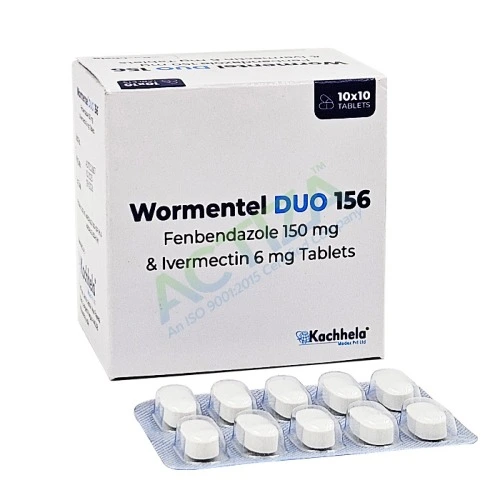
Fenbendazole Ivermectin Tablets (Wormentel Duo 156)
Medically reviewed by Sanjay Gangani, B.Pharm, CMO & Pharmacist
| Active Ingredient | Fenbendazole/Ivermectin |
|---|---|
| Indication | Parasitic infections, Anti Worm |
| Manufacturer | Kachhela Medex Pvt. Ltd. |
| Strength:- | 156mg |
| Dosage Form:- | Tablet |
| Packaging | 10 tablets in 1 strip |
| Country of Origin | India |
Fenbendazole Ivermectin Tablets (Wormentel Duo 156) | ||||
|---|---|---|---|---|
| Pack Size | Price | Quantity | Add To Cart | |
| 100 Tablet/s | $88 | |||
| 200 Tablet/s | $158 | |||
| 300 Tablet/s | $213 | |||
Introduction
Fenbendazole and Ivermectin are treatments for parasitic infections.
They help get rid of parasites in the body. They are part of a group of medicines known as anthelmintics. This group is all about removing worms from the body.
The drugs kick in and get rid of the parasites. They mainly help humans and animals fight infections from parasites. These parasites can harm the stomach, skin, or other organs.
This is common in areas with poor sanitation. Parasitic infections are a big health problem worldwide. The WHO says over 1.5 billion people have soil-transmitted helminth infections.
River blindness (onchocerciasis) impacts more than 21 million people. Ivermectin is common in human medicine, but Fenbendazole is mainly for veterinary use.
This shows a clear difference in how they’re used for people and animals.
This drug combination is gaining attention for its possible links to cancer. It’s also noted for off-label use and ties to veterinary medicine.
Joe Tippens’ story has been a big factor in its online popularity. It’s important to note that strong clinical proof is still limited. These uses aren’t backed by solid medical research yet.
What are Fenbendazole and Ivermectin?
Fenbendazole and Ivermectin are medications that kill parasites. They treat infections from worms. Below are their uses, class, and safety status in simple terms.
Fenbendazole Overview
Fenbendazole is a type of medicine that kills worms. It’s mainly used to treat animals like dogs, cattle, horses, and sheep.
Fenbendazole is a veterinary drug. It’s not for humans. There is no standard dose for people. Using it on humans isn’t approved, and it isn’t regulated.
This medicine is really useful for tackling parasitic infections in these animals. It’s commonly used in vet care. It stops parasites from growing in the gut.
But it’s not okayed for human use by big health agencies like the FDA or EMA. If you misuse it, you might face health risks.
Fenbendazole treats many animal parasites. Below are common infections it targets in animals.
Ivermectin Overview
Ivermectin is a type of medicine that’s used to treat lots of different infections in people. It’s called a macrocyclic lactone antiparasitic. That means it’s great at fighting off parasites.
It is approved for human use and usually needs a doctor’s prescription. Some ivermectin medicines are made for humans. One example is Stromectol.
Animal ivermectin is a lot stronger and different from the kind used for humans, so it’s not safe to use it on people. Common uses include treating strongyloidiasis.
It also helps with onchocerciasis, known as river blindness. Scabies is another condition it treats. It works by paralysing and killing parasites inside the body.
This medicine is also used a lot in animals. It helps prevent heartworm in dogs and controls parasites in livestock. When used the right way, it’s usually safe.
However, you might get side effects like nausea or a skin rash. People should never use animal versions, as they can be dangerous for humans.
History & Development
Fenbendazole began as a veterinary drug. Now, it is a popular dewormer. Its journey reflects changing uses, safety focus, and public interest trends.
Fenbendazole History
Fenbendazole was originally a drug for animals. It later became really well-known around the world. Its history shows it has been used for medical purposes. But it has also sparked modern debates.
It was made in the 1970s. This veterinary anthelmintic treats intestinal parasites. It works well for both livestock and pets. Plus, it’s safe to use.
Essential medicines are chosen to meet major health needs safely and affordably. Choosing wisely helps access. It promotes proper use and cuts costs. This helps health systems give reliable treatment to more people.
Ivermectin Discovery (Nobel Prize Story)
Discovering Ivermectin was a major milestone for medicine around the world. It played a vital role in managing parasites. Below are the discovery, development, Nobel Prize, and global impact explained.
Essential medicines are picked to meet basic health needs in a safe and affordable way. The WHO gives countries some helpful lists. These lists help make treatment easier to access. They cut costs and ensure everyone gets the care they need.
How Fenbendazole and Ivermectin Work (Mechanism of Action)
Fenbendazole MOA
Fenbendazole gets in the way of tubulin. This action takes place inside parasite cells. As a result, it stops microtubules from forming. Microtubules are important.
They help a parasite with its structure. They also support division and nutrient movement. Without microtubules, parasites can’t absorb glucose or keep their shape.
This causes major energy loss and leads to a breakdown in function.
Parasites can lose their movement. They may feel low on energy. In the end, they might not survive. Early lab and animal studies hint that disrupting microtubules can slow cancer cell division.
This could be a key to stopping cancer growth. The anticancer effect isn’t proven in humans yet. Researchers are still looking into it.
Ivermectin MOA
Ivermectin binds to proteins. These proteins are called glutamate-gated chloride channels. They block nerve signals.
These are found in the nerve and muscle cells of parasites. They block nerve signals. This lets more chloride in, making nerve cells too negative (hyperpolarised).
As a result, signals can’t pass correctly. So, the parasite gets paralysed and can’t function normally.
It also affects GABA-related channels. This also disrupts nerve and muscle activity. This mainly targets parasites.
Humans do not have these specific channels. Ivermectin works by blocking the parasite’s nerve signals. This stops its movement and feeding, leading to its death.
Medical Uses – Evidence-Based
These medicines work against parasites in both humans and animals. They use clinical studies. They also rely on global health programs.
Ivermectin Approved Uses in Humans
Ivermectin is a well-studied antiparasitic drug. Medical authorities have approved it. It’s often used to treat people and in public health programs. Key approved conditions include:
Strongyloidiasis
This treatment works well for intestinal threadworm infections when taken orally. It’s usually the top pick in many clinical guidelines.
Onchocerciasis
It helps large programs fight river blindness. It reduces parasite load and stops the disease from spreading.
Scabies
They come as oral and topical treatments. They are very helpful during outbreaks or if topical therapy fails.
Off-label (names only):
Ivermectin works well for parasitic infections. It can reduce microfilariae by 70-95% in onchocerciasis. This happens within one to two years if you take it every year.
For scabies, it works well too. One dose can cure 70-95% of cases.
The World Health Organisation suggests using it in big public health programs. This is especially true in sub-Saharan Africa for onchocerciasis. It also applies to parts of South and Southeast Asia for lymphatic filariasis.
Fenbendazole Use – Primarily Veterinary
Fenbendazole treats parasite infections. It’s mainly used for animals. It belongs to the same drug class as some human antiparasitics.
Parasites
It is used widely in animals to treat common intestinal worms. It includes Roundworms, hookworms, whipworms, and tapeworms.
Species
This is approved for different animal species. It is used in vet products for commercial purposes. It’s used for dogs, like Panacur and Safe-Guard, plus cattle, horses, sheep, goats, and rabbits.
Human Status
Not approved for human use by major regulators like the FDA or EMA. Its safety is unclear. The dosing and long-term effects in people are also not well studied. Self-use can carry unknown health risks.
Clinical Trials
No human clinical trials have been conducted for Phases 1, 2, or 3. This is the case for treating parasites. Most of what we know comes from studies on animals and in labs. There haven’t been any controlled studies in humans to back this up.
Fenbendazole has shown promise in lab studies. But so far, it’s unclear if it’s safe or effective for humans. Ivermectin is tested and approved.
It treats several human parasitic diseases. It’s crucial to do thorough research. You should also run proper clinical trials.
This is important before using a drug for anything other than its approved purpose. This is key to making sure it’s safe and actually works.
Approved Alternatives to Consider
These medicines are safe for parasitic infections. The FDA and WHO have approved them. Talk to a licensed doctor first. They can help you choose the best option for your needs. Below are the alternative trusted treatment options:
Albendazole
Albendazole is a medicine that treats a wide range of parasites. It’s been approved for use in people. Mostly, it’s used to deal with tapeworms and hydatid disease.
Mebendazole
It’s commonly used to treat worm infections. Mebendazole medication works well against several types of worms. These include roundworm, whipworm, hookworm, and pinworm.
Pyrantel Pamoate
It is a good option for mild infections that you can buy without a prescription. It’s mainly used for pinworm and roundworm infections. It works by paralysing the worms and allows your body to remove them naturally.
Praziquantel
Praziquantel is approved to treat serious parasitic infections. It’s often used for schistosomiasis. It also treats tapeworm infections.
Diethylcarbamazine (DEC)
Diethylcarbamazine is used to treat lymphatic filariasis. It works by killing off microfilariae in the blood. It’s often included in public health plans where these infections are common.
Approved treatments lead to better results. They lower risks and provide more choices. For the best care, choose treatments with strong proof. Pick those that experts trust.
Is Fenbendazole + Ivermectin Used Together in Humans?
The FDA and EMA don’t support using Fenbendazole and Ivermectin together in humans. So far, no major regulator has backed this particular combination.
No major medical guidelines from the WHO, CDC, or IDSA support this combination. Also, no large randomised controlled trials have tested it.
Currently, there is no proof that Fenbendazole and Ivermectin work together in humans. There is no evidence for any treatment. The Joe Tippens story is well-known. However, it’s just one story and not strong proof.
Recent data, like the ASCO 2026 reports, show that 499 patients reported using these drugs. This was observational. So, it can’t prove effectiveness.
Most cancer claims come from lab and animal studies. These studies show anti-tumour activity. There is still no strong human clinical evidence. So, this combination is experimental and unproven. Self-medication with these drugs carries important risks.
Before taking any meds or starting a new treatment plan, talk to a doctor. They can provide the details and help you decide what’s best for you. Self-medication can be risky. It might cause serious health problems or delay proper treatment.
Dosage Guidelines (Critical Section)
Correct dosing is key for safety and effectiveness. This section lists approved ivermectin doses. It also warns about the risks of misusing Fenbendazole.
Ivermectin Dosage – Human Use
Ivermectin dosing is based on body weight. It also depends on your health condition. It is usually taken as a single oral dose under medical guidance.
For a 70 kg adult, the typical dose of Ivermectin is around 10.5-14 mg, which is based on their weight. This is roughly 3 to 4 tablets.
Each tablet has 3 mg. The exact number depends on the dose prescribed.
Ivermectin dosing is based on your weight and the condition you’re treating. If you take too much or too little, it won’t work as well and might even cause problems.
That’s why it’s crucial to get guidance from a doctor. They’ll help you get the right amount for your specific needs.
Pediatric Ivermectin Dosage
Kids need their doses carefully figured out based on their weight and age. Younger kids need supervision when they use it. A healthcare pro should always be there.
Fenbendazole Dosage – Veterinary Reference ONLY
Fenbendazole dosing is for animals only, not for humans.
Human use lacks approved dosing and safety data. Animal dosing and warnings include:
Fenbendazole is not approved for humans. There is no safe dose for people. Do NOT use animal guidelines to calculate human doses. Formulations and safety standards differ, and they haven’t been tested on people.
Storage & Handling
Store ivermectin in a cool place, like under 30°C. Don’t leave it somewhere damp or in direct sunlight; it won’t stay stable.
And keep all your meds in a spot where kids can’t easily get to them. Don’t use expired tablets. Their safety and effectiveness can change over time.
Store Fenbendazole products for animals as directed on the label. They must not be used or handled as human medicine.
Clinical Evidence & Research
Clinical evidence shows what really works in medicine. This section explains the proof behind Ivermectin and its claims.
Ivermectin – Strong Clinical Backing
Ivermectin has solid scientific backing. It treats many parasitic diseases effectively. Many studies and years of research show it works well in real life.
Ivermectin is proven to treat parasitic diseases in many clinical trials; however, for COVID-19, the WHO and NIH don’t recommend it. Large trials, like TOGETHER and PRINCIPLE, showed no clear benefits. Patients did not gain much from these studies.
Fenbendazole – Very Limited Human Data
Most evidence on Fenbendazole comes from studies on animals and cells. There aren’t many human trials.
A study in PubMed (Dogra N et al., 2018, in Scientific Reports) found that tumours got smaller in mice. But people often misunderstood this as proof that it would work in humans. It’s worth noting that the study was done on animals and cell lines, not people.
Later lab and mouse studies found anti-tumour effects. These results are still just preclinical findings.
A 2024 review in Anticancer Research found that Fenbendazole might work as an anti-tumour agent. It hasn’t gained approval from the FDA or EMA for human use.
By 2026, Fenbendazole had not been tested in people. No clinical trials Phase 1, 2, or 3 had been done. A report from ASCO 2026 showed that 499 patients used the treatment.
But this was only observational, so it didn’t show clear results on how effective it was. Overall, lab findings show promise. However, strong evidence in humans is still missing. Claims are not proven yet.
Safety & Side Effects
Ivermectin is safe when used correctly. But side effects can still happen. Below are the side effects
Ivermectin Side Effects
Ivermectin side effects are mostly mild. This is true, especially at standard doses for humans. Here are the types of side effects and how severe they are.
Common (mild)
Mazzotti reaction (It happens due to dying parasites, not direct drug toxicity)
Rare serious effects (Mostly seen in very high doses or sensitive patients)
Overdose risk
Serious adverse events are rare. They occur in less than 1% of people in mass drug programs. This shows the drugs are safe when used correctly.
Fenbendazole – Safety Concerns in Humans
Fenbendazole isn’t safe for humans, and that’s largely because there’s been so little research done on it. It also hasn’t gotten official approval, which is a big part of the problem. Below are the key risks, unknowns, and medical concerns:
Risks of Using Fenbendazole in Humans
Fenbendazole is not for humans. It has serious safety risks. Below are the major health risks:
Drug Interactions
Interacting drugs affect the safety of medicine. Here are the key interaction risks:
Ivermectin – Known Interactions
Ivermectin doesn’t mix well with some meds. So, it’s important to keep a close eye on things. Here are some common interactions with other drugs and substances.
Warfarin
Ivermectin can act as a blood thinner. This means you’re more likely to bleed. If you take it with other medicines, check your INR levels.
CYP3A4 Inhibitors
Some medications can raise ivermectin levels in your body. Ketoconazole and clarithromycin are examples. This could lead to a higher chance of side effects. It’s helpful to consider this when planning your treatment.
CYP3A4 Inducers
Some medicines can lower ivermectin levels. Rifampicin and carbamazepine are two examples. This can make the treatment less effective.
P-gp Inhibitors
These help ivermectin enter the brain more easily. This raises the risk of serious neurological side effects.
Alcohol
To be on the safe side, avoid drinking alcohol when you’re using this. It can make you feel more dizzy, drowsy, and can also depress your central nervous system.
Fenbendazole – Unknown / Uncharacterized Interactions
Fenbendazole hasn’t been tested for interactions in people. So, we don’t know if it’s safe. Here are some of the limited and unclear risks related to interactions.
Ivermectin can interact with other medicines, so be careful. There’s not much information about how Fenbendazole affects humans. This adds to the uncertainty. Choosing safe medicines is important. Talking to doctors helps you make better treatment choices. This way, decisions are safer and more reliable.
Global Regulatory Status
Knowing how medicines are approved around the world is important. It helps us use them safely. It also helps us make informed choices. Below is the global approval status:
Ivermectin – Approved in Many Countries
Ivermectin is approved in many places. It treats human parasitic infections.
Here are the main health authorities that approve medicines:
Ivermectin is a pretty well-researched medicine. It’s approved in lots of countries. Adding it to essential medicine lists makes it easier for people to get. This also helps keep treatment safe and costs down for many communities.
Fenbendazole – Veterinary Drug Globally
Fenbendazole is for animals. It is not approved for human use anywhere in the world.
Below are the regulatory limits and status:
Conclusion
Ivermectin is a well-known antiparasitic drug with a strong track record. It’s got approved uses for humans and plenty of clinical evidence to support it.
Fenbendazole is a veterinary drug. It has no approved use for humans and lacks clinical trial data.
The mix of Fenbendazole and Ivermectin in humans lacks clinical proof. This makes it an untested and possibly unsafe method.
Don’t try to treat yourself with medicines, especially ones meant for animals. This can cause harm or delays in getting the right treatment. It’s best to avoid using veterinary products for human problems altogether.
For parasitic infections or any antiparasitic treatment, it’s best to see a doctor who’s properly licensed. They can give you the right advice and help you figure out the best course of action.
Stay up to date with trusted sources like the WHO, FDA, and PubMed. It’s better to get your info from them rather than social media posts or personal stories that haven’t been verified.
FAQs
Q1:- Can humans take Fenbendazole and Ivermectin together?
Ans:- No medical evidence backs up this combination for humans. Both the FDA and the WHO say it’s not recommended for any human health issue. There are a few risks to consider. One is that the drugs might not interact well with each other. There’s also a chance of liver toxicity. And then there’s the risk of delaying medical treatment that’s known to be effective.
Q2:- Is Fenbendazole safe for humans?
Ans:- Safety is not proven. There are no human safety studies. Veterinary formulations are not designed for human use. In some cases of self-medication, liver enzymes can rise. This raises concerns about potential harm.
Q3:- What is Ivermectin used for?
Ans:- Ivermectin is FDA-approved. It treats strongyloidiasis, onchocerciasis, and scabies. The WHO also uses it in major global health programs to fight parasitic diseases. It is NOT approved for COVID-19 by the WHO or the FDA.
Q4:- Are there clinical studies on this combination?
Ans:- There are no completed Phase 1, 2, or 3 clinical trials as of 2026. ASCO 2026 identified 499 users through self-reporting. It was not a clinical trial; it was an observational study. The research is still early. It focuses on animal and cell-line studies before moving ahead.
Q5:- Can children take these drugs?
Ans:- Ivermectin can be given to children over 15 kg. It should be dosed by weight and used only with a doctor’s guidance. Fenbendazole is NOT for children. There is no approved human dose for any age group.
Q6:- Can Ivermectin treat cancer?
Ans:- Some pre-clinical studies show possible anti-tumour activity. This includes cell-line research. So far, there’s no strong evidence from human trials that it fights cancer. The World Health Organisation, National Institutes of Health, and American Society of Clinical Oncology do not support Ivermectin. They do not recommend it for cancer treatment. It should never replace chemotherapy or immunotherapy.

B.Pharm, CMO & Pharmacist
Licensed pharmacist (B.Pharm) with 12+ years in clinical pharmacy and patient care. Reviews every article for evidence-based accuracy before it is published on ACTIZA Store.
Reviews
There are no reviews yet.