Empagliflozin 10 mg Medically reviewed by Sanjay Gangani, B.Pharm, CMO & Pharmacist
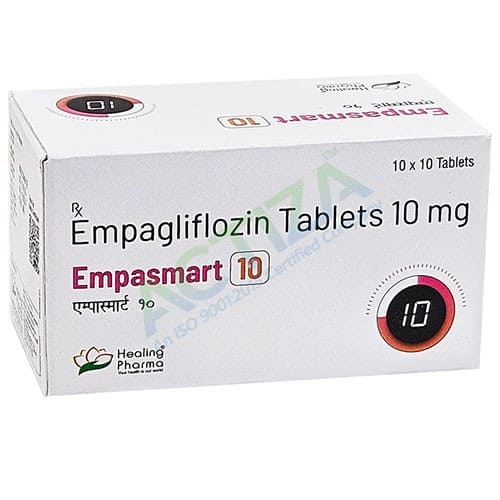
Active Ingredient Empagliflozin Indication Diabetes Type 2 Manufacturer Healing Pharma, India Strength:- 10 mg Packaging 10 tablets in 1 strip Dosage Form:- Tablet Country of Origin India
INQUIRE ABOUT Empagliflozin 10 mg
What is Empagliflozin 10 mg? Empagliflozin is a prescription tablet from the SGLT2 inhibitor class.
SGLT2 stands for sodium-glucose co-transporter 2.
The originator brand is Jardiance, from Boehringer Ingelheim.
It was first approved in the United States in 2014.
Many generic versions are now manufactured in India.
Tablets come in 10 mg and Empagliflozin 25 mg strengths.
Reduce the risk of cardiovascular death and hospitalisation in adults with heart failure.
Slow kidney decline in adults with chronic kidney disease at risk of progression.
Reduce cardiovascular death in adults with type 2 diabetes and established heart disease.
Improve blood glucose control in type 2 diabetes , alongside diet and exercise.
That last use covers adults and children aged 10 and over.
This is not only a diabetes medicine The heart failure indication does not require diabetes.
Neither does the kidney indication.
Roughly half the patients in one heart failure trial did not have diabetes.
In the kidney trial, around 44 percent had type 2 diabetes.
So a customer may be taking this with no diabetes at all.
Your page should not assume otherwise. Many pages do.
Not recommended for glucose control in type 1 diabetes.
In type 1 diabetes it significantly increases ketoacidosis risk.
Not recommended for glucose control if kidney function is below 30 mL/min/1.73 m2.
At that level it is unlikely to lower glucose, by its mechanism.
Not recommended for kidney disease caused by polycystic kidney disease.
Not recommended in those needing intravenous immunosuppression for kidney disease.
Not recommended for those on more than 45 mg prednisone or equivalent for kidney disease.
It is not expected to work in those groups.
What it does not do It does not replace insulin in anyone who needs insulin.
It does not cure diabetes, heart failure or kidney disease.
It is not a weight-loss medicine, though modest weight loss occurs.
It is not a diuretic, though it does increase urine output.
It does not lower blood glucose much once kidney function is very low.
How It Works (Mechanism of Action) The kidneys filter glucose out of the blood continuously.
Normally almost all of it is reabsorbed and returned to the circulation.
SGLT2 is the transporter doing most of that reabsorption.
Empagliflozin blocks SGLT2.
Less glucose is reclaimed, so more leaves in the urine.
At 10 mg, roughly 64 grams of glucose are excreted daily.
Blood glucose falls as a result.
Why it helps the heart and kidneys, which is a separate story Blocking SGLT2 also reduces sodium reabsorption.
More sodium therefore reaches the distal part of the kidney tubule.
This affects a feedback mechanism called tubuloglomerular feedback.
The result is reduced pressure inside the kidney’s filtering units.
It also lowers both the load entering and the resistance leaving the heart.
And it appears to reduce sympathetic nervous system activity.
These effects do not depend on lowering blood glucose.
That is why the drug works in people without diabetes.
Starting the tablet causes creatinine to rise and eGFR to fall within weeks.
These changes then stabilise.
In a large trial the rise in creatinine generally stayed within 0.1 mg/dL.
The eGFR fall generally stayed within 9 mL/min/1.73 m2 at week 4.
Both reversed after stopping treatment.
This looks alarming on a blood test but reflects a change in kidney pressure.
Patients sometimes stop the drug because of it, which is usually the wrong move.
That decision belongs to the prescribing doctor, not to a worried patient alone.
Pharmacokinetics Property Figure Time to peak blood level About 1.5 hours Half-life About 12.4 hours Protein binding About 86 percent Effect of food A high-fat meal lowers peak by 37 percent. Not clinically relevant. Metabolism Glucuronidation. No major active metabolites. CYP450 involvement None. It does not inhibit, inactivate or induce CYP enzymes. Elimination About 54 percent in urine, 41 percent in faeces QT interval No increase, even at 200 mg, which is eight times the maximum dose
Dosage Guide A doctor must prescribe this. The table reflects the current approved labelling.
Situation Dose Timing Notes Heart failure, adults 10 mg daily Morning With or without food Chronic kidney disease, adults 10 mg daily Morning With or without food Type 2 diabetes with established heart disease 10 mg daily Morning For cardiovascular protection Type 2 diabetes, glucose control, adults 10 mg daily Morning May increase to 25 mg if tolerated Type 2 diabetes, children aged 10 and over 10 mg daily Morning May increase to 25 mg if tolerated Before surgery or prolonged fasting Withhold At least 3 days before Resume when stable and eating During acute illness Hold and seek advice Not applicable See the sick-day rules above Missed dose Take when remembered Same day Never double up the next dose Liver impairment No adjustment stated Morning May be used. Exposure rises with severity. eGFR below 30, for glucose control Not recommended Not applicable Unlikely to be effective
How to Take It Take one tablet each morning.
Swallow it whole with water.
Take it with or without food. Either is fine.
Morning dosing reduces the chance of needing to pass urine overnight.
Drink enough fluid through the day.
Expect to pass urine more often, particularly at first.
If you miss a dose, take it when you remember that day.
Never take two tablets to make up for one.
Hold the tablet if you become acutely unwell, and call your doctor.
Stop at least 3 days before planned surgery, if possible.
What to expect in the first weeks More frequent urination is the commonest early change.
Some thirst is normal as the body adjusts.
A modest fall in blood pressure often occurs.
Light-headedness on standing should be reported, not ignored.
A small weight loss is common, mostly fluid at first.
A dip in kidney blood test results is expected and usually settles.
This medicine puts sugar into the urine. That is how it works.
Sugar in a warm moist area encourages yeast and bacteria.
Washing the genital area daily with water reduces that risk.
Drying thoroughly afterwards matters as much as washing.
Uncircumcised men should retract and clean beneath the foreskin.
Report any itching, discharge, soreness or redness early.
Most such infections are easily treated when caught early.
This advice costs nothing and prevents the commonest side effect.
Precautions Absolute contraindication Known hypersensitivity to empagliflozin or any ingredient in the tablet.
Serious reactions including angioedema have been reported.
That is the only formal contraindication in the current label.
The restrictions below are limitations of use and warnings, not contraindications.
Type 1 diabetes . This medicine is not recommended for glucose control in it.
Any previous episode of ketoacidosis.
Pancreatitis, now or in the past, or any pancreatic surgery.
Any history of recurrent urinary or genital infections.
Any foot ulcer, foot infection, or previous amputation.
Peripheral artery disease or poor circulation in the legs.
Water tablets, especially loop diuretics such as furosemide.
Insulin, or tablets that make the body release insulin.
Lithium, if you take it.
Whether you follow a ketogenic or very low carbohydrate diet.
Planned surgery or procedures.
Pregnancy, planned pregnancy, or breastfeeding.
Your age, if you are 75 or over.
Every other medicine you take.
Food, drink and daily life No food restriction applies. Take it with or without meals.
Drink adequate fluid, particularly in hot weather.
Heat and sweating add to the fluid loss this medicine causes.
Gujarat summers are a real consideration here.
Heavy alcohol use is a named precipitant of ketoacidosis. Avoid it.
Ketogenic and very low carbohydrate diets are also named precipitants.
Discuss any such diet with your doctor before starting it.
Routine preventative foot care is recommended for anyone on this drug class.
Check your feet regularly for sores, cuts or colour changes.
Before-use checklist Has a doctor prescribed this for me, with a stated reason?
Do I know whether it is for my heart, kidneys, diabetes, or more than one?
Has my kidney function been checked recently?
Has my hydration been assessed, especially if I take water tablets?
Do I have type 1 diabetes? If so, has this been discussed carefully?
Do I know the symptoms of ketoacidosis listed above?
Do I understand that my blood sugar can be normal during it?
Do I know to hold the tablet when I am acutely unwell?
Do I know to stop it 3 days before surgery?
Do I know the genital infection warning signs?
Am I taking insulin or a sulfonylurea? Has that dose been reviewed?
Do I have a plan for checking my feet regularly?
Side Effects Common effects, from pooled placebo-controlled trials Reported in 2 percent or more of adults with type 2 diabetes, and more often than placebo.
Effect Placebo Empagliflozin 10 mg Urinary tract infection 7.6% 9.3% Genital fungal infection, women 1.5% 5.4% Genital fungal infection, men 0.4% 3.1% Increased urination 1.0% 3.4% Raised cholesterol or triglycerides 3.4% 3.9% Joint pain 2.2% 2.4% Nausea 1.4% 2.3% Thirst 0% 1.7%
Genital fungal infection is the effect most clearly caused by the drug.
In women the rate more than tripled against placebo.
In men it rose roughly eightfold, though from a low base.
Very few people stopped treatment because of it, around 0.2 percent.
Urinary infections were commoner in women overall, at 18.4 percent on 10 mg.
In men the figure was 3.6 percent.
Those with a history of recurrent infections are more likely to get them.
In people aged 75 and over Effect Placebo Empagliflozin 10 mg Volume depletion effects 2.1% 2.3% Urinary tract infection 10.5% 15.7%
Urinary infection risk rises noticeably in this age group.
So does the risk of effects related to fluid depletion.
This is worth stating on a page likely to be read by older customers.
Low blood sugar: it depends entirely on what else is taken Combination Placebo Empagliflozin 10 mg On its own 0.4% 0.4% With metformin 0.5% 1.8% With metformin and a sulfonylurea 8.4% 16.1% With basal insulin 20.6% 19.5% With multiple daily insulin injections 37.2% 39.8%
Used alone, this medicine causes essentially no extra low blood sugar.
That is because it does not force the body to release insulin.
Added to a sulfonylurea, the rate roughly doubled.
The label advises considering a lower insulin or sulfonylurea dose when starting.
In children aged 10 to 17 the risk was higher regardless of insulin use.
Low blood sugar occurred in 19.2 percent of those children, against 7.5 on placebo.
Less common and serious effects Where What has been reported Metabolic Ketoacidosis, including with normal blood glucose. Fatal cases reported. Genital and urinary Urosepsis, pyelonephritis, Fournier’s gangrene Kidneys Acute kidney injury, some needing hospital admission or dialysis Circulation Symptomatic low blood pressure, dizziness on standing, dehydration, fainting Allergy Angioedema, rash, hives Digestive Constipation Men Phimosis, tightening of the foreskin Blood tests Raised haematocrit, raised LDL cholesterol, transient creatinine rise
Drug Interactions – Avoid With This drug has unusually few interactions, which is worth stating.
Severity Substance What happens DOSE REVIEW NEEDED Insulin Higher risk of low blood sugar. Insulin dose may need reducing. DOSE REVIEW NEEDED Sulfonylureas such as glimepiride or gliclazide Higher risk of low blood sugar. Dose may need reducing. CAUTION Diuretics, especially loop diuretics Increased urine volume. Greater risk of dehydration. MONITOR Lithium Serum lithium levels may fall. Monitor more closely when starting. TEST INTERFERENCE Urine glucose tests Will read positive. Do not use them to monitor control. TEST INTERFERENCE 1,5-anhydroglucitol assay Unreliable in anyone taking this class. Use another method. NO INTERACTION Metformin, glimepiride, pioglitazone, sitagliptin, linagliptin No clinically relevant effect either way NO INTERACTION Warfarin, digoxin, simvastatin, ramipril, verapamil No clinically relevant effect either way NO INTERACTION Hydrochlorothiazide, torsemide No clinically relevant effect on levels NO INTERACTION Combined oral contraceptives No clinically relevant effect
Empagliflozin does not inhibit, inactivate or induce CYP450 enzymes.
That removes a large category of interactions seen with other drugs.
The urine glucose point matters practically.
Anyone monitoring with urine strips must switch to blood testing.
A positive urine glucose result in these patients means nothing about control.
Emergency Warning Signs Stop the tablet and seek urgent medical care if any of these occur.
Nausea or vomiting.
Abdominal pain.
Unusual tiredness or feeling generally unwell.
Laboured or deep breathing.
A fruity smell on the breath.
Say plainly to staff: I take an SGLT2 inhibitor, please check for ketoacidosis.
Pain, tenderness, redness or swelling of the genital or perineal area.
Especially when combined with fever or feeling unwell.
Fever with back or flank pain, which may indicate a kidney infection.
Burning on passing urine with fever and shivering.
Other urgent signs Fainting, or severe dizziness on standing.
Passing much less urine than usual.
Swelling of the face, lips, tongue or throat.
A widespread rash, particularly with blistering.
A new foot ulcer, sore, or area of redness or pain in the foot.
Severe or persistent low blood sugar, if you also take insulin or a sulfonylurea.
Why Choose Empagliflozin 10 mg What the trial evidence actually shows Trial Population Main result Hazard ratio EMPA-REG OUTCOME T2DM with established heart disease Reduced cardiovascular death 0.62 EMPEROR-Reduced Heart failure, reduced ejection fraction Reduced CV death or HF hospitalisation 0.75 EMPEROR-Preserved Heart failure, preserved ejection fraction Reduced CV death or HF hospitalisation 0.79 EMPA-KIDNEY Chronic kidney disease Reduced kidney decline or CV death 0.72
The cardiovascular death reduction in EMPA-REG was substantial.
137 deaths on placebo against 172 across a group twice the size.
That translates to 5.9 percent versus 3.7 percent.
In EMPEROR-Preserved the benefit extended to preserved ejection fraction heart failure.
That group had very few effective treatments before these trials.
In EMPA-KIDNEY the benefit held across kidney function levels and causes.
It held whether or not the patient had diabetes.
Modest weight reduction, around 2 to 3 kilograms against placebo.
Modest blood pressure reduction, around 3 to 5 mmHg systolic.
Very low risk of causing low blood sugar when used alone.
Once-daily dosing, with or without food.
Almost no drug interactions, which simplifies prescribing.
No effect on the heart’s QT interval, even at eight times the maximum dose.
Usable in liver impairment without a stated dose change.
What should be said honestly alongside that Genital fungal infections are genuinely commoner on this medicine.
Urinary tract infections are commoner, especially in older women.
Ketoacidosis is rare but can be fatal, and can hide behind a normal glucose.
Fournier’s gangrene is very rare but catastrophic.
Kidney blood tests dip at the start, which alarms people who are not warned.
It does not lower glucose much once kidney function falls below 30.
It is not a weight-loss drug and should not be sold as one.
Storage Instructions Store at 20 °C to 25 °C.
Brief excursions from 15 °C to 30 °C are permitted.
Dispense and keep in a well-closed container.
Keep tablets in the original bottle or blister until taken.
Protect from moisture, heat and direct sunlight.
Do not refrigerate and do not freeze.
Bathrooms and parked cars are the two worst storage places.
Gujarat summer temperatures regularly exceed the permitted range.
Keep out of the reach of children.
Do not use tablets that are chipped, discoloured or damaged.
Do not use after the printed expiry date.
Return unused tablets to a pharmacy for disposal.
Never share this medicine with anyone else.
Sanjay Gangani
B.Pharm, CMO & Pharmacist
Licensed pharmacist (B.Pharm) with 12+ years in clinical pharmacy and patient care. Reviews every article for evidence-based accuracy before it is published on ACTIZA Store.



Reviews
There are no reviews yet.