

Loading cart...
Fenbendazole and Ivermectin Tablets for Humans
Medically reviewed by Sanjay Gangani, B.Pharm, CMO & Pharmacist
| Active Ingredient | Fenbendazole / Ivermectin |
|---|---|
| Indication | Filariasis, Scabies, Treat a variety of parasites |
| Manufacturer | Actiza Pharmaceutical Pvt. Ltd. |
| Strength:- | 222Mg/12Mg |
| Packaging | 10 tablets in 1 strip |
| Country of Origin | India |
| Dosage Form:- | Tablet |
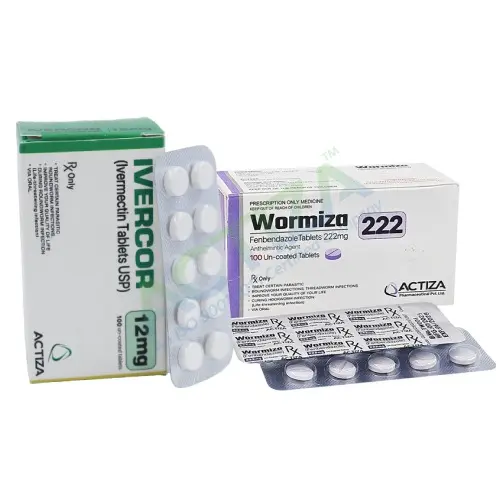
Fenbendazole 222 Mg (Wormiza) | ||||
|---|---|---|---|---|
| Pack Size | Price | Quantity | Add To Cart | |
| 100 Tablet/s | $32 | |||
| 200 Tablet/s | $58 | |||
| 300 Tablet/s | $80 | |||
Ivercor 12 Mg (Ivermectin) | ||||
|---|---|---|---|---|
| Pack Size | Price | Quantity | Add To Cart | |
| 50 Tablet/s | $45 | |||
| 100 Tablet/s | $80 | |||
| 200 Tablet/s | $150 | |||
| 300 Tablet/s | $220 | |||
| 500 Tablet/s | $360 | |||
| 1000 Tablet/s | $705 | |||
Regulatory Status & Safety Notices (MUST DISPLAY)
Important regulatory notice: This combo pack contains two different products with two different regulatory statuses. Ivercor 12 mg (ivermectin) is a human antiparasitic medicine with FDA-approved oral uses for intestinal strongyloidiasis and onchocerciasis.
Fenbendazole 222 mg (Wormiza) is not approved by the FDA, EMA, or other major human drug regulators for human use. Fenbendazole is approved primarily for veterinary use, and its human use remains off-label and investigational.
Fenbendazole and cancer caution: Fenbendazole is sometimes discussed online as part of cancer self-treatment plans, but there are no completed human clinical trials proving that it treats cancer in humans.
Preclinical work in cells and animals is not the same as proven human benefit. It should never replace standard cancer treatment.
What is the Fenbendazole + Ivermectin Combo Pack?
The Fenbendazole + Ivermectin Combo Pack is a pack of two separate tablets supplied together. One tablet of Fenbendazole 222 mg contains 222 mg of Fenbendazole.
The other is Ivercor 12 mg, which contains ivermectin 12 mg. These are not the same drug, and they are not used in the same way. They are packed together because they work through different antiparasitic mechanisms and cover different parasite groups.
In simple terms, the idea behind the combo is this: Ivermectin is stronger for some mites, microfilariae, and certain nematodes, while Fenbendazole is stronger for many intestinal helminths and other gut parasites.
When the two are considered together, the parasite coverage can be broader than with a single drug. That is the main reason combination use is discussed.
There is one more important point. This is not a standard, fixed-dose, approved human combination product, as some antibiotics are.
One part of the pack, ivermectin, has approved human oral uses. The other part, Fenbendazole, does not. So the combo must always be viewed with that split regulatory reality in mind.
Why Use a Combination? – Dual Mechanism Explained
The reason people look at this combo is simple. The two drugs do not work the same way. They attack parasites at different targets. That gives the pack a wider action range than either tablet alone.
Mechanism 1 – Ivermectin (Ivercor 12mg)
Ivermectin acts mainly on glutamate-gated chloride channels in parasites. These channels are found in many worms and arthropods. When ivermectin binds to them, the channels stay open.
Too much chloride moves into the parasite’s nerve and muscle cells. The cells stop working normally. The parasite becomes paralyzed, cannot feed or move well, and is then cleared by the body.
Ivermectin also adds to nerve inhibition through related signaling pathways.
This is why ivermectin is especially useful against scabies mites, microfilariae, and certain worm infections such as strongyloidiasis and onchocerciasis.
Mechanism 2 – Fenbendazole (Wormiza 222mg)
Fenbendazole is a benzimidazole anthelmintic. It works by binding to beta-tubulin in parasites. That stops the building of microtubules.
Parasites require microtubules for cell division, nutrient transport, cell shape, and glucose uptake. When those microtubules fail, the parasite loses energy, loses structure, and eventually dies.
Why the Combination is More Effective
The key idea is coverage. Ivermectin is usually the stronger agent against mites, microfilariae, and some blood- or tissue-nematodes. Fenbendazole is usually the stronger part for gut worms and some other intestinal parasites.
So the combo may make more sense in settings such as:
Indications – When is This Combo Used?
This combo is usually discussed when a clinician wants broader parasite coverage than a single medicine alone can provide.
Primary Indications:
Scabies: Here, ivermectin is the main active ingredient. Oral ivermectin is widely used off-label for scabies, often as 200 mcg/kg, with a second dose 7 to 14 days later. Fenbendazole is not the main antiscabies drug in the combo.
Lymphatic filariasis: Ivermectin remains the main active ingredient. In public health work, ivermectin is used in mass drug administration programs, often alongside other antiparasitic medicines, depending on the country and parasite patterns.
Onchocerciasis (river blindness): This is a formal oral use of ivermectin for humans. Ivermectin kills microfilariae but not adult worms, so repeat treatment is needed over time. Fenbendazole is not the approved main drug here.
Intestinal strongyloidiasis: This is another formal oral use of ivermectin in humans. The usual cure plan is a single weight-based dose, with repeat testing and repeat treatment if needed. Fenbendazole may add broader gut coverage, but ivermectin is the approved main therapy.
Mixed helminth infections: This is where the combo idea becomes more practical. Fenbendazole can be active against intestinal roundworms, hookworms, whipworms, and other gut helminths, while ivermectin can also treat strongyloidiasis and ectoparasites.
Investigational cancer protocols: Some people online discuss Fenbendazole and ivermectin together in cancer plans. This is not a proven human cancer treatment. There are no completed human trials proving that this combo treats cancer. It should never replace standard oncology care.
Dosage & Administration
The most important safety point here is this: the two tablets have different dosing rules and different food rules. They should not be treated as if they are the same.
For ivermectin, dosing is weight-based. Standard human oral dosing is usually about 200 mcg/kg for strongyloidiasis and 150 mcg/kg for onchocerciasis. Scabies is often treated off-label with 200 mcg/kg, usually given as 2 doses 7 to 14 days apart.
Because this product is Ivercor 12 mg, one tablet contains more ivermectin than the common 3 mg reference tablet. The weight-based principle stays the same, but fewer tablets are needed.
In broad practical terms:
A clinician must confirm the exact dose because it depends on body weight and indication. For Fenbendazole, there is no validated approved human dose. That has to be repeated clearly.
In off-label discussions, common human-use patterns include:
For intestinal helminths, benzimidazole-style dosing is often discussed over 3 to 5 days, and Fenbendazole is usually taken with food, especially a meal containing fat, because absorption improves with food.
A simple way to give the two tablets, when a clinician has chosen both, is:
Safety Information
This combo has to be understood as a mixed-regulation pack. Ivermectin has a strong safety record in humans at approved doses. Fenbendazole lacks the same human evidence base. So the safety profile of the combo is not as simple as “both are standard human drugs.” One is approved for some human uses. One is not.
Four major safety messages should always stay visible:
Side Effects
The side effects of this combo come from two different drugs, so they should be thought about separately.
With ivermectin, possible effects include:
With Fenbendazole, reported human problems include:
Contraindications
For ivermectin, major contraindications or strong cautions include:
For Fenbendazole, major contraindications or strong cautions include:
Drug Interactions
A few important interactions matter in this combo:
Storage & Handling
Store both products at 15-30°C. Keep them away from moisture, direct light, and excess heat. Keep the tablets in the original blister strips. Do not store them in the bathroom. Keep them away from children and pets. Do not use either tablet after the expiry date printed on the strip.
Conclusion
The Fenbendazole + Ivermectin Combo Pack combines Wormiza 222 mg and Ivercor 12 mg into two separate tablets with distinct antiparasitic actions. Ivermectin acts mainly by paralyzing parasites’ nerves and muscles. Fenbendazole primarily acts by disrupting microtubules and causing energy failure.
But the combo must be used with care. Ivermectin has approved human uses. Fenbendazole does not. The two tablets also have different food rules, different evidence bases, and different safety concerns.
he biggest risks to remember are veterinary substitution, Loa loa encephalopathy with ivermectin, and liver toxicity with Fenbendazole. This combo is for parasite-related discussion only and is not a COVID-19 treatment.
FAQ
Q1:- Can this combo be used for cancer?
Ans:- Some people try it, but it is not proven to treat cancer. There are no proper human studies. Do not use it instead of real cancer treatment. Always ask a doctor.
Q2:- How should the combo pack be stored?
Ans:- Keep at room temperature (15–30°C), in a dry place, away from heat and sunlight. Keep in original pack and away from children.
Q3:- Is fenbendazole in this combo FDA-approved for humans?
Ans:- No. It is a veterinary (animal) medicine. Not officially approved for human use.
Q4:- Why is this combo better than one drug alone?
Ans:- Both medicines work in different ways. Together they can cover more types of parasites, so useful in mixed infections.

B.Pharm, CMO & Pharmacist
Licensed pharmacist (B.Pharm) with 12+ years in clinical pharmacy and patient care. Reviews every article for evidence-based accuracy before it is published on ACTIZA Store.
Reviews
There are no reviews yet.