...

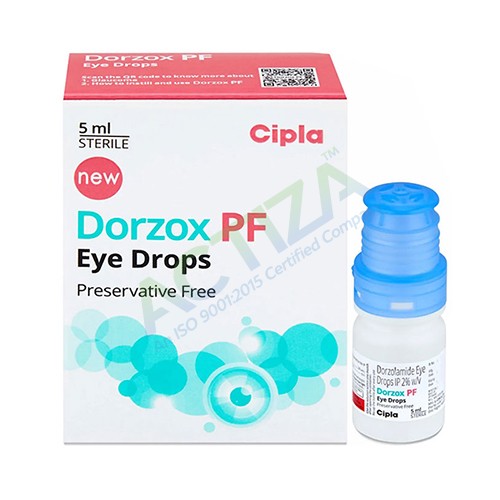
Dorzox PF Eye Drop (Dorzolamide)

Medically reviewed by Sanjay Gangani, B.Pharm, CMO & Pharmacist

Active Ingredient Dorzolamide
Indication Glaucoma
Manufacturer Cipla Limited
Strength:- 2%
Packaging 5ml in 1 Bottle

Dorzox PF Eye Drop (Dorzolamide)

Pack Size Price Price/unit Quantity Add To Cart
1 Eye Drop/s $18 $18.00/Piece
3 Eye Drop/s $44 $14.67/Piece
6 Eye Drop/s $78 $13.00/Piece

What is Dorzox PF?

  • Dorzox PF is a prescription eye drop containing dorzolamide 2 percent.

  • Each millilitre contains 20 mg of dorzolamide.

  • Cipla Ltd markets it in India.

  • Dorzox Eye Drop indicates the formulation contains no preservative.

  • It is supplied in 5 ml and 10 ml bottles.

  • The originator brand of this molecule is Trusopt.

  • Lowering raised pressure inside the eye.

  • Open-angle glaucoma, the commonest form of the disease.

  • Ocular hypertension, meaning raised pressure without nerve damage yet.

  • It may be used alone or alongside other pressure-lowering drops.

What glaucoma actually is

  • The eye continuously produces a fluid called aqueous humour.

  • That fluid nourishes the structures at the front of the eye.

  • It then drains out through a meshwork near the edge of the iris.

  • If production outpaces drainage, pressure inside the eye rises.

  • Sustained pressure damages the optic nerve at the back of the eye.

  • That nerve carries visual information to the brain.

  • Damaged nerve fibres do not regenerate.

  • Lowering the pressure is currently the only proven way to slow the damage.

How It Works (Mechanism of Action)

  • The ciliary body inside the eye produces aqueous humour.

  • Dorzox T Eye Drop depends on an enzyme called carbonic anhydrase.

  • Specifically the type found in the ciliary processes.

  • The enzyme drives movement of bicarbonate ions.

  • Water and sodium follow the ions, forming the fluid.

  • Dorzolamide blocks that enzyme locally.

  • Less bicarbonate is moved, so less fluid is produced.

  • With less fluid entering, the pressure inside the eye falls.

Dosage Guide

An ophthalmologist sets this. The table reflects the approved labelling.

SituationDoseFrequencyNotes
Standard use, aloneOne dropThree times dailyIn the affected eye or eyes
Used with other eye dropsOne dropThree times dailySpace all drops at least 10 minutes apart
Both eyes affectedOne drop in eachThree times dailyOne drop per eye, not two
Less frequent dosingNot establishedNot applicableEfficacy below three times daily is not established
Severe kidney impairmentNot recommendedNot applicableThe drug is cleared through the kidneys
Missed doseUse it when rememberedThen resume normallySkip if the next dose is near. Never double.
Taking an oral carbonic anhydrase inhibitorNot recommended togetherNot applicableEffects are additive and so is the risk

How to Use It

  • Wash your hands thoroughly.

  • Check the bottle is the right one and within its expiry date.

  • Tilt your head back, or lie down if that is easier.

  • Gently pull the lower eyelid down to form a small pocket.

  • Hold the bottle above the eye without touching anything.

  • Squeeze out one single drop into the pocket.

  • Close the eye gently. Do not blink hard or squeeze it shut.

  • Press the inner corner of the eye for one to two minutes.

  • Wipe away any excess with a clean tissue.

  • Replace the cap straight away.

  • If using another drop, wait at least ten minutes.

Common difficulties, and what helps

ProblemWhat helps
Cannot see the bottle approachingLie down and rest the hand holding the bottle on your forehead
Blinking the drop awayLie down, close the eye, place the drop in the inner corner, then open
Shaky handsRest your hand against your face. Drop-aid devices also exist.
Not sure the drop went inChill the bottle slightly. A cold drop is easier to feel.
Arthritis making squeezing hardAsk the pharmacist about squeeze aids for the bottle
Forgetting dosesKeep the bottle with your toothbrush. Set three alarms.
  • Remove soft contact lenses before instilling the drop.

  • Wait at least fifteen minutes before putting them back in.

  • Preservative-free formulations are gentler on lenses than preserved ones.

  • Even so, instilling drops over a lens is not recommended.

  • Discuss lens wear with your ophthalmologist if you use several drops.

Precautions

Contraindications

  • Known hypersensitivity to dorzolamide or any component of the product.

  • That is the only formal contraindication in the approved label.

  • It is a short list, which reflects the local route of administration.

Tell your doctor about

  • Any allergy to sulfa medicines, and what the reaction was.

  • Any kidney problem, particularly severe impairment.

  • Any liver problem.

  • Any previous corneal disease or corneal surgery.

  • Cataract surgery, and whether you were told about corneal cell counts.

  • Any current eye infection or injury to the eye surface.

  • Dry eye or any ocular surface problem.

  • Whether you wear contact lenses.

  • Any other eye drops you use, and when you use them.

  • Whether you take acetazolamide or any oral carbonic anhydrase inhibitor.

  • High-dose aspirin or salicylate therapy.

  • Pregnancy, planned pregnancy or breastfeeding.

  • Every other medicine you take.

Practical daily points

  • Food and drink do not interact with this medicine.

  • Alcohol does not interact with it directly.

  • Blurred vision may occur briefly after instilling a drop.

  • Wait until your vision is clear before driving.

  • Do not drive immediately after instilling the drops.

  • Keep the bottle away from heat and sunlight.

  • Preservative-free bottles have a limited life once opened.

  • Check the in-use period on your own pack and respect it.

Before-use checklist

  • Has an ophthalmologist prescribed this specifically for me?

  • Have I declared any sulfa allergy?

  • Do I know this is three times daily, not twice?

  • Do I know to use only one drop per eye?

  • Do I know to press the inner corner afterwards?

  • If I use other drops, do I know the ten-minute rule?

  • Do I know not to let the tip touch anything?

  • Do I know how long the bottle lasts once opened?

  • Is my next eye pressure check booked?

  • Do I understand this protects sight rather than restoring it?

  • Do I have a reminder system for all three doses?

  • Do I know the warning signs in Section 8?

Side Effects

Common effects

  • Burning or stinging immediately after instilling the drop.

  • A bitter, sour or unusual taste.

  • Superficial punctate keratitis, meaning tiny spots of surface irritation.

  • The label reports this in 10 to 15 percent of patients.

  • General eye discomfort.

  • Blurred vision shortly after use.

  • Itching and tearing.

  • Redness of the eye.

  • Comparative studies found dorzolamide stings more than brinzolamide.

  • The preservative-free version should cause less surface irritation than a preserved one.

Less common and serious effects

WhereWhat has been reported
Eye surfaceInflammation of the lid, conjunctivitis, crusting, foreign body sensation
Eye, seriousCorneal swelling, bacterial keratitis, inflammation inside the eye
Allergy, localContact dermatitis of the eyelids, local allergic reaction
Allergy, systemicRash, hives, and rarely severe skin reactions typical of sulfonamides
GeneralHeadache, nausea, tiredness, dizziness
BreathingShortness of breath, rarely
Blood, very rareDisorders typical of sulfonamide drugs
KidneyKidney stones have been reported with carbonic anhydrase inhibitors
Nose and throatNosebleed, throat irritation, dry mouth

Drug Interactions – Avoid With

SeveritySubstanceWhat happens
NOT RECOMMENDEDOral carbonic anhydrase inhibitors such as acetazolamideEffects are additive, as are the systemic risks
NOT RECOMMENDEDAnother topical carbonic anhydrase inhibitor such as brinzolamideNo added benefit, duplicated risk
CAUTIONHigh-dose salicylate therapyRare acid-base disturbances have been reported
CAUTIONOther sulfonamide medicinesShared allergy potential
TIMINGAny other eye dropSpace by at least ten minutes or the first is washed away
TIMINGEye ointmentsUse drops first, then ointment last
COMPATIBLEOther classes of glaucoma dropMay be used together, spaced appropriately
  • Dorzolamide has relatively few systemic drug interactions.

  • The oral carbonic anhydrase inhibitor point is the main one.

  • Tell any doctor that you use this drop, even for an unrelated problem.

  • Eye drops are frequently left off medicine lists. Include it on yours.

Emergency Warning Signs

Eye symptoms

  • Severe eye pain.

  • Sudden marked reduction in vision.

  • A sudden increase in redness with discharge.

  • Seeing halos around lights.

  • Severe light sensitivity.

  • A white or cloudy patch on the coloured part of the eye.

  • Eyelid swelling with a rash.

Signs of a sulfonamide reaction

  • A rash that spreads, blisters or peels.

  • Sores in the mouth, eyes or genital area.

  • Fever with a rash.

  • Unexplained bruising or bleeding.

  • Sore throat with fever that does not settle.

  • These are rare but are the reason the sulfonamide warning exists.

Signs of acute angle-closure glaucoma, a separate emergency

  • Sudden severe eye pain with a red eye.

  • Headache with nausea or vomiting.

  • Blurred vision with coloured halos around lights.

  • A hard eye that feels tender to touch.

  • This is a different condition from the one these drops treat.

  • It needs emergency care within hours to save sight.

Why Choose Dorzox PF

What holds up

  • The preservative-free formulation addresses a genuine, well-documented problem.

  • International dry eye guidance recommends preservative-free products where available.

  • Studies of switching to PF formulations showed improved ocular surface health.

  • That improvement came without losing pressure control.

  • Dorzolamide works by a different route from beta blockers and prostaglandins.

  • That makes it a useful addition when one drop is not enough.

  • It has few systemic drug interactions.

  • Unlike beta blocker drops, it does not affect the heart rate or airways.

  • That matters for patients with asthma or slow heart rhythms.

  • Cipla is named consistently as the marketer across every source checked.

What must be said alongside that

  • It stings more than some alternatives in the same class.

  • Three times daily dosing is demanding and lower frequencies are unproven.

  • It is a sulfonamide, so sulfa allergy must be declared.

  • Preservative-free products generally cost more than preserved ones.

  • Once opened, a preservative-free bottle has a shorter in-use life.

  • It does not restore any vision already lost.

Storage Instructions

  • Store below 25 °C unless your pack states otherwise.

  • Check your own carton, as Indian packs may specify a different limit.

  • Keep the bottle tightly closed when not in use.

  • Protect from direct sunlight and heat.

  • Gujarat summer temperatures regularly exceed typical eye drop limits.

  • Do not refrigerate unless the pack specifically says to.

  • Do not freeze.

  • Note the date you first open the bottle on the carton.

  • Preservative-free products have a limited life once opened.

  • Follow the in-use period stated on your own pack exactly.

  • Discard the bottle at the end of that period even if solution remains.

  • Never use a bottle whose solution has changed colour or become cloudy.

  • Never use a bottle whose tip has touched the eye or any surface.

  • Keep out of the reach of children.

  • Do not use after the printed expiry date.

  • Never share eye drops with anyone else, including family.

Sanjay Gangani

Sanjay Gangani

B.Pharm, CMO & Pharmacist

Licensed pharmacist (B.Pharm) with 12+ years in clinical pharmacy and patient care. Reviews every article for evidence-based accuracy before it is published on ACTIZA Store.

Reviews

There are no reviews yet.

Be the first to review “Dorzox PF Eye Drop (Dorzolamide)”

Your email address will not be published. Required fields are marked *

This site uses Akismet to reduce spam. Learn how your comment data is processed.

All Categories

Shopping Cart

0
×

Loading cart...