Kaymedorol 8 Mg (Methylprednisolone) Medically reviewed by Sanjay Gangani, B.Pharm, CMO & Pharmacist
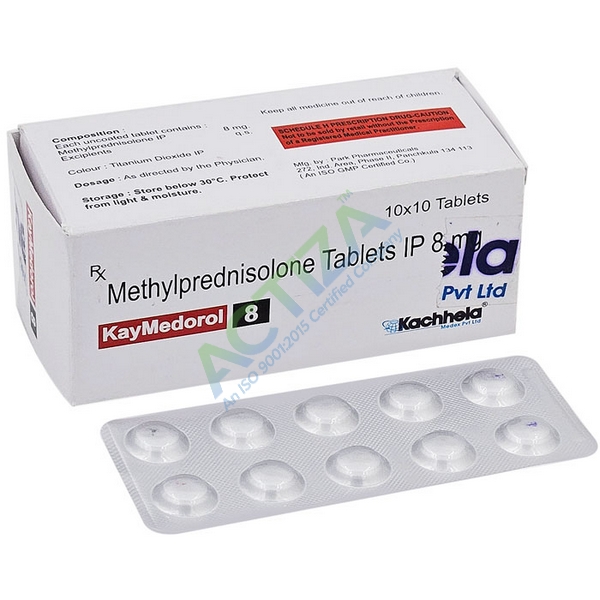
Active Ingredient Methylprednisolone Indication Severe allergic reactions, Allergy symptoms, Asthma Manufacturer Kachhela Medex Pvt. Ltd. Strength:- 8mg Packaging 10 tablets in 1 strip
INQUIRE ABOUT Kaymedorol 8 Mg (Methylprednisolone)
What is Kaymedorol 8 mg? Kaymedorol is sold as a methylprednisolone tablet.
The requested strength is 8 mg per tablet.
Only a 4 mg version could be found in any source.
Kaymedorol 4 Mg is a synthetic glucocorticoid.
It is a derivative of prednisolone.
No pharmacy or manufacturer listing names this brand.
Two business directory entries name it at 4 mg.
The label covers a very wide range of conditions:
Hormone disorders, including adrenal insufficiency.
Rheumatic disorders such as rheumatoid arthritis and gout.
Collagen diseases such as systemic lupus erythematosus.
Severe skin diseases , including pemphigus and severe psoriasis.
Severe allergic states not helped by usual treatment.
Serious inflammatory eye diseases.
Some respiratory diseases, including sarcoidosis.
Certain blood disorders and blood cancers.
Nephrotic syndrome, ulcerative colitis and Crohn’s disease.
Flare-ups of multiple sclerosis and brain tumour swelling.
Organ transplantation.
It is a more potent anti-inflammatory than prednisolone.
It causes less salt and water retention than prednisolone.
It is at least four times as potent as hydrocortisone.
How Methylprednisolone Works (Mechanism of Action) The action happens in four simple steps:
Inflammation is driven by chemical messengers in the body.
Those messengers cause swelling, redness, heat and pain.
Kaymedorol 16 Mg blocks the production of those messengers.
It also damps down parts of the immune response.
Swelling and pain settle across many different conditions.
Overactive immune reactions are brought under control.
The underlying disease is controlled, not cured.
A reduced immune response also means more infection risk.
How the body handles it:
It is rapidly absorbed after swallowing.
Peak blood levels occur about 1.5 to 2.3 hours after a dose.
Its bioavailability is high, at 82% to 89%.
Its elimination half-life is about 1.8 to 5.2 hours.
It is broken down by the liver enzyme CYP3A4.
It crosses into the brain and into breast milk.
Dosage Guide Doses below come from Pfizer’s Indian prescribing information.
Condition Initial Daily Dose Maintenance Dose Key Note Overall range 4 mg to 48 mg The lowest effective dose Set individually by the doctor Rheumatoid arthritis, severe 12 to 16 mg 6 to 12 mg Two tablets of this strength Rheumatoid arthritis, moderate 8 to 10 mg 4 to 8 mg One tablet is 8 mg Rheumatoid arthritis, mild 6 to 8 mg 2 to 6 mg Lower strengths exist Teenagers with arthritis 6 to 10 mg 2 to 8 mg As prescribed Systemic lupus erythematosus 20 to 40 mg 8 to 20 mg A higher starting dose Severe seasonal asthma 16 to 40 mg As directed Short-term control Severe hay fever or dermatitis 16 to 40 mg As directed For severe cases only Inflammatory eye disease 12 to 40 mg 2 to 12 mg Under specialist care Ulcerative colitis 16 to 60 mg As directed To cover a critical period Nephrotic syndrome 20 to 60 mg 12 to 40 mg Given in defined cycles Stopping after long treatment Reduce gradually Never stop abruptly See the warning above
How to read this table:
The label says the dose must be individualised.
It is raised or lowered according to how you respond.
Extra steroid may be needed during illness or major stress.
Your prescriber decides every change to the dose.
There is no clinical syndrome of acute steroid overdose.
Heart rhythm problems or collapse are possible after a large dose.
There is no specific antidote; treatment is supportive.
How to Take Methylprednisolone 8 mg Take the tablets exactly as your doctor has prescribed.
Take them at the same time each day.
Taking them in the morning is often advised.
Swallow the tablet with water.
Do not change the dose yourself.
Do not stop the medicine suddenly.
Tell any doctor or dentist that you take a steroid.
Carry a steroid card if your doctor provides one.
Attend all review appointments during treatment.
During illness or stress:
Your body may need a higher steroid dose temporarily.
That applies during infection, injury or surgery.
Contact your doctor rather than adjusting it yourself.
This need can persist for months after stopping treatment.
Report any infection or exposure to chickenpox promptly.
Tell your doctor if your mood changes noticeably.
Report blurred vision or any change in eyesight.
Precautions Contraindications – Do Not Use It If You: Have a systemic fungal infection.
Are allergic to methylprednisolone or any tablet ingredient.
Live or live-attenuated vaccines at immunosuppressive doses.
Killed vaccines may be given, but may work less well.
Smallpox vaccination during corticosteroid treatment.
Conditions Needing Caution or Monitoring Any current or latent infection, including tuberculosis.
Diabetes, because blood glucose can rise.
High blood pressure or congestive heart failure.
A tendency to blood clots or previous thrombosis.
Peptic ulcer, ulcerative colitis or diverticulitis.
Liver cirrhosis, which increases the steroid effect.
Kidney impairment or systemic sclerosis.
Seizure disorders.
Myasthenia gravis, a muscle weakness condition.
Glaucoma, cataract or ocular herpes simplex.
An underactive thyroid, which increases the effect.
Cushing’s disease.
A suspected phaeochromocytoma, a rare adrenal tumour.
Osteoporosis, especially in older patients.
Any history of mental illness or mood disorder.
Lactose, milk protein or fructose intolerance.
Pregnancy, Breastfeeding and Children Use in pregnancy only when strictly necessary.
It should then be at the lowest possible dose.
Some steroids cross the placenta readily.
Steroids pass into breast milk.
They may suppress a nursing infant’s growth.
Children on long-term treatment need growth monitoring.
Children face a particular risk of raised pressure in the head.
Before-Use Checklist Has a doctor prescribed this dose and duration?
Do you know never to stop the tablets suddenly?
Do you have any infection at present?
Have you had chickenpox, or been exposed to it?
Are any vaccinations planned?
Do you have diabetes, high blood pressure or glaucoma?
Have you had tuberculosis in the past?
Do you take anti-inflammatory painkillers or blood thinners?
Are you pregnant or breastfeeding?
Do you know what to do if you become ill?
Side Effects The label lists these with frequency not known.
Side Effect System Affected What It Feels Like What to Do Increased appetite and weight gain Metabolism Eating more, gaining weight Monitor weight; discuss with doctor Raised blood glucose Metabolism Thirst, more urine Diabetics need closer monitoring Fluid retention and swelling General Puffy ankles or face Report if marked Cushingoid appearance Endocrine Rounded face, body changes Report to your doctor Mood changes and insomnia Psychiatric Euphoria, irritability, poor sleep Tell your doctor promptly Severe depression or psychosis Psychiatric Marked mood or thought changes Seek medical advice urgently Increased infection risk Infections Fevers, infections that linger Seek advice early Stomach ulcer or bleeding Gastrointestinal Pain, black stools, vomiting blood Emergency — seek care Muscle weakness and wasting Musculoskeletal Weak limbs, difficulty rising Report to your doctor Thinning of the bones Musculoskeletal Often no symptoms Long-term risk; monitored Bone death or fracture Musculoskeletal Joint or back pain Seek medical assessment Cataract or glaucoma Eye Blurred or reduced vision Needs an eye examination Thin skin, bruising, stretch marks Skin Fragile skin, easy bruising Report to your doctor Raised blood pressure Vascular Often no symptoms Checked at reviews Blood clots Vascular Leg swelling, chest pain Emergency — seek care Slowed growth in children Endocrine Reduced height gain Growth is monitored Adrenal suppression Endocrine Weakness, collapse on stopping Never stop abruptly Tendon rupture Injury Sudden pain, often the Achilles Seek urgent assessment
About psychiatric effects:
They usually appear within days or weeks of starting.
They range from euphoria and insomnia to severe depression.
Most recover after the dose is reduced or stopped.
Effects can also appear when the dose is being tapered.
Seek advice if low mood or suicidal thoughts occur.
Complications depend on the dose and how long it is taken.
The lowest effective dose should always be used.
Short courses carry far less risk than long-term treatment.
Drug Interactions Medicines that raise methylprednisolone levels:
Ketoconazole and itraconazole, used for fungal infections.
Clarithromycin, erythromycin and troleandomycin.
HIV protease inhibitors such as indinavir and ritonavir.
Cobicistat, a pharmacokinetic enhancer.
Diltiazem, aprepitant, ciclosporin and isoniazid.
Grapefruit juice.
The steroid dose may need lowering to avoid toxicity.
Rifampicin, used for tuberculosis.
Carbamazepine, phenobarbital and phenytoin.
A higher steroid dose may be needed.
Combinations needing particular care:
Aspirin and anti-inflammatory painkillers raise ulcer risk.
Blood thinners, whose effect may increase or decrease.
Clotting tests should be monitored more often.
Water tablets and other potassium-lowering medicines.
Diabetes medicines, whose doses may need adjusting.
Ciclosporin, where convulsions have been reported.
Neuromuscular blocking drugs, because of muscle weakness.
Warning Signs – Seek Medical Help Seek urgent medical care if you have:
Severe abdominal pain, black stools or vomiting blood.
Sudden severe weakness, dizziness or collapse.
A high fever or any sign of serious infection.
Sudden breathlessness, chest pain or leg swelling.
Sudden loss or blurring of vision.
A seizure.
Swelling of the face, lips or throat.
Sudden pain in a tendon, often at the heel.
Contact your doctor promptly if:
You are exposed to chickenpox or measles.
Your mood changes, or you feel unusually low.
You develop severe muscle weakness.
Your blood sugar readings rise.
You cannot take your tablets because of illness.
Missing doses after long treatment risks adrenal failure.
That can be fatal if it is not treated.
Tell a doctor rather than simply stopping.
What This Strength Offers Benefits when clinically appropriate:
It controls inflammation across a very wide range of diseases.
It is a more potent anti-inflammatory than prednisolone.
It causes less salt and water retention than prednisolone.
It is taken as a single daily tablet in many regimens.
Four strengths exist, allowing careful dose reduction.
8 mg suits doses in the middle of the labelled range.
Its Indian prescribing information was revised in March 2026.
Honest balance for the buyer:
It must never be stopped suddenly after prolonged use.
It raises the risk of infection and can mask the signs.
Long-term use can thin the bones and the skin.
It can raise blood sugar, blood pressure and weight.
Mood changes are common and sometimes severe.
A generic alternative is listed at 42% less per tablet.
Storage Instructions Store at a temperature not exceeding 30°C.
Protect the tablets from moisture.
Keep them in the blister until use.
Keep out of the sight and reach of children.
Check the expiry date; the shelf life is 36 months.
Do not keep leftover steroid for future illnesses.
Return unused tablets to a pharmacy take-back scheme.
Sanjay Gangani
B.Pharm, CMO & Pharmacist
Licensed pharmacist (B.Pharm) with 12+ years in clinical pharmacy and patient care. Reviews every article for evidence-based accuracy before it is published on ACTIZA Store.



Reviews
There are no reviews yet.