...

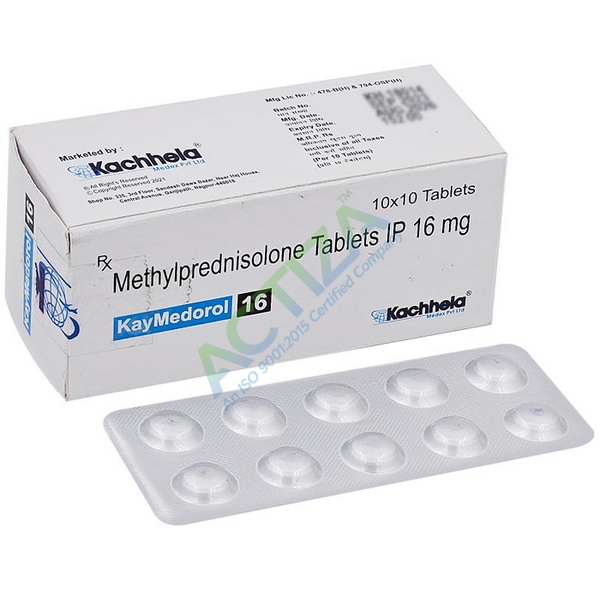
Kaymedorol 16 Mg (Methylprednisolone)

Medically reviewed by Sanjay Gangani, B.Pharm, CMO & Pharmacist

Active Ingredient Methylprednisolone
Indication Severe allergic reactions, Allergy symptoms, Asthma
Manufacturer Kachhela Medex Pvt. Ltd.
Strength:- 16mg
Packaging 10 tablets in 1 strip

Kaymedorol 16 Mg (Methylprednisolone)

Pack Size Price Price/unit Quantity Add To Cart
100 Tablet/s $70.41 $0.70/Pill
200 Tablet/s $119.22 $0.60/Pill
300 Tablet/s $160.56 $0.54/Pill

WHAT IS KAYMEDOROL 16?

  • Kaymedorol 16 contains methylprednisolone 16 mg per tablet.

  • Methylprednisolone is a corticosteroid taken by mouth.

  • It is a synthetic version of a natural adrenal hormone.

  • Kaymedorol 8 mg reduces inflammation throughout the body.

  • It also suppresses an overactive immune response.

  • It treats a very wide range of conditions.

  • The approved label lists thirteen broad categories.

  • These include rheumatic, allergic and skin conditions.

  • They also include lupus, eye and breathing conditions.

HOW IT WORKS (MECHANISM OF ACTION)

  • Kaymedorol 4 mg passes easily into body cells.

  • Inside the cell it binds a glucocorticoid receptor.

  • The bound receptor travels into the cell nucleus.

  • There it acts directly on the cell’s genes.

  • It switches off genes that make inflammatory proteins.

  • Those proteins include cytokines and prostaglandins.

  • It switches on genes that make anti-inflammatory proteins.

  • It also reduces the movement of white cells to tissues.

  • Swelling, redness, heat and pain all reduce.

Why the same action causes the side effects

  • Glucocorticoid receptors exist in almost every tissue.

  • The medicine therefore acts far beyond the target tissue.

  • It affects blood sugar, bone, skin, mood and immunity.

  • That is why side effects are widespread rather than local.

  • It is also why the lowest effective dose is used.

DOSAGE GUIDE

The label gives a range rather than a single dose, because the dose depends on the condition. Your doctor sets it. Never self-dose.

ParameterDetailNote
Initial daily dose range4 mg to 48 mgSet by the condition treated
Strength of this tablet16 mgMid-range
FrequencyUsually once dailySome regimens divide the dose
Best time of dayMorningMatches the natural hormone rhythm
With foodTake with food or milkReduces stomach irritation
Alternate-day therapyAn option in some conditionsPrescriber decides
Reducing the doseGradually, on a scheduleNever abruptly
DurationAs short as the condition allowsRisks rise with duration
Missed doseContact your doctorDo not double up
Self-adjustmentNeverBoth raising and stopping are unsafe

Why no single regimen is printed:

  • methylprednisolone treats everything from a short allergic flare to long-term lupus. A dose appropriate for one condition would be wrong and potentially harmful for another, so the label gives a range and leaves the choice to the prescriber. Your dose and your taper come from your doctor and your pack insert.

Morning dosing matters:

  • your own cortisol peaks in the early morning. Taking the dose then interferes least with that rhythm and tends to cause less sleep disturbance.

HOW TO TAKE IT

  • Take the tablet exactly as your doctor has directed.

  • Swallow the tablet whole with water.

  • Take it with food or a glass of milk.

  • Food reduces the risk of stomach irritation.

  • Take the dose in the morning unless told otherwise.

  • Do not crush or chew the tablet.

  • Follow your tapering schedule precisely.

  • Do not stop even if your symptoms clear completely.

  • Do not increase your own dose if symptoms return.

  • Tell your doctor if you become ill during treatment.

  • You may need a higher dose during illness or surgery.

  • Carry a steroid treatment card if your doctor provides one.

  • Tell any doctor or dentist treating you that you take steroids.

PRECAUTIONS

Absolute contraindications – do not use

The label lists only two absolute contraindications.

  • A systemic fungal infection anywhere in the body.

  • Known allergy to methylprednisolone or any ingredient.

Infection risk and masking

Steroids suppress the immune system and can hide infection.

  • New infections are more likely during treatment.

  • Existing infections can worsen more quickly.

  • Fever and other usual warning signs may be reduced.

  • An infection can therefore progress before it is noticed.

  • Report any fever, sore throat or new pain promptly.

  • Avoid close contact with chickenpox and measles.

  • Tell your doctor at once if you are exposed.

  • Latent tuberculosis can reactivate during long courses.

  • Preventive TB treatment may be needed alongside.

Strongyloides hyperinfection – a specific regional risk

The label warns that steroids can trigger Strongyloides hyperinfection, with potentially fatal results.

  • Strongyloides stercoralis is a soil-transmitted worm.

  • It is common in tropical and subtropical regions.

  • It can live in the body for years without symptoms.

  • Suppressing immunity lets it multiply out of control.

  • That hyperinfection can spread and can be fatal.

  • Screening before steroids is advised in endemic areas.

  • Treating the worm first prevents the problem.

  • Ivermectin-based treatment clears Strongyloides.

  • Tell your doctor where you have lived and travelled.

Live vaccines

Live vaccines are contraindicated at immunosuppressive doses.

  • Live vaccines include measles, mumps and rubella.

  • They also include oral polio, yellow fever and BCG.

  • Live shingles and some typhoid vaccines are included.

  • The vaccine organism can cause illness if immunity is low.

  • Inactivated vaccines are usually acceptable.

  • They may produce a weaker response during treatment.

  • Ask your doctor before any vaccination.

  • Tell any vaccination clinic that you take steroids.

Conditions to disclose to your doctor

  • Diabetes, as this medicine raises blood sugar.

  • High blood pressure.

  • Heart failure or any heart disease.

  • Stomach ulcer, or any history of one.

  • Osteoporosis or thin bones.

  • Glaucoma or cataracts.

  • Any eye infection, especially herpes of the eye.

  • Epilepsy or a history of seizures.

  • Depression, psychosis or any mental illness.

  • Tuberculosis, past or present.

  • Any fungal, viral or parasitic infection.

  • Liver or kidney disease.

  • An underactive thyroid.

  • Myasthenia gravis.

  • Any recent vaccination, or one planned.

  • Pregnancy, suspected pregnancy, or breastfeeding.

  • All other medicines, including painkillers and blood thinners.

Effects to watch for during longer courses

  • Blood pressure can rise, with salt and water retention.

  • Potassium can fall.

  • Blood sugar can rise, unmasking latent diabetes.

  • Insulin or tablet doses may need increasing.

  • Bones can thin, raising fracture risk.

  • Aseptic necrosis of bone has been reported.

  • Tendons can rupture, especially the Achilles tendon.

  • Cataracts and glaucoma can develop with prolonged use.

  • Mood can change, from low mood to frank psychosis.

  • Peptic ulcer with perforation or bleeding can occur.

  • Growth can slow in children on prolonged treatment.

  • Weight gain and a rounded face can develop.

  • Skin can thin and bruise more easily.

Food, drink and daily-life precautions

  • Take it with food to protect your stomach.

  • Avoid alcohol, which adds to stomach irritation.

  • Limit added salt, which worsens fluid retention.

  • Eat enough potassium-rich food, such as bananas.

  • Ensure adequate calcium and vitamin D intake.

  • Avoid grapefruit juice, which can raise drug levels.

  • Weight-bearing exercise helps protect your bones.

  • Monitor your blood sugar if you have diabetes.

  • Have your blood pressure checked regularly.

  • Have your eyes checked during long-term use.

Before-use safety checklist

  • I have a valid prescription stating my dose.

  • I know exactly how many tablets to take each day.

  • I know my tapering schedule, if I have one.

  • I understand I must never stop abruptly.

  • I have enough tablets to complete the course.

  • I have no systemic fungal infection.

  • I have told my doctor about every infection risk.

  • I have told my doctor where I have lived and travelled.

  • I know not to have a live vaccine during treatment.

  • I know to report fever or new pain promptly.

  • I will tell any doctor or dentist that I take steroids.

  • I carry a steroid card if one was given to me.

SIDE EFFECTS

Common side effects, more likely with higher doses or longer courses

Side effectSystem affectedWhat to do
Increased appetite and weight gainMetabolicWatch diet; tell your doctor
Fluid retention and swellingFluid balanceLimit salt; tell your doctor
Raised blood pressureCardiovascularRegular monitoring
Raised blood sugarMetabolicMonitor if diabetic
Difficulty sleepingNervous systemTake the dose in the morning
Mood changes or irritabilityPsychiatricTell your doctor
Indigestion or stomach discomfortGastrointestinalTake with food
Acne or skin changesDermatologicUsually settles after the course
Easy bruisingDermatologicTell your doctor
Muscle weaknessMusculoskeletalTell your doctor
Rounded face (Cushingoid appearance)EndocrineReversible after stopping
Low potassiumFluid and electrolyteBlood test; medical review

Serious side effects

EventNoteRequired action
Secondary adrenal insufficiencyAfter abrupt stoppingEmergency care
Peptic ulcer with perforationGastrointestinalEmergency care
Gastrointestinal bleedingGastrointestinalEmergency care
Severe depression or psychosisPsychiatricUrgent medical review
Serious or masked infectionImmunosuppressionUrgent medical review
Strongyloides hyperinfectionCan be fatalEmergency care
Tuberculosis reactivationLong coursesUrgent medical review
Osteoporosis and fractureLong coursesBone assessment
Aseptic necrosis of boneLong coursesSpecialist review
Achilles or other tendon ruptureMusculoskeletalUrgent assessment
Posterior subcapsular cataractProlonged useEye examination
GlaucomaProlonged useEye examination
Growth suppression in childrenProlonged useMonitor height
Convulsions with cyclosporinInteractionEmergency care

DRUG INTERACTIONS – AVOID WITH

Contraindicated at immunosuppressive doses

  • Live and live attenuated vaccines.

  • Cyclosporin: convulsions have been reported together.

  • Each drug inhibits the metabolism of the other.

  • Phenobarbital increases methylprednisolone clearance.

  • Phenytoin increases its clearance.

  • Rifampicin increases its clearance.

  • A higher steroid dose may be needed with these.

  • Ketoconazole inhibits its metabolism.

  • Troleandomycin inhibits its metabolism.

  • Clarithromycin and erythromycin can have the same effect.

  • Grapefruit juice can raise levels.

  • A dose reduction may be needed with these.

Other important interactions

  • Anticoagulants: the effect varies, so monitor clotting.

  • Aspirin at high dose: clearance may be increased.

  • NSAIDs raise the risk of stomach ulcer and bleeding.

  • Diuretics can worsen potassium loss.

  • Diabetes medicines may need dose increases.

  • Other steroids, inhaled or nasal, add to total exposure.

  • Tell your doctor about every medicine you take.

EMERGENCY WARNING SIGNS

Seek emergency medical care if you have:

  • Severe stomach pain, especially with vomiting.

  • Vomiting blood, or material that looks like coffee grounds.

  • Black, tarry stools.

  • Severe confusion, agitation or hallucinations.

  • Thoughts of harming yourself.

  • A seizure or fit.

  • Sudden severe pain in the heel or back of the ankle.

  • Sudden loss of vision or severe eye pain.

  • Signs of severe infection, with high fever and collapse.

  • Extreme weakness, dizziness and vomiting after stopping.

  • It can follow stopping the medicine abruptly.

  • Tell the emergency team that you take steroids.

  • Tell them whether you recently stopped them.

Contact your doctor promptly, though not as an emergency, if:

  • You develop a fever or any new infection.

  • You have been exposed to chickenpox or measles.

  • Your mood changes noticeably.

  • Your blood sugar readings rise.

  • Your ankles swell.

  • You have persistent indigestion.

  • Your vision becomes blurred.

  • Your child seems to be growing more slowly.

WHY CHOOSE KAYMEDOROL 16

  • Contains methylprednisolone, a long-established corticosteroid.

  • It is effective across a very wide range of conditions.

  • The approved label lists thirteen indication categories.

  • It has a relatively low salt-retaining effect.

  • That compares favourably with older steroids.

  • It is taken by mouth, with no injection needed.

  • Once-daily morning dosing suits most regimens.

  • The 16 mg strength suits mid-range and tapering courses.

  • An 8 mg strength is available for smaller steps.

  • Its effects and risks are extremely well documented.

  • It is far less costly than most newer immune treatments.

STORAGE INSTRUCTIONS

  • Store at room temperature, below 30 degrees C.

  • Keep tablets in the original blister and carton.

  • Protect from light and moisture.

  • Do not store in a bathroom.

  • Do not refrigerate and do not freeze.

  • Keep away from direct sunlight and heat.

  • Check the expiry date before each course.

  • Keep your tapering schedule with the pack.

  • Reorder before your current strip runs out.

  • Never share this medicine with anyone else.

  • Return unused tablets to a pharmacy.

Sanjay Gangani

Sanjay Gangani

B.Pharm, CMO & Pharmacist

Licensed pharmacist (B.Pharm) with 12+ years in clinical pharmacy and patient care. Reviews every article for evidence-based accuracy before it is published on ACTIZA Store.

Reviews

There are no reviews yet.

Be the first to review “Kaymedorol 16 Mg (Methylprednisolone)”

Your email address will not be published. Required fields are marked *

This site uses Akismet to reduce spam. Learn how your comment data is processed.

All Categories

Shopping Cart

0
×

Loading cart...