ZyHMG 150 IU (Menotrophin) Medically reviewed by Sanjay Gangani, B.Pharm, CMO & Pharmacist
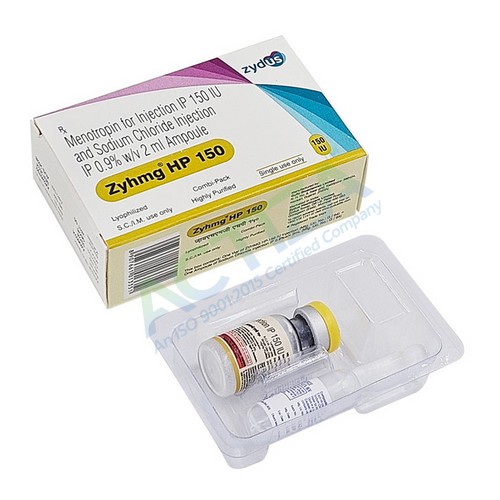
Active Ingredient Menotrophin [HMG] Indication female infertility, male hypogonadism and male infertility. Manufacturer Zydus Lifesciences Strength:- 150iu Packaging 1 Injection in 1 vial Dosage Form:- Injection Country of Origin India
INQUIRE ABOUT ZyHMG 150 IU (Menotrophin)
What is ZyHMG 150 IU? ZyHMG 150 IU is a prescription fertility injection.
It contains 150 international units of menotrophin.
Menotrophin is also called human menopausal gonadotrophin, or hMG.
It is a mixture of two natural hormones, FSH and LH.
Those hormones control egg development in women.
They also control sperm production in men.
The hormones are extracted from the urine of post-menopausal women.
It is made by Zydus Healthcare Ltd., part of Zydus Cadila.
In women it stimulates the ovaries to develop eggs.
ZyHMG 75iu is used for ovulation problems and in IVF treatment.
In men it is used for low sperm count caused by low hormone levels.
It is supplied as a powder mixed with liquid before injection.
Listings state it should be given by a doctor or nurse.
It is not an oral medicine and not a self-care product.
PharmEasy lists this 150 IU product as discontinued.
How ZyHMG Works (Mechanism of Action) How it works in women, in five steps:
The ovaries contain follicles, each holding an immature egg.
FSH stimulates those follicles to grow and mature.
LH supports the hormone production that follicles need.
The injection supplies both hormones together.
One or more follicles mature and are ready for ovulation.
Some men lack the brain hormones that drive the testes.
That condition is called hypogonadotropic hypogonadism.
FSH in the injection stimulates sperm production directly.
LH stimulates the testes to make testosterone.
It is often given with a second hormone, hCG.
Each woman’s ovaries respond differently to the same dose.
Too little response means no egg develops.
Too much response can overstimulate the ovaries.
Ultrasound and blood tests show how the ovaries are responding.
Doses are adjusted in real time based on those results.
That is why treatment happens under a fertility specialist.
Dosage Guide There is no fixed dose. Your specialist sets and adjusts it.
Situation How the Dose Is Decided Timing Key Note Women, ovulation induction Set by the specialist; adjusted to response Daily injections over days Guided by ultrasound monitoring Women, IVF stimulation Set within an IVF protocol As the clinic schedules Part of a wider treatment plan Women, response too strong Dose reduced or treatment stopped Decided at monitoring Guards against hyperstimulation Men, low sperm count Set by the specialist Usually several times weekly Often combined with hCG Men, duration Often months of treatment As prescribed Sperm production takes time Route Muscle or under the skin As the clinic directs Given by a doctor or nurse Missed dose Contact the clinic promptly Do not double up Timing matters in fertility cycles Pituitary or hypothalamic tumour Do not use Not applicable A contraindication in listings Ovarian cyst not due to PCOS Do not use Not applicable A contraindication in listings Children Not recommended Not applicable Per product listings
How to read this table:
No page can give you a correct dose for this medicine.
The dose depends on how your body responds day by day.
That can only be judged through clinical monitoring.
Never change the dose without your specialist.
Never start a course without a monitoring plan in place.
How It Is Given A doctor or nurse normally gives the injection.
Listings advise patients not to inject it themselves.
The powder is mixed with the supplied liquid before use.
It is injected into a muscle or under the skin.
Injection sites are usually rotated.
Women attend regular ultrasound scans during treatment.
Blood hormone levels are also checked.
The clinic uses those results to adjust each dose.
A separate trigger injection may be given to release the egg.
Follow the clinic’s schedule exactly.
If a clinic has trained you to inject at home:
Follow only the technique your clinic has taught you.
Use a new sterile needle every time.
Dispose of needles in a proper sharps container.
Keep attending every monitoring appointment.
Contact the clinic at once about any warning sign.
Precautions Absolute Contraindications – Do Not Use If You: Are allergic to menotrophin or any ingredient.
Have a tumour of the pituitary gland.
Have a tumour of the hypothalamus.
Have a tumour of the womb, ovaries or breasts.
Have ovarian cysts not caused by polycystic ovary syndrome.
Have unexplained vaginal bleeding.
Are already pregnant.
Conditions You Must Disclose to Your Specialist Polycystic ovary syndrome, which raises hyperstimulation risk.
Any previous ovarian hyperstimulation.
Any history of blood clots, in you or your family.
Any thyroid or adrenal gland disorder.
Any previous ectopic pregnancy or tubal problem.
Any history of miscarriage.
Obesity or smoking, which affect clot risk.
Any hormone treatment or anabolic steroid use.
Whether you are breastfeeding.
All prescription, herbal and over-the-counter products you use.
Food, Drink and Lifestyle No specific food needs to be avoided.
Stay well hydrated during a stimulation cycle.
Avoid alcohol while trying to conceive.
Stopping smoking improves fertility outcomes.
Avoid strenuous exercise if the ovaries are enlarged.
Your clinic may advise on intercourse timing and restrictions.
Before-Use Checklist Is your supply this exact product, given it is listed as discontinued?
Is a fertility specialist directing your treatment?
Is a monitoring plan with scans and blood tests in place?
Will a doctor or nurse give the injections?
Has the product been kept refrigerated as its pack requires?
Have you disclosed any history of blood clots?
Have you disclosed polycystic ovary syndrome if you have it?
Do you know the warning signs of overstimulation?
Do you know how to reach your clinic urgently?
Have you checked the expiry date on the vial?
Common and Less Common Side Effects Ovarian hyperstimulation is the effect that requires urgent action.
Side Effect Frequency What It Feels Like What to Do Injection site pain Common Soreness, redness or bruising Rotate sites; usually settles Headache Common Dull or throbbing head pain Rest and drink water Stomach cramps Common Lower abdominal discomfort Report if worsening Bloating Common Swollen, full feeling in the abdomen Report if increasing Fatigue Common Unusual tiredness Rest; report if severe Mood changes Less common Irritability, low mood or restlessness Tell your clinic Breast tenderness Less common Sore or swollen breasts Usually settles Nausea Less common Queasy stomach Report if it repeats Ovarian enlargement Less common Pelvic pain or pressure Contact your clinic Multiple pregnancy Increased risk Twins or more Discussed before treatment Ectopic pregnancy Increased risk One-sided pain in early pregnancy Seek urgent care Ovarian hyperstimulation Uncommon but serious Severe bloating, pain, rapid weight gain Emergency – contact clinic at once Blood clots Rare Leg pain or swelling, chest pain, breathlessness Emergency – call for help Severe allergic reaction Rare Swelling of face, lips or throat Emergency – call for help
About ovarian hyperstimulation syndrome:
It happens when the ovaries respond too strongly.
Fluid can shift out of the blood into the abdomen.
Mild cases cause bloating and discomfort.
Severe cases cause rapid weight gain and breathlessness.
It can also raise the risk of blood clots.
Monitoring is designed to catch it early.
Contact your clinic immediately about any warning sign.
Drug Interactions – Use With Caution Your specialist coordinates this with other fertility drugs.
Other gonadotrophins, including FSH-only products.
hCG, often used alongside or as an ovulation trigger.
Clomiphene, which also stimulates ovulation.
GnRH agonists and antagonists used in IVF protocols.
Testosterone or anabolic steroids.
Herbal fertility products, which may contain hormones.
Combining ovarian stimulants raises hyperstimulation risk.
IVF protocols deliberately combine several drugs.
Only a specialist can balance those combinations safely.
External testosterone suppresses the body’s own sperm production.
Herbal products may add undeclared hormonal effects.
Emergency Warning Signs – Seek Urgent Medical Help Contact your clinic or emergency services immediately if you have:
Severe abdominal pain or bloating.
Rapid weight gain over a few days.
Passing much less urine than usual.
Breathlessness or chest pain.
Severe nausea, vomiting or diarrhoea .
Pain, swelling or warmth in one leg.
Sudden severe headache or weakness on one side.
Sharp one-sided pain in early pregnancy.
Swelling of the face, lips, tongue or throat.
Tell every treating doctor you are having fertility treatment.
Name menotrophin and any other fertility drugs you use.
State the date of your last injection and any trigger injection.
Bring your clinic’s contact details with you.
Role of This Medicine, and Its Limits What menotrophin offers in the right setting:
It supplies both FSH and LH in a single product.
It can induce ovulation where simpler tablets have failed.
It is an established part of assisted conception such as IVF.
It can restore sperm production in men with low hormone levels.
Zydus is a large, established Indian manufacturer.
Why this is not a typical online product:
Listings state it should be given by a doctor or nurse.
Women need scans and blood tests throughout treatment.
The dose changes with each patient’s response.
Overstimulation can be serious without that monitoring.
It needs cold chain storage from supplier to clinic.
This particular 150 IU product is listed as discontinued.
It is best supplied to fertility clinics, not direct to patients.
Storage Instructions Follow the storage statement on the pack you hold.
PharmEasy lists this product as refrigerated.
Comparable menotrophin products are stored at 2°C to 8°C.
Do not freeze the vial or the diluent.
Keep the vial in its carton to protect it from light.
Use the solution immediately after mixing.
Discard any unused solution after the injection.
Do not use a vial whose seal is broken.
Do not use solution that is cloudy or contains particles.
Keep all injection materials out of reach of children.
Dispose of needles in a proper sharps container.
Check the expiry date on the vial and carton.
Sanjay Gangani
B.Pharm, CMO & Pharmacist
Licensed pharmacist (B.Pharm) with 12+ years in clinical pharmacy and patient care. Reviews every article for evidence-based accuracy before it is published on ACTIZA Store.



Reviews
There are no reviews yet.