...

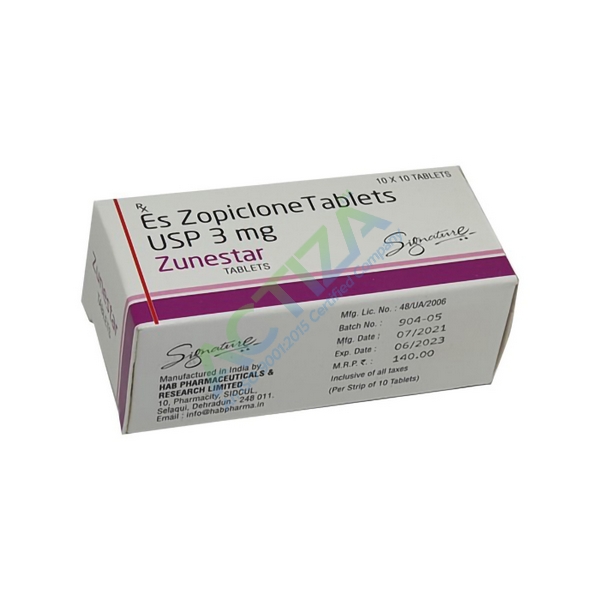
Zunestar 3 Mg (Eszopiclone)

Medically reviewed by Sanjay Gangani, B.Pharm, CMO & Pharmacist

Active Ingredient Eszopiclone
Indication Anxiety and Insomnia
Manufacturer HAB Pharmaceuticals & Research Ltd
Strength:- 3 mg
Packaging 10 Tablets in a strip

What is Zunestar 3 mg?

  • Zunestar 3 is a prescription sleeping tablet for adults.

  • Each tablet contains 3 mg of the active ingredient eszopiclone.

  • Eszopiclone is a non-benzodiazepine sedative-hypnotic, often called a Z-drug.

  • It is used for the treatment of insomnia.

  • It shortens the time taken to fall asleep.

  • It also helps people stay asleep through the night.

  • The reference brand in the United States is Lunesta.

  • Eszopiclone is the active S-enantiomer of zopiclone.

  • In plain terms, it is the working half of the zopiclone molecule.

  • It is a different medicine with its own dosing scale.

  • Never swap eszopiclone and zopiclone doses milligram for milligram.

  • Eszopiclone tablets come in 1 mg, 2 mg and 3 mg strengths.

  • The recommended starting dose is 1 mg, not 3 mg.

  • Zunestar 2 mg is the maximum approved dose for adults.

  • It treats the symptom of poor sleep, not its underlying cause.

  • It is not an anti-anxiety or antidepressant medicine.

  • It is a Schedule IV controlled substance in the United States.

  • Use it only when a doctor has specifically prescribed it.

How Zunestar 3 mg Works (Mechanism of Action)

The action happens in five simple steps:

  • GABA is the main calming chemical messenger in the brain.

  • GABA acts on receptors called GABA-A receptors on nerve cells.

  • Eszopiclone binds to a site on those same receptors.

  • This makes the receptors respond more strongly to GABA.

  • Brain activity slows, which allows sleep to begin.

  • Slowed brain activity shortens the time taken to fall asleep.

  • It also reduces waking during the night.

  • The effect is sedation, not restoration of natural sleep.

  • Sleep architecture is not returned to a normal pattern.

How it differs from zopiclone:

  • Zopiclone is a mixture of two mirror-image forms of the molecule.

  • Eszopiclone is only the active form of that pair.

  • Milligram for milligram, eszopiclone is therefore more potent.

  • The eszopiclone dose range is 1 mg to 3 mg.

  • The zopiclone dose range is 3.75 mg to 7.5 mg.

  • Eszopiclone is approved by the US FDA; zopiclone is not.

  • The medicine is absorbed quickly after swallowing.

  • A high-fat meal delays absorption and slows the onset of sleep.

  • The liver enzyme CYP3A4 plays a major role in clearing it.

  • Blood levels remain measurable into the following morning.

  • That is why next-day impairment is greatest at the 3 mg dose.

Dosage Guide

The table below shows approved eszopiclone dosing for insomnia.

Patient SituationApproved Eszopiclone DoseTimingKey Note
Adults, recommended starting dose1 mgImmediately before bedtimeAlways start at the lowest effective dose
Zunestar 3 mg tablet3 mg – the approved maximumImmediately before bedtimeOnly if a doctor has raised you to this dose
Adults, maximum approved dose3 mgImmediately before bedtimeRaises next-day impairment risk further
Sleep window requiredAny doseOnly with 7 to 8 hours availableNever take it with a short night ahead
Older or debilitated patientsMust not exceed 2 mgImmediately before bedtimeThis tablet exceeds their permitted maximum
Severe liver impairmentMust not exceed 2 mgImmediately before bedtimeThis tablet exceeds their permitted maximum
Taking potent CYP3A4 inhibitorsMust not exceed 2 mgImmediately before bedtimeThis tablet exceeds their permitted maximum
Anyone under 18 yearsNot established; do not useNot applicableSafety has not been demonstrated
Previous complex sleep behaviourContraindicated; never use againNot applicableThis is an absolute bar, not a caution
Pregnancy or breastfeedingDiscuss fully with a doctor firstNot applicableUse only if clearly necessary

How to read this table:

  • Every dose shown comes from the approved eszopiclone label.

  • 1 mg is the starting dose for all adults.

  • This 3 mg tablet is the top of the range, not a first dose.

  • For three groups, 2 mg is the maximum, so this tablet is excluded.

  • Those groups must never move up to 3 mg.

  • Never raise your own dose because sleep has not improved.

  • Use the lowest dose that works, for the shortest useful time.

  • Clinical trials supporting approval ran up to six months.

  • Long use still carries tolerance and dependence risk.

  • If insomnia persists after 7 to 10 days, see your doctor.

  • Persistent insomnia may point to another medical condition.

  • Agree a plan for stopping the medicine before you start.

  • Do not stop suddenly after regular use; taper with medical advice.

Missed dose and overdose rules:

  • Take the tablet only at bedtime, never during the day.

  • If you forget it and the night has passed, skip that dose.

  • Never take a second tablet later the same night.

  • Never take two tablets to make up for a missed one.

  • Overdose causes deep drowsiness, confusion and slowed breathing.

  • Overdose risk is far higher with alcohol or opioids.

  • Call emergency services immediately after a suspected overdose.

How to Take Zunestar 3 mg

  • Take the dose exactly as your doctor has prescribed it.

  • Swallow the tablet whole with a glass of water.

  • Take it immediately before getting into bed.

  • Only take it when you have 7 to 8 hours free for sleep.

  • Do not take it after a heavy or high-fat meal.

  • A fatty meal delays the medicine and slows sleep onset.

  • Take one dose per night and never repeat it that night.

  • Do not take it with or after alcohol.

  • Do not take it alongside other sleeping tablets or sedatives.

  • Do not drive or operate machinery the following morning.

  • Assume impairment is possible even if you feel fully awake.

  • Return to your doctor for review as agreed.

Practical usage tips:

  • A bitter or metallic taste the next morning is common.

  • That taste is more noticeable at higher doses.

  • Getting out of bed too soon after a dose raises fall risk.

  • Older adults are at particular risk of night-time falls.

  • Ask a partner to tell you about any unusual night behaviour.

  • Talking therapy for insomnia is the recommended first-line treatment.

  • Tell your doctor if you feel low, anxious or unusually distressed.

Precautions

Absolute Contraindications – Do Not Use Zunestar 3 If You:

  • Have ever had a complex sleep behaviour episode on eszopiclone.

  • Have ever sleep-walked, sleep-driven or eaten while not fully awake on it.

  • Are allergic to eszopiclone or any tablet ingredient.

  • Have had swelling of the face, throat or tongue from this medicine.

  • Have had a severe allergic reaction to zopiclone in the past.

  • Cannot allow a full 7 to 8 hours of sleep tonight.

  • Have drunk alcohol, or plan to drink alcohol, that day.

  • Are under 18 years of age.

  • Stop the medicine and never restart it after such an episode.

  • Tell your doctor immediately so an alternative can be found.

Conditions You Must Disclose to Your Doctor

  • Any liver disease, hepatitis or reduced liver function.

  • Any kidney disease or reduced kidney function.

  • Any lung disease, asthma, COPD or breathing difficulty.

  • Any snoring, suspected or untreated sleep apnoea.

  • Any history of alcohol misuse or drug dependence.

  • Any history of depression, anxiety or suicidal thoughts.

  • Any psychiatric illness or recent change in mood.

  • Any previous episode of sleepwalking or night-time confusion.

  • Any memory problems or episodes of unexplained memory loss.

  • Any history of falls, especially if you are over 65.

  • Any opioid painkiller you take, including codeine and tramadol.

  • Any antifungal, antibiotic or HIV medicine you take.

  • Any other sedative, sleeping tablet or muscle relaxant.

  • All prescription, herbal and over-the-counter products you use.

  • Any plan to drive, work shifts or operate machinery.

Food and Drink Precautions

  • Do not drink alcohol on any day you take this tablet.

  • Alcohol and eszopiclone together deepen sedation dangerously.

  • Alcohol also raises the risk of complex sleep behaviours.

  • Do not take the tablet with or right after a heavy meal.

  • A high-fat meal delays absorption and slows sleep onset.

  • Grapefruit juice may raise eszopiclone levels through CYP3A4.

  • Limit caffeine in the evening, as it works against the medicine.

  • Avoid herbal sedatives such as valerian without medical advice.

  • Do not use cannabis or other sedating substances with this tablet.

Before-Use Safety Checklist

  • Has a doctor prescribed this exact strength for you?

  • Did you start on 1 mg before moving to 3 mg?

  • Are you certain you are in none of the three capped groups?

  • Have you ever done anything while asleep on this medicine?

  • Can you sleep seven to eight uninterrupted hours tonight?

  • Have you confirmed you will not drink alcohol today?

  • Have you avoided a heavy meal in the last few hours?

  • Have you disclosed any liver problems to your doctor?

  • Have you told your doctor about any opioid painkillers?

  • Have you disclosed any history of dependence or misuse?

  • Do you need to drive or work early tomorrow morning?

  • Do you know the emergency warning signs in Section 8?

Common and Less Common Side Effects

An unpleasant bitter taste is the most characteristic effect.

Side EffectFrequencyWhat It Feels LikeWhat to Do
Unpleasant or metallic tasteCommonPersistent bitter taste, often on wakingUsually harmless; report if intolerable
HeadacheCommonDull ache on wakingRest and drink water; report if severe
Next-day drowsinessCommonSleepiness or grogginess in the morningDo not drive; tell your doctor
DizzinessCommonLight-headed or off-balance feelingMove slowly; take care on stairs
Dry mouthCommonReduced saliva, thirst on wakingSip water; maintain dental hygiene
Respiratory infection symptomsCommonCold-like symptoms or sore throatReport if they persist or worsen
Reduced coordinationCommonClumsiness or slowed reactionsAvoid driving and machinery
Nausea or indigestionLess commonQueasy or upset stomachReport if severe or persistent
Anxiety or nervousnessLess commonFeeling tense or on edgeContact your doctor
ConfusionLess commonMuddled thinking, especially at nightContact your doctor promptly
Memory gaps (amnesia)Less commonNo memory of events after the doseStop and contact your doctor
Low mood or depressionLess commonFeeling flat, tearful or hopelessContact your doctor promptly
Rash or itchingLess commonRed or itchy patches on the skinStop use and contact your doctor
Falls, especially in older adultsLess commonLoss of balance getting up at nightSeek medical review of the dose
Rebound insomniaLess commonWorse sleep for a night or two after stoppingDo not restart alone; seek advice
ToleranceWith continued useThe usual dose stops working as wellDo not increase it; seek review
DependenceWith continued useFeeling unable to sleep without itSeek medical help to taper safely
Complex sleep behavioursRareSleep-walking, sleep-driving, eating while asleepStop immediately; never restart
HallucinationsRareSeeing or hearing things that are not thereStop and seek urgent medical advice
Aggression or disinhibitionRareOut-of-character anger or behaviourStop and seek urgent medical advice
Anaphylaxis or angioedemaRareSwelling of face, throat or tongueEmergency — call for help immediately
Respiratory depressionRareSlow, shallow or difficult breathingEmergency — call for help immediately
Suicidal thoughtsRareThoughts of self-harm or hopelessnessSeek urgent medical help the same day
  • Severe allergic reactions have occurred with eszopiclone.

  • These can involve swelling of the throat and difficulty breathing.

  • Complex sleep behaviours have caused serious injury and death.

  • Next-day impairment can occur even when you feel fully awake.

  • This list is not complete; report any unusual symptom.

  • Report suspected reactions to your national pharmacovigilance programme.

Drug Interactions – Avoid or Use With Caution

Never combine Zunestar 3 with these:

  • Alcohol in any quantity, including earlier the same day.

  • Opioid painkillers such as morphine, oxycodone, codeine and tramadol.

  • Opioid substitution treatments such as methadone and buprenorphine.

  • Other sleeping tablets, including zopiclone, zolpidem and zaleplon.

  • Benzodiazepines such as diazepam, lorazepam and temazepam.

  • Any other eszopiclone product.

Use only with medical supervision:

  • Potent CYP3A4 inhibitors: ketoconazole, itraconazole, clarithromycin.

  • Ritonavir, nefazodone and other strong enzyme inhibitors.

  • CYP3A4 inducers: rifampicin, carbamazepine, phenytoin, phenobarbital.

  • Sedating antihistamines such as promethazine and chlorphenamine.

  • Antipsychotic medicines and sedating antidepressants.

  • Anti-anxiety medicines and muscle relaxants.

  • General anaesthetics before any planned procedure.

  • St John’s wort, which can reduce the medicine’s effect.

  • Grapefruit juice, which can raise eszopiclone blood levels.

Interaction outcomes to understand:

  • Opioids plus eszopiclone can cause severe respiratory depression.

  • That combination can lead to coma and death.

  • Alcohol deepens sedation and raises the risk of falls.

  • Alcohol also raises the chance of complex sleep behaviours.

  • Potent CYP3A4 inhibitors cap the dose at 2 mg, below this tablet.

  • CYP3A4 inducers lower eszopiclone levels and reduce its effect.

  • Stacking sedatives is a common route to accidental overdose.

Emergency Warning Signs – Seek Urgent Medical Help

Call emergency services or go to hospital immediately if you have:

  • Swelling of the face, lips, tongue or throat.

  • Difficulty breathing or swallowing.

  • Slow, shallow or laboured breathing.

  • Blue-tinged lips, face or fingertips.

  • Extreme drowsiness that you cannot be roused from.

  • Loss of consciousness or unresponsiveness.

  • Severe confusion or disorientation.

  • A seizure or convulsion.

Stop the medicine and contact a doctor the same day if you have:

  • Any episode of sleep-walking, sleep-driving or sleep-eating.

  • Any phone call, meal or other activity you cannot remember.

  • Any activity carried out while not fully awake.

  • No memory of a period after taking the tablet.

  • Hallucinations or seeing things that are not there.

  • Out-of-character aggression or agitation.

  • New or worsening low mood or hopelessness.

  • Any thoughts of harming yourself.

Critical instructions in an emergency:

  • Tell every treating doctor you have taken eszopiclone.

  • Say eszopiclone clearly, since it differs from zopiclone.

  • State the strength, the amount and the time of the dose.

  • State whether any alcohol, opioid or sedative was also taken.

  • Bring the pack with you if that is possible.

  • Never leave someone with slowed breathing to sleep it off.

  • Persistent insomnia is often linked to low mood or anxiety.

  • A doctor can help with both the sleep and the underlying cause.

  • Local crisis helplines are available if you feel unsafe.

Why Choose This Medicine?

What eszopiclone offers when it is clinically appropriate:

  • It shortens the time taken to fall asleep.

  • It also improves the ability to stay asleep.

  • It is approved by the US FDA, unlike plain zopiclone.

  • Its supporting trials ran for up to six months.

  • That is longer evidence than most hypnotics carry.

  • Three tablet strengths allow careful dose adjustment.

  • The 1 mg strength allows a genuinely low starting dose.

  • Generic pricing keeps a prescribed course affordable.

Honest balance for the buyer:

  • This medicine carries the FDA’s most serious warning type.

  • Complex sleep behaviours can cause serious injury or death.

  • 3 mg is three times the recommended 1 mg starting dose.

  • 3 mg carries the highest next-day impairment risk of the three.

  • Regulators lowered the starting dose to 1 mg over that concern.

  • Three patient groups cannot use this strength at all.

  • A lower strength suits most people starting treatment.

  • Impairment can be present even when you feel fully awake.

  • Eszopiclone causes tolerance, dependence and withdrawal.

  • It is a controlled substance in the United States.

  • Talking therapy for insomnia is the recommended first-line treatment.

  • That approach has lasting benefit without dependence risk.

  • Insomnia often signals stress, pain, depression or sleep apnoea.

  • Treating the cause matters more than sedating the symptom.

Storage Instructions

  • Store below 30°C in a cool, dry place.

  • Keep tablets in the original blister until use.

  • Protect from direct sunlight, heat and moisture.

  • Do not store in the bathroom or near a sink.

  • Do not refrigerate or freeze the tablets.

  • Store the pack securely to prevent theft or misuse.

  • A lockable cupboard is advisable for a controlled substance.

  • Do not keep the pack on a bedside table overnight.

  • That reduces the risk of a confused repeat dose.

  • Keep well out of sight and reach of children.

  • A single tablet can seriously harm a child.

  • Keep away from pets at all times.

  • Never share this medicine with another person.

  • Sharing a controlled substance is a criminal offence in many countries.

  • Check the expiry date printed on the blister and carton.

  • Do not use tablets that are chipped, discoloured or damp.

  • Do not transfer tablets into unlabelled containers.

  • Do not flush unused tablets down the toilet.

  • Return leftover tablets to a pharmacy take-back scheme.

Sanjay Gangani

Sanjay Gangani

B.Pharm, CMO & Pharmacist

Licensed pharmacist (B.Pharm) with 12+ years in clinical pharmacy and patient care. Reviews every article for evidence-based accuracy before it is published on ACTIZA Store.

Reviews

There are no reviews yet.

Be the first to review “Zunestar 3 Mg (Eszopiclone)”

Your email address will not be published. Required fields are marked *

This site uses Akismet to reduce spam. Learn how your comment data is processed.

All Categories

Shopping Cart

0
×

Loading cart...