

Loading cart...
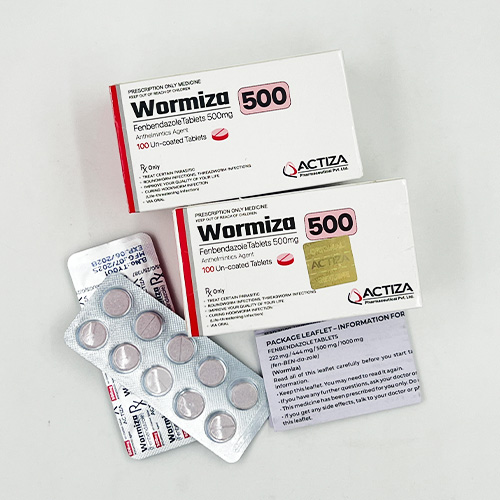
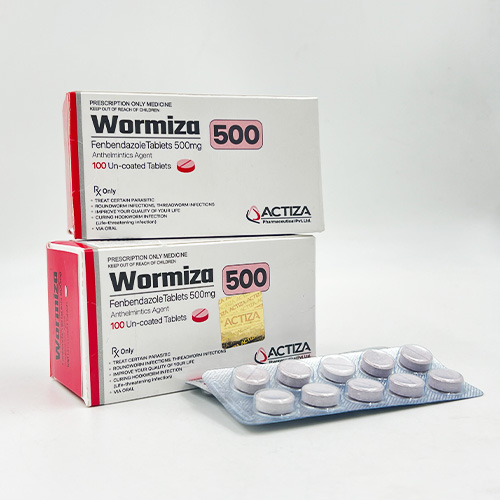
Wormiza 500 Mg (Fenbendazole)
Medically reviewed by Sanjay Gangani, B.Pharm, CMO & Pharmacist
| Active Ingredient | Fenbendazole |
|---|---|
| Indication | Treat a variety of parasites |
| Manufacturer | Actiza Pharmaceutical |
| Strength:- | 500mg |
| Packaging | 10 tablet in 1 strip |
| Dosage Form:- | Tablet |
| Country of Origin | India |


1 / 4
Wormiza 500 Mg (Fenbendazole) | ||||
|---|---|---|---|---|
| Pack Size | Price | Quantity | Add To Cart | |
| 100 Tablet/s | $44 | |||
| 200 Tablet/s | $77 | |||
| 300 Tablet/s | $105 | |||
Regulatory Status & Critical Warnings (MUST DISPLAY)
What is Wormiza 500mg?
Wormiza 500mg is a high-strength tablet that contains fenbendazole 500mg. Fenbendazole is a benzimidazole anthelmintic, meaning it is part of a drug class used to treat worms and other parasites. In animals, fenbendazole is used to treat roundworms, hookworms, whipworms, tapeworms, lungworms, and Giardia.
For humans, the situation is very different. Fenbendazole is not approved as a human medicine in major Western markets. In human use, it is considered off-label and investigational only. Approved human drugs in the same broad family include mebendazole and albendazole.
Wormiza 500mg is part of the Wormiza product family, which includes 150mg, 222mg, 444mg, 500mg, and 1000mg strengths. The 500mg version is designed for people who need a higher-strength tablet, so fewer tablets are needed in higher-dose, physician-supervised protocols.
Wormiza 500mg vs Wormiza 222mg – Key Differences:
The biggest difference is the strength per tablet. Wormiza 222mg contains 222mg of fenbendazole. Wormiza 500mg contains 500mg of fenbendazole.
This means that for a 500mg daily protocol, the 500mg tablet is more convenient because it requires only one tablet, whereas the 222mg strength would require two to three tablets. For a 1000mg dose, the 500mg version needs two tablets, while the 222mg version needs four to five tablets.
The higher strength offers better tablet-count convenience, but it also requires greater caution. A 500mg daily dose may carry more liver risk than a lower daily dose. So the 500mg strength is not simply “better.” It is just a stronger and more concentrated option.
Mechanism of Action
Fenbendazole works mainly as an antiparasitic drug. It also has some early lab research in cancer models, but those findings are still only preclinical.
Antiparasitic Mechanism (Primary):
Fenbendazole reaches the gastrointestinal tract after it is swallowed. There, it binds to beta-tubulin inside susceptible parasites. This stops tubulin polymerization, preventing the parasite from forming normal microtubules.
Microtubules are vital for parasite survival. They help with glucose uptake, cell division, nutrient movement, and cell structure.
When the parasite loses microtubule function, it cannot take up glucose well. Without enough glucose, it loses energy.
Over time, the parasite becomes weak, stops functioning, and dies. The dead worms then pass out through normal bowel movement.
At a 500mg dose, the amount of drug in the gut is higher than at a lower strength. That may increase local gut exposure, but because fenbendazole has poor absorption, its blood levels remain low.
Proposed Anticancer Mechanisms (Preclinical ONLY – Evidence Level Specified):
All the possible anticancer actions listed below are based solely on cell or animal studies. They are not proven human cancer treatments.
One proposed mechanism is beta-tubulin disruption, the same basic process behind its antiparasitic use. In lab studies, this may disturb the mitotic spindle in cancer cells. This has been studied in lung, colorectal, and pancreatic cell lines. Evidence level: in vitro plus animal, not human.
Another proposed mechanism is glycolysis inhibition, especially through GLUT1 downregulation. This may reduce glucose uptake in cancer cells. This has been studied in colorectal, lung, and liver cancer cells. Evidence level: in vitro only.
There are also reports of p53 reactivation, which may push cancer cells toward apoptosis, or programmed cell death. This has been studied in colorectal and lung cancer cells. Evidence level: in vitro only.
Other proposed preclinical actions include proteasomal inhibition, ferroptosis induction, HIF-1alpha downregulation, and inhibition of the Wnt/beta-catenin pathway. These findings are interesting for research, but none of them prove that fenbendazole works as a cancer treatment in humans.
Critical Pharmacokinetic Limitation for Cancer Use:
The biggest scientific problem is bioavailability. Fenbendazole has very poor water solubility, around 0.2 mg/L. As a result, its oral absorption is very poor. Even if a person takes 500mg by mouth, the amount that reaches the bloodstream may stay low.
That creates a major problem for cancer use. A lab dish can expose cancer cells directly to a set drug level.
But in a human body, the drug must be absorbed, carried in the blood, and reach the tumor in an adequate amount. With fenbendazole, that is very uncertain. This is the main reason why its lab results cannot simply be treated as proof of human cancer benefit.
Other Dosage
Dosage – What Is Known
Commonly Discussed Dosage Patterns (Anecdotal / Off-Label Only):
One conservative off-label pattern is 500mg once daily for 3 to 5 days. This is often discussed in the context of intestinal parasites and is loosely based on veterinary-style thinking and comparisons with single-tablet human benzimidazole practice.
A more extended pattern sometimes discussed is 500mg once daily for 5 to 7 days. This is still not validated in human clinical trials.
In investigational cancer-related discussions, one pattern is 500mg once daily, 3 days on and 4 days off. Another higher pattern is 1000mg, 3 days on and 4 days off, which would mean two 500mg tablets per dosing day. These patterns are based solely on anecdotal use. They are not clinically validated.
Some people also discuss 500mg every 3 to 6 months for periodic deworming, but again, there is no standard human schedule for fenbendazole periodic use.
Administration Notes:
Fenbendazole should be taken with a fatty meal. This is important because it has very poor water solubility. Fatty foods such as olive oil, avocado, full-fat milk, or fatty fish may help improve absorption.
Some anecdotal protocols combine it with supplements such as vitamin E succinate, curcumin, or CBD oil, but these combinations are not clinically validated.
Do not combine fenbendazole with metronidazole, because there is concern for severe skin reactions such as Stevens-Johnson syndrome in the benzimidazole class.
Do not raise the dose without medical supervision. Higher doses increase the risk of liver toxicity.
Liver tests should be done before starting, then again at about 2 weeks and 4 weeks, and monthly if treatment continues. Stop immediately and seek medical help if there is jaundice, dark urine, unusual fatigue, or right upper abdominal pain.
Safety Information
The most important safety concern with Wormiza 500mg is the risk to the liver. At this higher strength, extra caution is needed. Human data are limited, so every use should be treated carefully.
Fenbendazole has a long history in veterinary medicine, but its human safety is not well defined. At 500mg, the level of caution should be higher than with smaller strengths.
Side Effects
Reported side effects in humans come mainly from case reports and anecdotal use, rather than from large, formal trials.
Commonly reported problems include nausea, vomiting, abdominal pain, cramping, diarrhea, fatigue, and raised liver enzymes. These may be more likely at 500mg or higher.
The most serious known problem is drug-induced liver injury. Published case material shows that serious liver injury can happen in people taking fenbendazole. That is why liver tests are not optional with this product.
A second concern is possible bone marrow suppression, especially with prolonged higher-dose use. This is better known in the wider benzimidazole class than in strong fenbendazole human trial data, but it still matters enough that CBC monitoring should be considered for longer use.
Skin rash or hypersensitivity may also happen, though these appear to be less common.
Contraindications & Cautions
Wormiza 500mg should be used only with strong care. The lack of approved human dosing and the real liver risk mean it is not a casual product.
Absolute Contraindications:
Do not use Wormiza 500mg if there is:
Use With Caution (Medical Supervision Required):
These groups may have different absorption, interaction, or toxicity risk, and should not use this product without a full medical review.
Extra caution is needed in:
Drug Interactions
Several interactions matter with fenbendazole:
Storage & Handling
Store Wormiza 500mg below 25°C. Keep it away from moisture, heat, and direct sunlight. Keep the tablets in the original blister pack or sealed package.
Do not store in the bathroom. Keep out of reach of children and pets. Do not use after the expiry date.
Conclusion
Wormiza 500mg is a high-strength fenbendazole tablet from the benzimidazole class. It is made as a pharmaceutical-grade human tablet, but it is not approved for human use by the FDA, EMA, TGA, or Health Canada.
Its main known action is antiparasitic, especially in the gastrointestinal tract. There are also preclinical cancer findings, but these remain only lab and animal findings, not proven human treatment.
The biggest practical issue is poor absorption, and the biggest safety issue is liver toxicity.
The most important message is simple: there is no standard human dose for Wormiza 500mg, and higher-strength formulations require greater caution.
Any human use must be under medical supervision with proper liver monitoring. It should never replace approved first-line human treatments when those are available and appropriate.
FAQ
Q1: Is fenbendazole 500mg safe for humans?
Ans:- Fenbendazole lacks completed human clinical trial data at any dose. At 500mg – above the commonly discussed 222mg dose liver toxicity risk is expected to be higher. Published case reports document drug-induced liver injury (DILI) in humans taking fenbendazole. Liver function tests (ALT, AST) before and during use are essential. Medical supervision is mandatory.
Q2:- Why should I take fenbendazole with fatty food?
Ans:- Fenbendazole has very poor water solubility – approximately 0.2mg per litre. Taking it with a fatty meal (olive oil, full-fat milk, avocado, fatty fish) significantly increases oral absorption. Without dietary fat, most of the 500mg dose may remain in the GI tract with negligible systemic absorption, limiting any effect beyond local GI antiparasitic action.
Q3:- Can fenbendazole 500mg treat cancer?
Ans:- No. There is no clinical trial evidence that fenbendazole treats cancer in humans at any dose. Preclinical studies (cell cultures, animal models) show interesting anti-cancer mechanisms, but these have not been validated in human trials. Do not substitute fenbendazole for standard oncology treatment. The Joe Tippens case cannot be attributed to fenbendazole alone due to concurrent pembrolizumab use.
Q4:- Do I need liver tests when taking Wormiza 500mg?
Ans:- Yes, liver function monitoring is mandatory for all fenbendazole human use, and especially important at the higher 500mg dose. A baseline ALT/AST/ALP/bilirubin panel before starting is essential. Recheck at 2 weeks, 4 weeks, then monthly during use. Stop immediately if liver enzymes rise significantly or if liver symptoms appear (jaundice, dark urine, fatigue, right upper abdominal pain).

B.Pharm, CMO & Pharmacist
Licensed pharmacist (B.Pharm) with 12+ years in clinical pharmacy and patient care. Reviews every article for evidence-based accuracy before it is published on ACTIZA Store.
Reviews
There are no reviews yet.