

Loading cart...
Wormiza 150 Mg (Fenbendazole)
Medically reviewed by Sanjay Gangani, B.Pharm, CMO & Pharmacist
| Active Ingredient | Fenbendazole |
|---|---|
| Indication | Treat a variety of parasites |
| Manufacturer | Actiza Pharmaceutical Pvt. Ltd. |
| Strength:- | 150mg |
| Packaging | 10 tablet in 1 strip |
| Dosage Form:- | Tablet |
| Country of Origin | India |
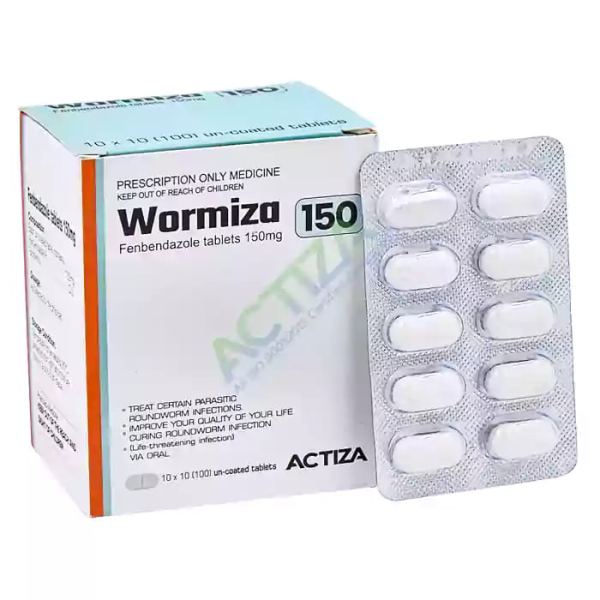
Wormiza 150 Mg (Fenbendazole) | ||||
|---|---|---|---|---|
| Pack Size | Price | Quantity | Add To Cart | |
| 100 Tablet/s | $18 | |||
| 200 Tablet/s | $35 | |||
| 300 Tablet/s | $45 | |||
| 500 Tablet/s | $70 | |||
What Is Wormiza 150 Mg?
Wormiza 150 Mg is a tablet with fenbendazole 150 mg. Fenbendazole is a worm medicine in the benzimidazole class. It is in the same group as albendazole and mebendazole.
Those two are approved for humans. Fenbendazole is not approved for human use by the FDA or EMA. In many countries, it is treated as a worm medicine for animals.
Fenbendazole has been used in animals since the 1970s. It is used in dogs, cats, horses, cattle, sheep, pigs, and other animals. It is known because it works against many animal parasites. But use in animals does not mean it is an approved human medicine.
The Benzimidazole Drug Class – Where Fenbendazole Fits
Fenbendazole is part of the benzimidazole drug group. This is a well-known group of worm medicines. Drugs in this group work similarly. They harm parasite cells by acting on tubulin and microtubules.
The big difference is not the drug group. The big difference is approval and human research. Albendazole is approved for the treatment of important human infections. Mebendazole is approved for common worm infections, including roundworm, whipworm, hookworm, and pinworm. Both are also on the WHO essential medicines list. Fenbendazole is in the same family, but it does not have the same human approval.
How Fenbendazole Works (Mechanism of Action)
Fenbendazole works in the same broad way as other benzimidazole drugs. It disrupts the parasite’s cell structure and reduces its energy. That is how it kills worms.
Primary Mechanism – Beta-Tubulin Binding and Microtubule Disruption
Fenbendazole binds to beta-tubulin in parasite cells. This stops the making of microtubules. Microtubules are needed for cell division, cell shape, and the movement of materials inside the cell. When the parasite cannot make them, its cell system starts to break down.
The drug also reduces glucose uptake. This means the parasite gets less energy. Over time, it loses structure and energy, then dies.
Why This Mechanism Has Selectivity for Parasites over Mammalian Cells
Humans also have tubulin, so a common question is why fenbendazole harms parasites more than it harms human cells. The answer is selectivity. Fenbendazole binds better to parasite tubulin than to human tubulin. That is why it mainly acts on parasites at usual worm-treatment levels.
But this is not perfect. At very high levels, human cells may also be affected. That is why people worry about risks such as bone marrow problems with long or high off-label use.
The ‘Poor Absorption’ Feature – Important for Intestinal Parasite Targeting
Fenbendazole has poor oral absorption and poor water solubility. This can look like a weakness. But for parasites in the gut, it can help. The drug can stay in the intestine, where many worms live, without needing high blood levels.
This helps explain why fenbendazole has worked well in animals against many intestinal parasites, even though its human whole-body drug profile remains unclear.
Antiparasitic Spectrum – What Parasites Does Fenbendazole Target?
Fenbendazole has a broad spectrum of veterinary parasites, especially gut parasites. It is best known for action against many nematodes, some tapeworms, and a small number of protozoa.
Nematodes (Roundworms) – Veterinary Indications
Animal references describe actions against roundworms, such as Toxocara; hookworms, such as Ancylostoma; whipworms, such as Trichuris; strongyles; strongyloides-like worms; and several livestock worms. These are common targets in dogs, cats, horses, cattle, sheep, and pigs.
There was also an old human study from 1976 on Trichuris, Ascaris, and hookworm. People sometimes mention it because it is one of the few human parasite studies. But it was small and old. It is not enough to make fenbendazole an approved human medicine.
Cestodes (Tapeworms) – Veterinary Indications
Fenbendazole works against some Taenia tapeworms in animals. But that does not mean it covers all tapeworms well. In human care, other medicines are usually preferred for tapeworm treatment.
Protozoa – Limited Activity
Fenbendazole has some animal uses for the treatment of Giardia in dogs and cats. The evidence is weaker than for worm infections, and it is not a standard first-choice human Giardia treatment. In people, approved medicines are preferred.
Pharmacokinetics – What Is Known About Fenbendazole in Humans
Human pharmacokinetic data for fenbendazole are limited. This is one of the biggest gaps in the topic. Unlike approved human drugs, fenbendazole has not undergone the usual large-scale human studies for dose-finding, blood-level testing, and long-term safety.
What is known suggests that fenbendazole has poor oral absorption and poor water solubility. This helps explain why it may work better in the gut than as a drug that needs strong whole-body exposure.
Human liver metabolism also matters. A 2013 PubMed-listed study found that CYP2J2 and CYP2C19 are major enzymes in fenbendazole metabolism in human liver microsomes. This means drug interactions are possible, and blood levels may change based on enzyme activity and other medicines.
Some later summaries also discuss a newer human-specific metabolic pattern, in which humans may produce more aminofenbendazole, while animals may produce more oxfendazole-like active metabolites. That exact newer claim is harder to prove from strong primary published sources, so it should be treated carefully.
Other Medicine:-
Dosage Information – Veterinary Reference & Human Context
There are no official FDA or EMA human dose guidelines for fenbendazole. That is the most important dosing fact. Any discussion of human doses is off-label, non-standard, and not supported by modern approval data.
Animal dosing is easier to define. In dogs, a common reference is about 50 mg/kg once daily for 3 to 5 days for several intestinal parasites and Giardia-related use. Other animal species use different dose plans based on the parasite and the animal.
Human use is much less clear. Online discussions often mention daily doses such as 150 mg, 222 mg, 300 mg, or 444 mg, as well as different cycle plans. These are anecdotal reports. They have not been proven in human clinical trials. They should not be presented as approved treatment plans.
How to Take – General Guidance
If a doctor has decided to use fenbendazole off-label, the simple advice is to take it with food, because food may help absorption. Swallow the tablet whole with water. Do not use veterinary pastes, animal granules, or large-animal products instead of a pharmaceutical tablet.
If the course is long, liver monitoring should be planned. Alcohol should be avoided because both alcohol and fenbendazole can stress the liver.
Safety Profile & Side Effects
Fenbendazole has a long animal safety record, but human safety is less clear because formal human trials are limited. The biggest human safety concern is liver injury. Published case reports describe serious drug-induced liver injury in people who used fenbendazole off-label. The liver tests improved after the drug was stopped.
Commonly Reported Side Effects – Mild (Human Anecdotal + Regulatory Data)
Commonly reported mild problems include nausea, vomiting, stomach pain, cramps, diarrhea, and raised liver enzymes. These effects are usually mild and may improve when the tablet is taken with food.
Serious Adverse Effects – Important Safety Information
The most important serious risk is hepatotoxicity, which means liver injury. Baseline and repeat ALT, AST, and bilirubin tests are important during any off-label use, especially if treatment goes beyond a short time.
A second concern is possible bone marrow suppression with long or high exposure. This is better described in animal use and as a class concern than in strong human data, but it is still important enough that CBC monitoring should be considered for longer courses. Severe skin reactions and allergy-type reactions are also possible.
Warnings & Precautions
Several warnings must be clear. Fenbendazole is not approved for human use by the FDA or EMA. People with liver disease should avoid it or use it only with a specialist review.
It should be avoided in pregnancy because benzimidazole drugs have shown embryo harm in animal work. Breastfeeding safety is not established. Use in children has no standard human dosing basis.
Drug interaction caution also matters. Human metabolism studies show roles for CYP2C19 and CYP2J2, and review articles also discuss wider enzyme involvement. This means other medicines may raise or lower fenbendazole levels. People taking warfarin, CYP-active drugs, or many prescription medicines should have a full medication review before any off-label use.
Another major safety point is formulation. Veterinary formulations should not be used in people. Animal pastes, granules, and suspensions may contain ingredients and strengths not meant for human use.
Fenbendazole vs Human-Approved Benzimidazoles – Clinical Comparison
For a confirmed human parasite infection, albendazole and mebendazole are the better choices. They are approved for human use, well studied, and supported by treatment guidelines. MedlinePlus lists clear human uses for both, and WHO includes them on the essential medicines list.
In simple terms, fenbendazole is in the same drug family and works in a similar broad way, but it does not have human approval or strong modern human trial data.
Albendazole is the more systemic human benzimidazole and is used for several tissue-stage infections. Mebendazole is a strong human option for common intestinal worms and has lower absorption, so it acts more in the gut.
Storage Instructions
Store Wormiza 150 Mg below 30°C. Keep it away from heat, moisture, and direct sunlight. Keep the tablet in its original blister pack until use. Keep it out of reach of children. Check the expiry date before use. Unused tablets should be returned to a pharmacist whenever possible, rather than thrown into regular household waste.
Conclusion
Wormiza 150 Mg is a fenbendazole 150 mg tablet from the benzimidazole drug class. It works by binding to beta-tubulin, damaging parasite microtubules, and lowering the parasite’s energy supply.
This is the same broad class action seen with human-approved benzimidazoles such as albendazole and mebendazole.
The two most important facts are simple. First, fenbendazole is not approved for human use by the FDA or EMA. Second, human liver injury has been reported, so monitoring is important in any off-label use.
For confirmed human parasite infections, approved benzimidazoles such as albendazole and mebendazole remain the proper first-line choices.
FAQ
Q1:- Is fenbendazole approved for human use?
Ans:- No. Fenbendazole is not approved by the US FDA or EMA for human use. It is a veterinary drug. For humans, albendazole or mebendazole are approved alternatives.
Q2:- Is fenbendazole the same as albendazole or mebendazole?
Ans:- They belong to the same benzimidazole class and work similarly, but differ in absorption, clinical use, and approval. Only albendazole and mebendazole are approved for humans.
Q3:- Can fenbendazole treat cancer?
Ans:- No proven evidence in humans. Only early lab studies exist. No clinical trials confirm it as a cancer treatment.
Q4:- Why use Wormiza 150mg instead of veterinary fenbendazole?
Ans:- Wormiza 150mg is pharmaceutical-grade with accurate dosing and quality control, unlike veterinary products which may be unsafe for human use.
Q5:- Do I need a prescription for Wormiza 150mg?
Ans:- Yes. A valid doctor’s prescription is required as it is investigational for human use and needs medical supervision.

B.Pharm, CMO & Pharmacist
Licensed pharmacist (B.Pharm) with 12+ years in clinical pharmacy and patient care. Reviews every article for evidence-based accuracy before it is published on ACTIZA Store.
Reviews
There are no reviews yet.