

Loading cart...
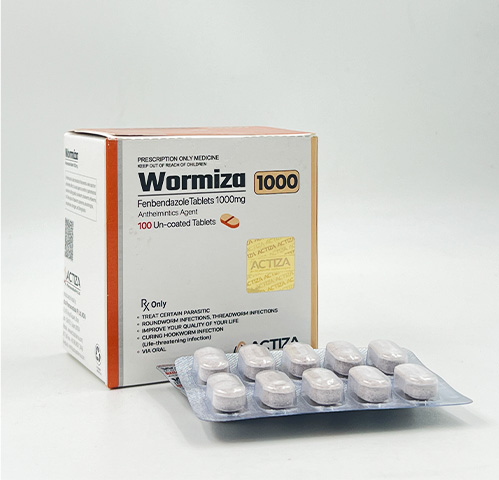
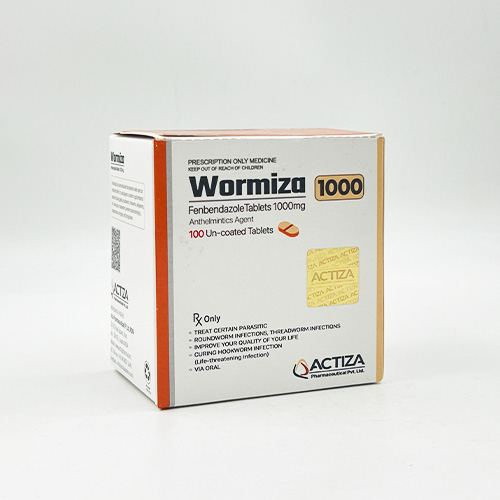
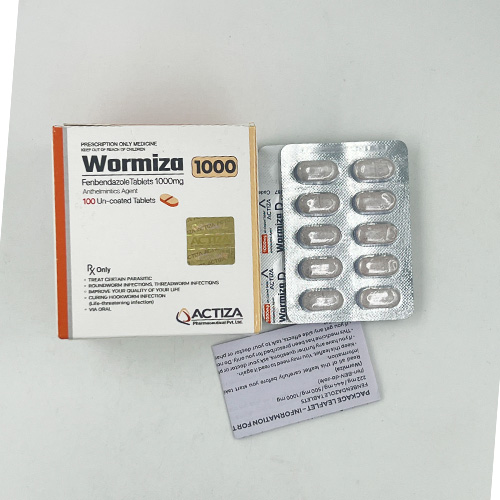
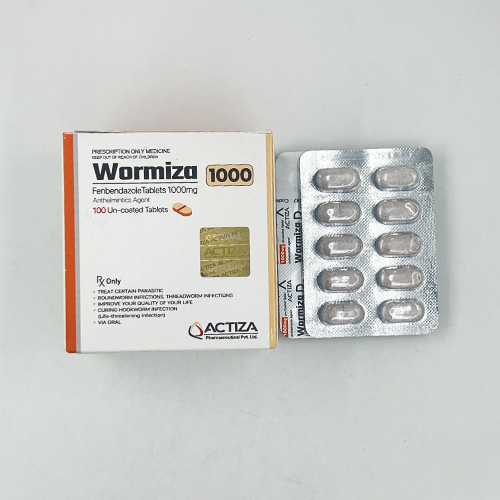
Wormiza 1000 Mg (Fenbendazole)
Medically reviewed by Sanjay Gangani, B.Pharm, CMO & Pharmacist
| Active Ingredient | Fenbendazole |
|---|---|
| Indication | Treat a variety of parasites |
| Manufacturer | Actiza Pharmaceutical Pvt. Ltd. |
| Strength:- | 1000mg |
| Packaging | 10 tablet in 1 strip |
| Dosage Form:- | Tablet |
| Country of Origin | India |
1 / 4
Wormiza 1000 Mg (Fenbendazole) | ||||
|---|---|---|---|---|
| Pack Size | Price | Quantity | Add To Cart | |
| 100 Tablet/s | $60 | |||
| 200 Tablet/s | $108 | |||
| 300 Tablet/s | $145 | |||
Regulatory Status & Critical Warnings (MUST DISPLAY)
No fixed human dose exists. There is no approved human dosing guide for fenbendazole at 500mg or at any other strength. The 500mg tablet is a higher-strength option, so it should not be used casually or without medical review.
Liver safety is a major concern. Human case reports have described serious liver injury in people who used fenbendazole. Because Wormiza 500mg gives a higher dose than smaller strengths, liver risk may be higher. Baseline liver tests such as ALT, AST, ALP, and bilirubin should be checked before use and then checked again during treatment. Anyone with existing liver disease should not use this product.
What is Wormiza 500mg?
Wormiza 500mg is a high-strength fenbendazole tablet. Fenbendazole belongs to the benzimidazole drug group. This is the same broad family as mebendazole and albendazole, which are approved for human use in many worm infections.
In animals, fenbendazole is widely used against parasites such as roundworms, hookworms, whipworms, tapeworms, lungworms, and Giardia.
In humans, however, fenbendazole does not have the same approval status. Its use remains off-label and investigational only.
Wormiza 500mg is part of the wider Wormiza range, which also includes 150mg, 222mg, 444mg, and 1000mg strengths. The 500mg version is mainly useful where a higher-strength tablet is preferred, because it reduces the total number of tablets needed in higher-dose off-label protocols.
Wormiza 500mg vs Wormiza 222mg – Key Differences:
The main difference is simple: Wormiza 222mg gives 222mg of fenbendazole per tablet, while Wormiza 500mg gives 500mg per tablet.
That means the 500mg tablet is more convenient for people using 500mg-level or 1000mg-level off-label plans, because fewer tablets are needed. For example, a 1000mg dose would need two 500mg tablets, but around four to five 222mg tablets.
Even so, more strength does not automatically mean a better choice. A 500mg daily dose may bring a higher side effect burden, especially for the liver. So the 500mg version is mostly about dose convenience, not lower risk.
Mechanism of Action
Fenbendazole is mainly known as an antiparasitic agent. It also appears in some preclinical cancer discussions, but those are still early-stage findings only.
Antiparasitic Mechanism (Primary):
After it is swallowed, fenbendazole reaches the digestive tract. There, it binds to beta-tubulin inside susceptible parasites. This blocks the normal formation of microtubules.
Microtubules are very important for parasite survival. They help with glucose uptake, cell division, movement of nutrients, and cell structure.
Once fenbendazole disrupts this system, the parasite can no longer use glucose well. Without glucose, it loses energy. As the energy supply drops, the parasite weakens, stops functioning, and eventually dies.
The dead parasite is then removed naturally through bowel movement. At the 500mg strength, the amount of fenbendazole in the gut is greater than with smaller tablets, so local intestinal exposure is also greater. Even so, the drug still has poor absorption into the bloodstream.
Proposed Anti-Cancer Mechanisms (Preclinical ONLY – Evidence Level Specified):
All proposed anti-cancer actions for fenbendazole come from lab studies or animal work only. These are not proven human cancer effects.
One proposed action is beta-tubulin disruption, which may disturb the internal spindle structure that cancer cells use for division. This has been studied in lung, colorectal, and pancreatic cell lines. Evidence level: cell studies plus animal studies.
Another suggested action is reduced glucose use, sometimes linked to GLUT1 downregulation. This has been explored in colorectal, lung, and liver cancer cells. Evidence level: cell studies only.
Some early studies also suggest effects on the p53 pathway, proteasome activity, ferroptosis, HIF-1alpha signalling, and the Wnt/beta-catenin pathway. These findings are useful for research discussion, but they do not prove that fenbendazole is an effective cancer treatment in people.
Critical Pharmacokinetic Limitation for Cancer Use:
The biggest scientific problem is poor bioavailability. Fenbendazole has very low water solubility, so only a limited amount is absorbed after oral use.
This matters a lot for cancer discussions. A lab study can place a drug directly onto cells at a chosen concentration. But in a human body, the drug must be absorbed, survive metabolism, travel in the blood, and reach the tumor in an amount.
With fenbendazole, that whole process is uncertain. This poor absorption is one of the main reasons why its lab findings cannot be treated as proof of real human cancer benefit.
Other Dosage
Dosage – What Is Known
There is no approved human dose for fenbendazole. All dose patterns discussed in public use are based on anecdotal reports, informal practice, or loose comparison with veterinary or benzimidazole use. They are not official medical guidelines.
Commonly Discussed Dosage Patterns (Anecdotal / Off-Label Only):
One commonly discussed off-label pattern is 500mg once daily for 3 to 5 days, especially in discussions around intestinal parasites.
Another pattern is 500mg once daily for 5 to 7 days, usually mentioned when people talk about persistent or mixed worm burden.
In cancer-related off-label discussions, some people mention 500mg daily using a 3-day-on, 4-day-off cycle. Others mention 1000mg using the same 3-on, 4-off pattern, which would mean two 500mg tablets on each dosing day.
Some users also discuss intermittent deworming schedules, such as one tablet every few months, but there is no validated human schedule for this.
Administration Notes:
Fenbendazole is usually discussed as best taken with a fatty meal, because fat may help improve absorption. Common examples include olive oil, avocado, full-fat dairy, or oily fish.
Some anecdotal protocols combine it with supplements such as vitamin E succinate, curcumin, or CBD oil. Still, these combinations are not clinically proven and do not have clear human safety data.
Do not mix fenbendazole with metronidazole, because there is concern about severe skin reactions in the wider benzimidazole class.
Do not increase the dose without medical advice. More drugs mean more risk, especially for the liver.
Liver testing should be done before use, then repeated at about 2 weeks, 4 weeks, and then monthly if treatment continues. Stop at once and seek medical help if there is yellow skin or eyes, dark urine, unusual tiredness, or pain in the upper right side of the abdomen.
Safety Information
Wormiza 500mg needs careful handling because human safety data are still limited. The biggest known concern is liver injury. That is why this strength should never be treated as a routine self-medication product.
Higher-strength use may also raise the chance of stomach side effects and other unwanted reactions. Medical supervision is especially important with this 500mg version.
Side Effects
Known side effects in humans come mainly from case reports and off-label user reports, not from large formal studies.
Commonly reported problems include nausea, vomiting, stomach pain, cramps, diarrhea, fatigue, and raised liver enzymes. These may be more likely at 500mg than at lower doses.
The most serious known problem is drug-induced liver injury. This is the clearest major safety issue seen in human reports. Skin rash or allergic-type reactions may also occur.
Contraindications & Cautions
This product should be used only with strong caution because there is no approved human dosing standard, and there is a real liver risk.
Absolute Contraindications:
Do not use Wormiza 500mg if there is:
These groups may have a higher risk from altered absorption, interactions, or organ stress.
Extra care is needed in:
Drug Interactions
Important drug interactions include:
Storage & Handling
Store Wormiza 500mg below 25°C. Keep it away from heat, moisture, and direct sunlight. Keep the tablets in the original pack until use. Do not store in the bathroom. Keep away from children and pets. Do not use after the expiry date.
Conclusion
Wormiza 500mg is a high-strength fenbendazole tablet from the benzimidazole group. It is made as a pharmaceutical-grade tablet, but it is not approved for human use by the FDA, EMA, TGA, or Health Canada.
Its best-known action is antiparasitic, especially in the digestive tract. There are also preclinical cancer findings, but these are still only early research results, not proven human treatment evidence. The biggest medical concern with this strength is liver toxicity, and the biggest scientific limit is poor absorption..
FAQ
Q1:- Why do people use fenbendazole 1000mg?
Ans:- The 1000mg dose became widely known through the Joe Tippens case a cancer patient who reportedly achieved complete remission while also receiving pembrolizumab (Keytruda) immunotherapy. The 1000mg single dose matches the tablet dose in his anecdotal protocol. People also use it for intestinal parasites where approved alternatives are unavailable or have failed.
Q2:- How does Wormiza 1000mg work against parasites?
Ans:- Fenbendazole binds to β-tubulin in parasitic worms, blocking microtubule assembly. Without microtubules, parasites cannot absorb glucose their primary energy source. They become immobilized and die within 24-72 hours, then pass in stool. At 1000mg, gastrointestinal drug concentration is maximised for local antiparasitic effect; systemic absorption remains limited without fatty food.
Q3:- Why must I take fatty food with Wormiza 1000mg?
Ans:- Fenbendazole has extremely poor water solubility (~0.2mg per litre). Without dietary fat to enhance GI absorption, the vast majority of the 1000mg dose may pass through the GI tract with minimal systemic uptake. Fatty food significantly increases fenbendazole’s bioavailability by enhancing micellar solubilization in the intestinal lumen. This is critical at 1000mg to achieve any measurable plasma levels.
Q4:- Can I take Wormiza 1000mg with chemotherapy?
Ans:- Not without explicit oncologist approval. Drug-drug interactions between fenbendazole and chemotherapy agents are completely unstudied in humans. Additionally, both fenbendazole and many chemotherapy drugs are hepatotoxic — combination at 1000mg could significantly increase liver injury risk. Your oncologist must evaluate the safety of this combination for your specific regimen before you proceed.

B.Pharm, CMO & Pharmacist
Licensed pharmacist (B.Pharm) with 12+ years in clinical pharmacy and patient care. Reviews every article for evidence-based accuracy before it is published on ACTIZA Store.
Reviews
There are no reviews yet.