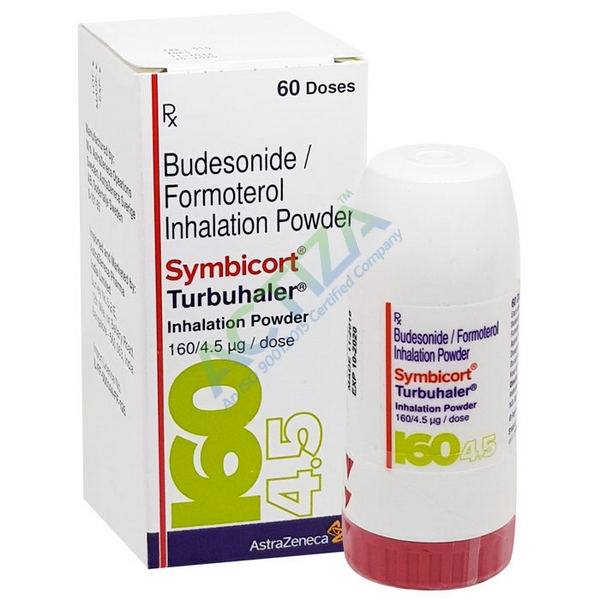
Symbicort Turbuhaler 160 mcg (Budesonide/Formoterol) Medically reviewed by Sanjay Gangani, B.Pharm, CMO & Pharmacist
Active Ingredient Budesonide/Formoterol Indication used in the treatment of asthma and chronic obstructive pulmonary disease Manufacturer AstraZeneca Pharma India Ltd Strength:- 160mcg Packaging 60 MDI in a Turbuhaler
INQUIRE ABOUT Symbicort Turbuhaler 160 mcg (Budesonide/Formoterol)
What is Symbicort Turbuhaler 160? Symbicort Turbuhaler is a combination inhaler for the lungs.
Each delivered dose gives budesonide 160 micrograms.
It also gives formoterol fumarate dihydrate 4.5 micrograms.
Budesonide is a corticosteroid that reduces inflammation.
Formoterol is a long-acting beta-2 agonist that opens airways.
It is marketed in India by AstraZeneca Pharma India Ltd.
The device is a dry powder inhaler, not a pressurised spray.
Regular Symbicortturbuhaler 80 Mcg treatment in people aged 12 and over.
That applies where a steroid and long-acting bronchodilator suit.
It suits those not controlled on a steroid plus a reliever.
It also suits those already controlled on both as separate inhalers.
It is also licensed as reliever therapy in mild asthma from age 12.
It is licensed for COPD symptoms in adults aged 18 and over.
That COPD use requires reduced lung function and past flare-ups.
How Symbicort Works (Mechanism of Action) Two medicines with different jobs:
Budesonide calms the inflammation that swells the airway lining.
That reduces symptoms and the number of flare-ups over time.
Formoterol relaxes the muscle bands around the airways.
That opens the airways and eases breathing quickly.
Together they add up to fewer asthma attacks than either alone.
Why this combination can also relieve symptoms:
Formoterol begins working within 1 to 3 minutes.
Its effect lasts at least 12 hours after one dose.
That speed lets the same inhaler be used for relief in some plans.
The label calls this an anti-inflammatory reliever .
Budesonide reaches peak blood levels within 30 minutes.
Formoterol reaches peak blood levels within 10 minutes.
Budesonide is broken down mainly by the liver enzyme CYP3A4.
Dosage Guide – Three Different Regimens Your doctor chooses one regimen. Do not mix them up.
Regimen Maintenance Dose For Symptoms Key Rule Maintenance only, adults 18+ 1 to 2 inhalations twice daily Use a separate reliever inhaler Maximum 4 inhalations twice daily Maintenance only, ages 12 to 17 1 to 2 inhalations twice daily Use a separate reliever inhaler Carry that reliever at all times Maintenance and reliever, 12+ 2 inhalations per day 1 extra inhalation as needed Same inhaler for both purposes If symptoms persist Not applicable Take 1 more after a few minutes Never more than 6 at one time Reliever only, mild asthma, 12+ None 1 inhalation as needed Never more than 6 at one time B and C daily limit Not applicable Not applicable Over 8 a day means seek advice B and C absolute limit Not applicable Not applicable Up to 12 a day only briefly COPD, adults 18 and over 2 inhalations twice daily As your doctor directs Not licensed under 18 Children 6 to 11 years A lower strength exists As prescribed The 100/6 strength, maintenance only Children under 6 years Not recommended Not applicable Only limited data available Children under 12 years Not for regimens B or C Not applicable Reliever use is not recommended
Which regimen carries which reliever:
On regimen A, always carry a separate rapid-acting reliever.
On regimens B and C, the Symbicort inhaler is the reliever.
Always have the right rescue inhaler with you.
Symbicort is not intended for the initial management of asthma.
Do not start it during a flare-up or while asthma is deteriorating.
Once control is achieved, the dose is reduced to the lowest effective one.
Do not stop it abruptly; the dose should be tapered.
Every asthma patient should have a written action plan.
How to Use the Turbuhaler Read the instruction leaflet packed with each inhaler.
The device releases powder as you breathe in.
Breathe in forcefully and deeply through the mouthpiece.
Never breathe out through the mouthpiece.
Replace the cover after every use.
Rinse your mouth with water after your maintenance dose.
Spit the water out rather than swallowing it.
Two points that worry new users:
You may not taste or feel anything when you inhale.
That is normal, because the powder amount is very small.
If thrush develops, also rinse after any as-needed doses.
Take your maintenance dose even when you feel well.
Keep the correct rescue inhaler available at all times.
Tell your doctor if you need more inhalations than usual.
Precautions Contraindication Allergy to budesonide, formoterol or lactose.
The lactose contains small amounts of milk protein.
That protein may cause allergic reactions.
Conditions Needing Caution An overactive thyroid, or a tumour called phaeochromocytoma.
Diabetes, which may need extra blood sugar checks.
Untreated low blood potassium.
Certain heart muscle and heart valve conditions.
Severe high blood pressure or an aneurysm.
Ischaemic heart disease, fast heart rhythms or severe heart failure.
A prolonged QT interval on a heart tracing.
Active or past tuberculosis of the lungs.
Fungal or viral infections of the airways.
Recent or current treatment with steroid tablets.
Medicines to Avoid or Discuss Beta-blockers, including eye drops, which oppose formoterol.
They should not be given together without compelling reasons.
Strong CYP3A4 inhibitors such as itraconazole and ritonavir.
Also ketoconazole, voriconazole, clarithromycin and others.
The reliever regimen is not recommended with those medicines.
Medicines that prolong the QT interval.
Monoamine oxidase inhibitors, which may raise blood pressure.
Xanthines, steroids and diuretics, which can lower potassium.
Before-Use Checklist Do you know which of the three regimens you are on?
Do you know whether Symbicort is also your reliever?
If not, do you carry a separate reliever inhaler?
Do you know the maximum inhalations for one day?
Are you aged 12 or over for asthma, or 18 for COPD?
Have you told your doctor about heart or thyroid conditions?
Do you take any beta-blocker, including eye drops?
Do you know to rinse your mouth after the maintenance dose?
Do you have a written asthma action plan?
Side Effects Frequencies come from AstraZeneca’s own label.
Side Effect Frequency What It Feels Like What to Do Thrush in the mouth or throat Common White patches, soreness Rinse after doses; treatable Pneumonia in COPD patients Common Fever, cough, breathlessness Seek medical assessment Headache Common Head pain Report if persistent Tremor Common Shaky hands Usually mild; settles in days Palpitations Common Awareness of the heartbeat Usually mild; settles in days Throat irritation, cough, hoarseness Common Croaky voice, throat tickle Rinse after doses; report if lasting Dizziness Uncommon Light-headedness Report if troublesome Anxiety, restlessness or sleep problems Uncommon Feeling on edge, poor sleep Tell your doctor Fast heartbeat Uncommon Racing heart Report to your doctor Blurred vision Uncommon Vision not sharp Ask for an eye assessment Nausea, bruising or muscle cramps Uncommon Various mild effects Report if persistent Low blood potassium Rare Weakness or cramps Blood tests may be needed Heart rhythm disturbances Rare Irregular heartbeat Seek medical advice promptly Allergic reactions Rare Rash, hives, swelling Emergency if breathing is affected Steroid effects on the body Very rare Often no early symptoms Doctors weigh dose and benefit Cataract or glaucoma Very rare Vision changes Eye assessment needed Paradoxical bronchospasm Very rare Wheeze worsens right after a dose Emergency – stop and seek care
About tremor and palpitations:
These are the most common effects of this drug class.
They tend to be mild and settle within a few days.
These are far less likely than with steroid tablets.
They include adrenal suppression and reduced bone density.
They include slowed growth in children and adolescents.
Children on long-term treatment should have their height monitored.
Report blurred vision, as an eye check may be needed.
Drug Interactions Avoid where possible:
Potent CYP3A4 inhibitors raise budesonide levels markedly.
They include itraconazole, ketoconazole and voriconazole.
They also include clarithromycin and HIV protease inhibitors.
If unavoidable, space the doses as far apart as possible.
Beta-blockers, including eye drops, weaken formoterol’s effect.
Quinidine, disopyramide and procainamide.
Phenothiazines, some antihistamines and tricyclic antidepressants.
Digitalis medicines, if potassium is low.
Halogenated anaesthetics used during surgery.
Monoamine oxidase inhibitors may cause a rise in blood pressure.
Levodopa, thyroxine, oxytocin and alcohol may affect heart tolerance.
Xanthines, steroids and diuretics can add to potassium loss.
Emergency Warning Signs – Seek Urgent Medical Help Seek urgent assessment if:
Your asthma or COPD suddenly and progressively worsens.
Wheezing increases immediately after an inhalation.
You cannot speak in full sentences.
Your lips or fingertips turn blue.
Your treatment becomes less effective than before.
You need more than 8 inhalations in a day.
You develop swelling of the face, lips or throat.
Symptoms stay uncontrolled after starting treatment.
You develop fever and a cough, especially with COPD.
White patches appear in your mouth or throat.
Your vision becomes blurred.
A child on long-term treatment seems to be growing slowly.
The label calls sudden deterioration potentially life-threatening.
Extra steroids or antibiotics may be needed urgently.
Why Choose Symbicort Turbuhaler? Benefits when clinically appropriate:
Two medicines in one device simplify treatment.
Formoterol works within 1 to 3 minutes and lasts 12 hours.
One inhaler can serve as both preventer and reliever.
Trials showed fewer severe flare-ups with that approach.
In one trial, patients needed no reliever on 57% of days.
The device releases powder as you breathe, needing no coordination.
AstraZeneca markets it in India through its own subsidiary.
Honest balance for the buyer:
Three regimens exist and confusing them is a real risk.
It must not be started during a flare-up.
Thrush, hoarseness, tremor and palpitations are common.
COPD patients on inhaled steroids get more pneumonia.
It is not licensed for children under 12 as a reliever.
It costs far more per dose than single-ingredient inhalers.
Storage Instructions The UK label requires no special storage conditions.
One Indian listing states storage below 30°C.
Follow the storage statement on your own pack.
Keep the cover on the inhaler between uses.
Keep the device dry.
Keep out of the reach of children.
Check the expiry date the shelf life is 3 years.
Dispose of the used inhaler as local rules require.
Sanjay Gangani
B.Pharm, CMO & Pharmacist
Licensed pharmacist (B.Pharm) with 12+ years in clinical pharmacy and patient care. Reviews every article for evidence-based accuracy before it is published on ACTIZA Store.



Reviews
There are no reviews yet.