Orcibest 10 Mg (Orciprenaline) Medically reviewed by Sanjay Gangani, B.Pharm, CMO & Pharmacist
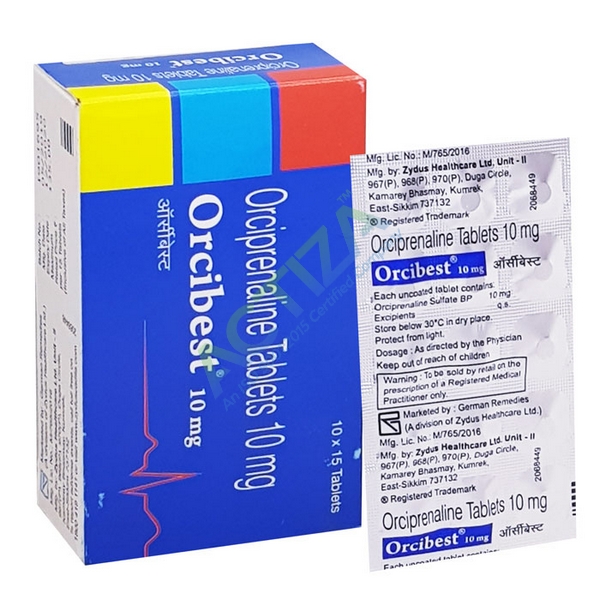
Active Ingredient Orciprenaline Indication Asthma, Chronic obstructive pulmonary disorder (COPD) Manufacturer Zydus Lifesciences Strength:- 10mg Packaging 10 tablets in 1 strip
INQUIRE ABOUT Orcibest 10 Mg (Orciprenaline)
What is Orcibest 10 mg Tablet? Orcibest 10 is a prescription bronchodilator tablet.
Each tablet contains 10 mg of orciprenaline.
Orciprenaline is also known as metaproterenol.
It is made by Zydus Healthcare Limited in Sikkim.
It is sold as a strip of 15 tablets.
It is swallowed, not inhaled.
Relieving the symptoms of asthma .
Relieving chronic obstructive pulmonary disease symptoms.
Those symptoms include wheezing, coughing and breathlessness.
It eases reversible narrowing of the airways.
It was developed from an older medicine called isoprenaline.
Newer relievers such as salbutamol act more selectively.
Asthalin Nebulizer relievers reach the lungs directly and act faster.
Guideline bodies advise against oral relievers of this type.
How Orciprenaline Works (Mechanism of Action) The action happens in four simple steps:
Bands of muscle surround the airways in the lungs.
In asthma those muscles tighten, narrowing the airway.
Orciprenaline stimulates beta-2 receptors on that muscle.
The muscle relaxes, so the airway opens and breathing eases.
The drug activates an enzyme called adenylate cyclase.
That enzyme raises a messenger chemical called cyclic AMP.
Raised cyclic AMP is what relaxes the muscle.
Why selectivity matters here:
Beta receptors also exist in the heart and elsewhere.
Orciprenaline is described as only moderately selective.
So it also stimulates receptors outside the lungs.
That explains tremor and a faster heartbeat as effects.
A swallowed tablet reaches the whole body through the blood.
An inhaler delivers the drug mainly to the lungs instead.
Dosage Guide Doses below come from United States labelling for the same molecule.
Group Labelled Dose How Often Key Note Adults 20 mg Three or four times daily Two of these tablets per dose Older adults, to start 10 mg Three or four times daily This tablet matches that dose Older adults, if needed Increased to 20 mg Three or four times daily Only if required Children over 9 years 20 mg Three or four times daily Or over 27 kilograms Children 6 to 9 years 10 mg Three or four times daily Or under 27 kilograms Children under 6 years Not recommended Not applicable Per United States labelling Missed dose Take it when you remember Skip if nearly due Never take a double dose If it stops working Do not take more Seek medical review A sign of worsening asthma With a methylxanthine Extreme care needed As prescribed See the interaction warning Regular review Progress checked at visits Ongoing Per the labelling
What this 10 mg strength corresponds to:
It is the children’s dose for ages 6 to 9 abroad.
It is also the starting dose for older adults abroad.
The usual adult dose there is double this strength.
An Indian adult may therefore be prescribed two tablets.
Only the prescriber can decide that.
Follow the dose printed on your own pack insert.
Two major asthma guideline bodies advise against oral relievers.
They cite the slow onset of action.
They also cite an increased risk of side effects.
Inhaled relievers are preferred wherever possible.
How to Take Orcibest 10 mg Swallow the tablet whole with water.
Take it at the times your doctor has set.
Space the doses evenly through the day.
Do not take extra tablets for a stronger effect.
Do not stop it suddenly without medical advice.
Keep your inhaled reliever with you if you have one.
Attend the review visits your doctor arranges.
Relief builds over a longer period than with an inhaler.
Tremor and a faster heartbeat are common at first.
Those effects usually settle as treatment continues.
A heartbeat that stays fast or feels irregular.
Chest pain or discomfort.
Breathing that becomes harder rather than easier.
Needing the medicine more often than before.
Precautions Contraindications in the Labelling Heart rhythm disturbances associated with a fast heart rate.
Known allergy to orciprenaline or any ingredient.
It says the tablet may not suit people with certain heart problems.
It names an irregular or fast heartbeat specifically.
Conditions Needing Caution Ischaemic heart disease, meaning reduced blood flow to the heart.
High blood pressure.
Any other heart rhythm problem.
Low blood potassium.
Diabetes, as blood sugar may rise.
An overactive thyroid gland.
A seizure disorder.
Being unusually sensitive to this class of medicine.
Medicines Needing Particular Care Other medicines of the same stimulant class.
The labelling calls for extreme care in that situation.
Monoamine oxidase inhibitors, or use within the last 14 days.
Tricyclic antidepressants, on the same basis.
Beta agonists were given with methylxanthines to animals.
Heart rhythm disturbances and sudden death were recorded.
Damage to heart muscle was found on examination.
What this means for people is described as unknown.
Theophylline is an example of a methylxanthine.
Before-Use Checklist Has a doctor prescribed this tablet specifically?
Do you know how many tablets make up your dose?
Do you have any heart rhythm problem?
Do you have heart disease or high blood pressure?
Do you have an overactive thyroid or diabetes?
Do you take theophylline or a similar medicine?
Do you take an antidepressant?
Have you discussed whether an inhaler would suit you better?
Side Effects Effects reported for this molecule:
Side Effect Category What It Feels Like What to Do Tremor Common Shaky hands Usually settles; report if severe Nervousness Common Feeling on edge Report if troublesome Dizziness Common Light-headedness Sit down until it passes Weakness Common Low energy Report if persistent Headache Common Head pain Report if persistent Nausea Common Queasy stomach Report if persistent Fast heartbeat Common Racing or pounding heart Report to your doctor Vomiting Reported Being sick Report if persistent Raised blood sugar Reported More thirst, more urine Diabetics need monitoring Low blood potassium Reported Weakness, cramps Blood tests may be needed Irregular heartbeat Rare but serious Fluttering or skipped beats Seek medical assessment Chest pain or discomfort Rare but serious Pain or tightness Emergency – seek care Worsening breathlessness Rare but serious Breathing harder, not easier Emergency – seek care Allergic reaction Rare Rash, swelling, breathlessness Emergency – call for help
Why a tablet causes more of these than an inhaler:
A swallowed tablet is absorbed into the bloodstream.
It then reaches the heart and muscles as well as the lungs.
An inhaler delivers most of its dose to the airways.
That is why guideline bodies prefer inhaled relievers.
No source consulted gives percentages for these effects.
Check the pack insert for the full list.
Drug Interactions Any other medicine of the same stimulant class.
Monoamine oxidase inhibitors, including recent use.
Tricyclic antidepressants, on the same basis.
Theophylline and similar breathing medicines.
Beta-blockers, which oppose the effect of this tablet.
Water tablets, which can lower potassium further.
Give your doctor a complete list of your medicines.
Include anything bought without a prescription.
Mention any inhaler you already use.
Emergency Warning Signs – Seek Urgent Medical Help Breathing that becomes suddenly much worse.
Difficulty speaking in full sentences.
Blue lips or fingertips.
Chest pain or tightness.
A markedly irregular or racing heartbeat.
Swelling of the face, lips or throat.
You need the medicine more often than before.
It does not relieve your symptoms as well as it used to.
You wake at night with breathing symptoms.
Tremor or palpitations do not settle.
It usually means the underlying condition is worsening.
A reliever treats the symptom, not the inflammation.
A preventer medicine may be needed instead.
An Honest Assessment for the Retailer It is an established bronchodilator with decades of use.
A tablet suits people who cannot manage an inhaler.
It needs no device, no technique and no coordination.
It is licensed for both asthma and COPD.
Zydus is a large, established Indian manufacturer.
It costs about 13 to 15 rupees per tablet.
The UK regulator withdrew this molecule after a risk review.
The British formulary called it less suitable for prescribing.
Two asthma guideline bodies advise against oral relievers.
Inhaled relievers act faster and cause fewer side effects.
This molecule is less selective, so it affects the heart more.
10 mg is a children’s dose in United States labelling.
It is contraindicated with fast heart rhythm problems.
Storage Instructions Store below 30°C.
Keep the tablets in a closed container.
Keep them away from heat, moisture and direct light.
Do not let them freeze.
Keep out of the sight and reach of children.
Check the expiry date before use.
Return unused tablets to a pharmacy take-back scheme.
Sanjay Gangani
B.Pharm, CMO & Pharmacist
Licensed pharmacist (B.Pharm) with 12+ years in clinical pharmacy and patient care. Reviews every article for evidence-based accuracy before it is published on ACTIZA Store.



Reviews
There are no reviews yet.