Muvera 15 Mg (Meloxicam) Medically reviewed by Sanjay Gangani, B.Pharm, CMO & Pharmacist
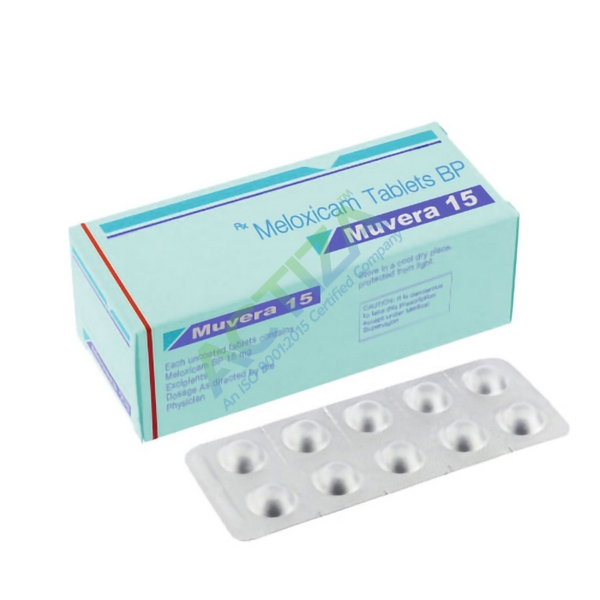
Active Ingredient Meloxicam Indication Pain relief Manufacturer Sun Pharmaceutical Industries Ltd Strength:- 15mg Packaging 10 Tablets in Strip
INQUIRE ABOUT Muvera 15 Mg (Meloxicam)
What is Muvera 15 mg Muvera 15 mg is a prescription tablet containing meloxicam 15 mg.
Meloxicam is a non-steroidal anti-inflammatory drug, or NSAID.
It reduces pain, swelling and stiffness in arthritis.
It is taken once a day, because it acts for a long time.
Muvera 15 Mg relieves symptoms; it does not slow joint damage.
It is taken for the shortest period that controls symptoms.
It is not a paracetamol-type painkiller .
It is not a steroid.
It is not a disease-modifying arthritis drug.
It is not suitable for a child of any weight.
It is not suitable for anyone on dialysis at this strength.
It is not a substitute for low-dose aspirin for the heart.
It is not to be combined with another NSAID.
How it works (mechanism of action) Step by step
Injured or inflamed tissue releases arachidonic acid.
Cyclo-oxygenase enzymes convert that into prostaglandins.
Prostaglandins widen blood vessels at the inflamed site.
They also sensitise nerve endings to pain.
And they help set the body temperature higher.
Meloxicam blocks cyclo-oxygenase, mainly the COX-2 form.
M-Cam 7.5 production at the inflamed joint falls.
Swelling, pain and stiffness therefore reduce.
Why the same mechanism causes the harms
COX-1 prostaglandins protect the stomach lining.
Blocking them reduces that protection.
That is the route to ulcers and bleeding.
Prostaglandins also help the kidney maintain blood flow.
Blocking them can reduce kidney function.
They also influence salt and water handling.
That is the route to swelling, raised blood pressure and heart strain.
A half-life of 15 to 20 hours is what allows once-daily dosing.
It also means the drug lingers for days after stopping.
Very high protein binding matters in low-albumin states.
The second peak reflects reabsorption from bile.
Dosage guide Doses are from the reference label. Only a prescriber may set yours.
Patient group or situation Dose Frequency Maximum Notes Adult, osteoarthritis 7.5 mg to start Once daily 15 mg a day Increase only if 7.5 mg is not enough Adult, rheumatoid arthritis 7.5 mg to start Once daily 15 mg a day Increase only if 7.5 mg is not enough Adult already on 15 mg 15 mg Once daily 15 mg a day This is the ceiling Patient on haemodialysis 7.5 mg Once daily 7.5 mg a day Half of this tablet; use the 7.5 mg pack Severe kidney impairment Not recommended Not applicable Not applicable Avoid unless benefit clearly outweighs risk Child weighing 60 kg or more 7.5 mg Once daily 7.5 mg a day No added benefit above 7.5 mg Child weighing under 60 kg Not indicated Not applicable Not applicable No tablet dose applies About 20 to 30 weeks pregnant Lowest effective dose Shortest duration Per prescriber Ultrasound if used beyond 48 hours About 30 weeks pregnant or later Avoid Not applicable Not applicable Risk of premature ductus closure Around coronary bypass surgery Contraindicated Not applicable Not applicable Do not use
The two strengths and what they are for
So the 7.5 mg tablet covers more situations than the 15 mg.
The 15 mg tablet covers exactly one situation, the adult step up.
Splitting a 15 mg tablet is not the labelled way to reach 7.5 mg.
A separate 7.5 mg tablet exists for that purpose.
Use the lowest effective dose.
Use it for the shortest duration consistent with treatment goals.
Review the need for it at every consultation.
The cardiovascular risk grows with dose and duration.
So does the gut risk.
How to take it Confirm the prescriber intended 15 mg, not 7.5 mg.
Confirm how many days or weeks the course should run.
Take one tablet by mouth with a glass of water.
Swallow the tablet whole; do not chew it.
Take it at about the same time each day.
Take it with or without food, as you prefer.
Take it with food if it upsets your stomach.
Stay upright for a while after taking it.
Do not take any other NSAID alongside it.
Do not take more than one tablet in 24 hours.
Report any stomach pain or black stools at once.
Food, antacids and the once-daily rhythm
The label says it may be taken without regard to meals.
A high-fat meal raises the peak level by about 22%.
Total absorption does not change with food.
Antacids have no pharmacokinetic interaction with it.
Keeping to the same time each day keeps levels steady.
Take the missed tablet when you remember it that day.
If it is nearly the next day, skip the missed tablet.
Never take two tablets in one 24-hour period.
The long half-life makes doubling up risky.
These drugs reduce inflammation and fever.
Fever and inflammation are how infections announce themselves.
So the drug can make an infection harder to spot.
Tell your doctor if you feel unwell while taking it.
Precautions Absolute contraindications Known hypersensitivity to meloxicam.
Known hypersensitivity to any component of the tablet.
Any previous anaphylaxis to meloxicam.
Any previous serious skin reaction to meloxicam.
A history of asthma after aspirin or another NSAID.
A history of hives after aspirin or another NSAID.
Any allergic-type reaction after aspirin or another NSAID.
The setting of coronary artery bypass graft surgery.
Some people react to aspirin with asthma, hives or swelling.
That group may also have nasal polyps and sinus disease.
Severe, sometimes fatal anaphylaxis has been reported in them.
For them every NSAID, including this one, is contraindicated.
Tell your prescriber about any reaction to a painkiller.
Conditions to disclose to your doctor Condition or medicine Why it matters Any previous stomach ulcer More than ten-fold higher bleeding risk Any previous gut bleed More than ten-fold higher bleeding risk Current indigestion or reflux May signal gut vulnerability Taking a corticosteroid Adds to the gut bleeding risk Taking aspirin of any dose Adds to the gut bleeding risk Taking an anticoagulant Adds to the gut bleeding risk Taking an SSRI or SNRI Adds to the gut bleeding risk Smoking Adds to the gut bleeding risk Regular alcohol use Adds to the gut bleeding risk Age over 65 Greatest risk group for gut events Any heart disease Raised risk of heart attack and stroke A recent heart attack Avoid unless benefits clearly outweigh risks Heart failure NSAIDs roughly double heart failure admissions High blood pressure Can worsen; monitor readings Any kidney disease Risk of renal insufficiency and failure Dehydration or low fluid intake Raises the kidney risk Taking a diuretic Raises the kidney risk Taking an ACE inhibitor or ARB Raises the kidney risk Any liver disease Liver enzyme rises occur in about 1% Advanced liver disease Raises the gut bleeding risk Any clotting disorder Raises the gut bleeding risk Asthma of any kind Monitor for worsening symptoms Pregnancy or possible pregnancy Week-specific restrictions apply Breastfeeding Discuss with the prescriber Planned surgery Tell the surgeon and anaesthetist
Food and drink precautions No food is forbidden; it may be taken with or without meals.
Take it with food if it causes stomach discomfort.
Avoid alcohol, which adds to the gut bleeding risk.
Drink fluids steadily, since dehydration raises kidney risk.
Reduce added salt if your ankles swell.
Watch your blood pressure if you monitor it at home.
Antacids may be taken; there is no interaction.
Do not use another over-the-counter painkiller without advice.
Many combination cold remedies contain an NSAID.
Before-use safety checklist Confirm a registered doctor prescribed meloxicam.
Confirm the prescriber chose 15 mg, not 7.5 mg.
Confirm how long the course should last.
Confirm you have never reacted badly to aspirin or an NSAID.
Confirm you are not having coronary bypass surgery soon.
Confirm you have had no recent heart attack.
Confirm you have no heart failure.
Confirm you have no previous ulcer or gut bleed.
Confirm your kidney function has been considered.
Confirm you are not on dialysis.
Confirm your blood pressure has been checked.
Confirm the prescriber knows every other medicine you take.
Confirm you are not pregnant, or know the week limits.
Confirm you are not taking another NSAID.
Confirm you know the warning signs of a gut bleed.
Confirm the expiry date and that the strip is intact.
Common and less common side effects From the 12-week osteoarthritis trial Side effect Placebo Meloxicam 7.5 mg Meloxicam 15 mg Any gastrointestinal effect 17.2% 20.1% 17.3% Diarrhoea 3.8% 7.8% 3.2% Indigestion 4.5% 4.5% 4.5% Headache 10.2% 7.8% 8.3%
From the 12-week rheumatoid arthritis trials Side effect Placebo Meloxicam 7.5 mg Meloxicam 15 mg Any gastrointestinal effect 14.1% 18.9% 16.8% Upper respiratory tract infection 4.1% 7.0% 6.5% Indigestion 3.8% 5.8% 4.0% Headache 6.4% 6.4% 5.5%
From the six-month osteoarthritis trials Side effect Meloxicam 7.5 mg Meloxicam 15 mg Any gastrointestinal effect 26.6% 24.2% Indigestion 8.9% 9.5% Upper respiratory tract infection 8.3% 7.5% Urinary tract infection 4.7% 6.9% Anaemia 4.1% 2.9%
Gastrointestinal effects rose from 12 weeks to six months.
They went from roughly 17% to roughly 25%.
That is the duration effect the boxed warning describes.
Short-term rates did not separate the two strengths clearly.
The serious events, not the common ones, drive the dose warning.
DRESS stands for drug reaction with eosinophilia and systemic symptoms.
It usually begins with fever, rash, swollen glands or facial swelling.
It can involve the liver, kidneys, blood, heart muscle or muscles.
Early signs can appear before any rash does.
Stop the drug and get assessed promptly if these occur.
Drug interactions – avoid with The pemetrexed rule is specific and strict.
Meloxicam is interrupted for at least five days beforehand.
It is also withheld on the day and for two days afterwards.
It is not recommended if creatinine clearance is below 45.
Monitoring applies if clearance is 45 to 79.
Every prescription medicine you take.
Every over-the-counter painkiller or cold remedy.
Any blood thinner or antiplatelet tablet.
Any herbal or ayurvedic joint preparation.
Any steroid tablet, injection or inhaler.
Emergency warning signs Only about one in five patients gets a warning symptom first.
So four in five serious events arrive without notice.
That is why black stools must never be ignored.
Nor should new, unexplained stomach pain.
Elderly patients and past ulcer patients are most at risk.
Passing much less urine than usual.
New or rapidly worsening ankle swelling.
Sudden weight gain over a few days.
Breathlessness when lying flat.
These need the drug stopped and a blood test.
Why choose this medicine Clinical reasons a prescriber may select meloxicam
Once-daily dosing suits long-term arthritis treatment.
Its half-life of 15 to 20 hours covers a full day.
Oral bioavailability is high, at about 89%.
It can be taken with or without food.
Antacids do not interfere with it.
It preferentially inhibits COX-2 at usual doses.
Two strengths allow a genuine dose step.
Digoxin levels were unaffected at 15 mg for a week.
It is the step up for adults who need more than 7.5 mg.
It is the highest approved daily dose.
It avoids taking two 7.5 mg tablets each day.
It is a single once-daily tablet at the ceiling dose.
Honest limitations
It carries a current two-part boxed warning.
15 mg sits at the top of the dose-related risk range.
There is no approved step above it.
Serious gut events rose to 2% to 4% over a year of use.
It relieves symptoms without slowing joint damage.
It is excluded for several large patient groups.
Its long half-life means slow washout after stopping.
It is not dialysable, so a session does not remove it.
Storage instructions Instruction Detail Temperature Store below 30 degrees Celsius Indian listing wording A cool, dry place; 10 to 25 degrees on one page Light Protect from sunlight and light Moisture Protect from moisture; keep in a dry place Container Keep tablets in the original strip Bathroom storage Avoid; humidity degrades tablets Refrigeration Not required; do not freeze Children Store well out of sight and reach Expiry Do not use after the printed expiry date Damaged tablets Discard chipped, soft or discoloured tablets Sharing Never share with another person Leftover tablets Return to a pharmacy at the end of the course Disposal Do not flush; return to a pharmacy
These tablets look like an ordinary painkiller.
A family member may take one for a headache.
For an aspirin-sensitive person that can be dangerous.
For an elderly relative the gut risk is highest.
No child should ever take this strength.
Return unused tablets rather than keeping a reserve.
Sanjay Gangani
B.Pharm, CMO & Pharmacist
Licensed pharmacist (B.Pharm) with 12+ years in clinical pharmacy and patient care. Reviews every article for evidence-based accuracy before it is published on ACTIZA Store.



Reviews
There are no reviews yet.