

Loading cart...
Lupi-HCG 5000 Injection (HCG)
Medically reviewed by Sanjay Gangani, B.Pharm, CMO & Pharmacist
| Active Ingredient | HCG (Human Chorionic Gonadotropin) |
|---|---|
| Indication | Female infertility |
| Packaging | 1 Vial in Box |
| Manufacturer | Lupin Limited |
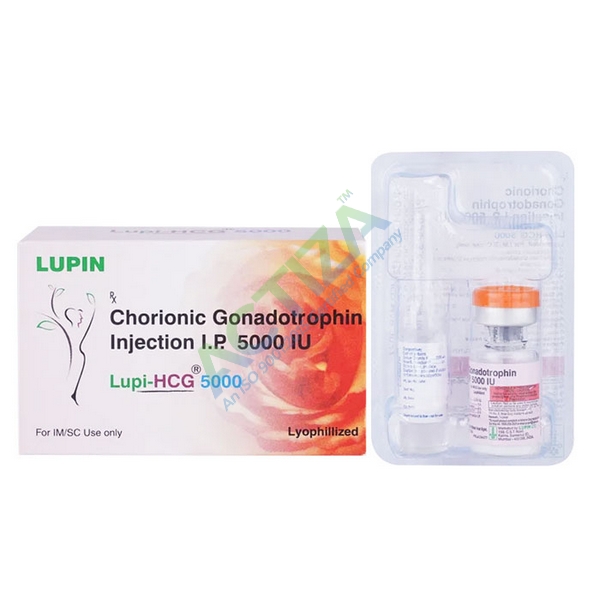
Lupi-HCG 5000 Injection (HCG) | ||||
|---|---|---|---|---|
| Pack Size | Price | Quantity | Add To Cart | |
| 3 Vial/s | $60 | |||
| 6 Vial/s | $120 | |||
| 9 Vial/s | $170 | |||
What is Lupi-HCG 5000 Injection
Product identity
| Field | Detail |
| Brand name | Lupi-HCG 5000 Injection |
| Generic name | Chorionic Gonadotrophin IP (human chorionic gonadotrophin, hCG) |
| Strength | 5000 IU |
| Pack | One vial per pack |
| Drug class | Gonadotrophin; luteinising hormone (LH) analogue |
| Manufacturer and trade mark owner | Lupin Ltd |
| Registered address listed | Kalpataru Inspire, Santacruz East, Mumbai 400 055 |
| Country of origin | India |
| Primary uses | Ovulation trigger; male hypogonadism; undescended testis |
| Route | Intramuscular or subcutaneous, as prescribed |
| MRP (listed) | About Rs. 448.70 per pack |
| Storage | Refrigerate at 2 to 8 degrees Celsius; do not freeze |
| Legal status in India | Prescription only, Schedule H |
| ATC code | G03GA01 (chorionic gonadotrophin) |
What it is not
How it works (mechanism of action)
The underlying principle
In women – triggering ovulation
In men – restoring the missing signal
Dosage guide
Doses below are from the reference label, in USP Units. Your specialist decides.
| Indication | Patient group | Regimen | How a 5000 IU vial fits |
| Ovulation induction | Anovulatory infertile women | 5,000 to 10,000 Units as a single dose | One vial gives the lowest labelled dose |
| Ovulation induction – timing | Anovulatory infertile women | One day after the last menotropins dose | Hour set by the clinic |
| Hypogonadotropic hypogonadism | Males, regimen A | 500 to 1,000 Units three times weekly, three weeks | One vial covers several doses |
| Hypogonadotropic hypogonadism | Males, regimen A continued | Then twice weekly for three weeks | Frequency falls, dose unchanged |
| Hypogonadotropic hypogonadism | Males, regimen B | 4,000 Units three times weekly, six to nine months | Close to one vial per dose |
| Hypogonadotropic hypogonadism | Males, regimen B continued | Then 2,000 Units three times weekly, three months | About two doses per vial |
| Prepubertal cryptorchidism | Boys, usually 4 to 9 years | 4,000 Units three times weekly, three weeks | Close to one vial per dose |
| Prepubertal cryptorchidism | Boys, alternative | 5,000 Units every other day, four injections | One vial per injection |
| Prepubertal cryptorchidism | Boys, alternative | 500 to 1,000 Units, 15 doses over six weeks | One vial covers several doses |
| Prepubertal cryptorchidism | Boys, alternative | 500 Units three times weekly, four to six weeks | One vial covers many doses |
Why 5000 IU is a recognised trigger dose
Where no dose is established
| Group | Position |
| Kidney impairment | No specific adjustment stated |
| Liver impairment | No specific adjustment stated |
| Confirmed pregnancy | Not for use |
| Breastfeeding | Not an indication |
| Primary ovarian failure | Outside the ovulation indication |
| Obesity or weight loss | Stated as not demonstrated effective |
How to take it
Who administers it
Why the exact hour is recorded in a fertility cycle
Precautions
Absolute contraindications
Conditions to disclose to your doctor
| Condition | Why it matters |
| Polycystic ovary syndrome | Higher hyperstimulation risk |
| Many follicles seen on scan | Trigger may be reduced or cancelled |
| Previous hyperstimulation episode | Risk of recurrence |
| Any clotting disorder | Arterial thromboembolism is reported |
| Previous leg or lung clot | Needs specialist assessment |
| Heart disease | Androgens can cause fluid retention |
| Kidney disease | Androgens can cause fluid retention |
| Epilepsy | Named for caution in the reference label |
| Migraine | Named for caution in the reference label |
| Asthma | Named for caution in the reference label |
| Untreated thyroid or adrenal disease | Must be corrected first |
| Untreated pituitary tumour | Must be assessed first |
| Undiagnosed vaginal bleeding | Needs investigation first |
| Ovarian, uterine or breast cancer | Needs specialist assessment |
| Allergy to urine-derived products | Anaphylaxis has been reported |
| Known lactose or excipient allergy | Pack excipients are unpublished |
Food and drink precautions
Before-use safety checklist
Common and less common side effects
| Group | Side effect | What to do |
| Common | Headache | Report if severe or persistent |
| Common | Injection site pain, swelling or redness | Usually settles in a day |
| Common | Abdominal pain | Report; may signal hyperstimulation |
| Common | Abdominal bloating or distension | Report; may signal hyperstimulation |
| Common | Nausea | Report if it stops you drinking |
| Common | Vomiting | Report promptly |
| Common | Tiredness or fatigue | Rest; report if marked |
| Common | Irritability or restlessness | Report to your clinic |
| Common | Low mood or depression | Report to your clinic |
| Less common | Fluid retention and swollen ankles | Report to your clinic |
| Less common | Breast tenderness | Usually settles after the cycle |
| Less common | Gynaecomastia in males | Report to your prescriber |
| Less common | Precocious puberty in treated boys | Stop therapy; see the doctor |
| Less common | Localised hypersensitivity rash | Report before the next dose |
| Serious | Ovarian hyperstimulation syndrome | Contact the clinic urgently |
| Serious | Ruptured ovarian cyst with internal bleeding | Emergency care at once |
| Serious | Arterial thromboembolism | Emergency care at once |
| Serious | Systemic allergic reaction or anaphylaxis | Emergency care at once |
| Serious | Pleural effusion with breathlessness | Emergency care at once |
| Outcome risk | Multiple pregnancy, mostly twins | Discussed before treatment |
The multiple-pregnancy figure
Drug interactions – avoid with
| Drug, test or group | Interaction | Action |
| Menotrophin, including Lupi-HMG | Used together; raises hyperstimulation risk | Specialist supervision only |
| FSH and urofollitropin | Used together in stimulation protocols | Specialist supervision only |
| GnRH agonists and antagonists | Alter the timing of the trigger | Clinic sets the schedule |
| Clomifene citrate | Often precedes the trigger | Written protocol only |
| Letrozole | Often precedes the trigger | Written protocol only |
| Testosterone preparations | Suppress the pituitary LH signal | Disclose before treatment |
| Anabolic steroids | Suppress natural gonadotrophins | Disclose any past use |
| Corticosteroids | May add to fluid retention | Tell the prescriber |
| Anticoagulants | Clot risk needs review | Specialist review required |
| Home pregnancy tests | hCG itself causes a positive reading | Test only on the clinic date |
| Gonadotrophin blood assays | Interferes, especially with LH | Tell the laboratory |
| Any other hormone injection | Combined effects are unpredictable | Disclose everything |
Sport and doping
Emergency warning signs
Go to hospital immediately
| Warning sign | Possible cause |
| Rapidly swelling, painful abdomen | Ovarian hyperstimulation syndrome |
| Sudden severe lower abdominal pain | Ruptured ovarian cyst |
| Fainting with abdominal pain | Internal bleeding |
| Breathlessness or chest tightness | Pleural effusion or clot |
| Rapid weight gain over a day or two | Severe fluid shift |
| Passing very little urine | Severe hyperstimulation |
| Severe persistent nausea and vomiting | Severe hyperstimulation |
| Calf pain, swelling or redness | Deep vein thrombosis |
| Sudden one-sided weakness or slurred speech | Arterial thromboembolism |
| Swollen lips, tongue, face or throat | Angioedema or anaphylaxis |
| Widespread rash with collapse | Anaphylaxis |
| Early puberty signs in a treated boy | Androgen-induced precocious puberty |
About hyperstimulation specifically
Why choose Lupi-HCG 5000 Injection
Clinical reasons a specialist may select it
When a specialist may choose something else
| Situation | Likely preference | Reason |
| High hyperstimulation risk | GnRH agonist trigger | Shorter hormonal exposure |
| Allergy to urine-derived products | Recombinant choriogonadotropin alfa | Avoids urinary protein |
| Protocol specifies 10,000 IU | Lupi-HCG 10000 | Avoids combining two vials |
| Purified grade requested | Lupi-HCG HP 5000 IU | Highly purified presentation |
| No reliable cold chain | Discuss with the clinic | Pack needs 2 to 8 degrees |
| Primary ovarian failure | Donor egg pathway | hCG cannot help this cause |
| Weight loss sought | Diet and exercise programme | hCG is not effective for this |
Honest limitations
Storage instructions
| Instruction | Detail |
| Temperature | Store in a refrigerator at 2 to 8 degrees Celsius |
| Freezing | Do not freeze; discard if frozen |
| Cold chain | Must stay refrigerated from pharmacy to patient |
| Transport | Carry in an insulated box with a cold pack |
| Light | Keep in the original carton, away from light |
| Refrigerator position | Store on a shelf, not in the door |
| Freezer compartment | Never place the vial against it |
| Before use | Let the vial reach room temperature briefly |
| After reconstitution | Follow the carton; do not keep leftovers casually |
| Appearance check | Discard if cloudy, discoloured or holding particles |
| Children and pets | Store well out of their reach |
| Expiry | Do not use after the printed expiry date |
| Sharps | Dispose of needles in a sharps container |
| Disposal | Return unused vials to a pharmacy |
The storage conflict you may encounter online

B.Pharm, CMO & Pharmacist
Licensed pharmacist (B.Pharm) with 12+ years in clinical pharmacy and patient care. Reviews every article for evidence-based accuracy before it is published on ACTIZA Store.
Reviews
There are no reviews yet.