Happy Diwali!•Our team is celebrating the festival of lights.•You can order and pay as usual; all orders ship from 16 November.Happy Diwali!•Our team is celebrating the festival of lights.•You can order and pay as usual; all orders ship from 16 November.Happy Diwali!•Our team is celebrating the festival of lights.•You can order and pay as usual; all orders ship from 16 November.
Happy Diwali!•Our team is celebrating the festival of lights.•You can order and pay as usual; all orders ship from 16 November.Happy Diwali!•Our team is celebrating the festival of lights.•You can order and pay as usual; all orders ship from 16 November.Happy Diwali!•Our team is celebrating the festival of lights.•You can order and pay as usual; all orders ship from 16 November.
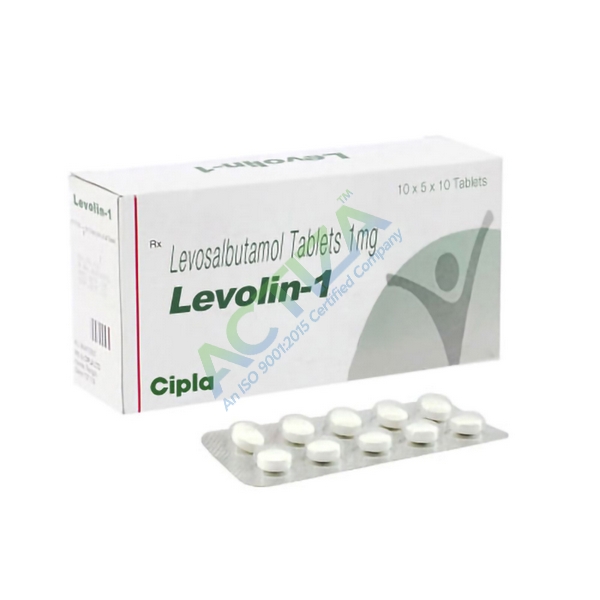
Levolin 1 mg contains levosalbutamol 1 mg per tablet.
Levosalbutamol is a short-acting bronchodilator.
It relaxes the muscle around the airways.
That widens the airways and eases breathing.
Levolin 50 treats bronchospasm, meaning tightened airways.
This is the tablet form, swallowed by mouth.
Levolin 2 mg is also made as an inhaler and as respules.
The tablet acts more slowly than the inhaled forms.
HOW IT WORKS (MECHANISM OF ACTION)
Airways are surrounded by a layer of smooth muscle.
In asthma that muscle tightens and narrows the airway.
Levosalbutamol stimulates beta-2 receptors on that muscle.
Stimulating the receptor raises cyclic AMP inside the cell.
Raised cyclic AMP makes the muscle relax.
The airway widens and air moves more freely.
Ordinary salbutamol is a mixture of two mirror-image forms.
These are called the R and S enantiomers.
The mixture is half R-salbutamol and half S-salbutamol.
The R form binds the beta-2 receptor and opens the airway.
The S form has little bronchodilator activity.
Levosalbutamol is the R form supplied on its own.
The theory, and what the evidence shows
The theory is that the R form alone gives equal benefit.
It should therefore cause fewer side effects.
Laboratory work also suggested the S form may be unhelpful.
Clinical trials have not confirmed a meaningful advantage.
One comparison found no significant difference in lung measures.
Rates of extra treatment and admission were also similar.
The levo form cost far more per dose in that comparison.
The theoretical rationale is sound but unproven in practice.
DOSAGE GUIDE
No dosing figures are stated here, and this is deliberate.
Parameter
Position
Reason
Oral dose
Prescriber-determined
No regulatory label exists
Source of your dose
The Cipla pack insert
The only authoritative source
Frequency
As prescribed
Varies by patient
Children under 12
Not without medical advice
Per the product record
Maximum daily dose
From the pack insert
Do not exceed
Self-adjustment
Never
Side effects rise with dose
Acute severe attack
Do not rely on a tablet
Onset is 30 to 60 minutes
Pregnancy and breastfeeding
Avoid unless directed
Per the product record
Why no numbers appear above:
Every other dosing figure in this content series is traced to an FDA or MHRA label. For oral levosalbutamol no such label exists, because no major regulator has approved the oral route. Printing a dose from a retail listing would break that standard. Send the Cipla pack insert and the dosing table can be completed from it.
An important clinical point:
A tablet taking 30 to 60 minutes to work is not a rescue treatment. Anyone with asthma needs a fast-acting inhaled reliever for sudden symptoms. A tablet must never be the only treatment available during an attack.
HOW TO TAKE IT
Take the tablet exactly as your doctor has directed.
Swallow the tablet whole with water.
Take it at the same times each day.
You can take it with or without food.
Taking it with food may reduce stomach upset.
Do not crush or chew the tablet.
Do not take extra tablets if symptoms worsen.
Use your inhaled reliever for sudden breathlessness.
Keep taking any preventer inhaler you are prescribed.
Do not stop this tablet suddenly without advice.
Store tablets out of reach of children.
A child swallowing these tablets needs urgent medical care.
PRECAUTIONS
Absolute contraindications – do not use
Known allergy to levosalbutamol.
Known allergy to ordinary salbutamol.
Known allergy to any tablet ingredient.
Allergy to either form means avoiding both.
Conditions to disclose to your doctor
Any heart disease or irregular heart rhythm.
High blood pressure.
A known long QT interval on an ECG.
Overactive thyroid (thyrotoxicosis).
Diabetes, as this medicine can raise blood sugar.
Low blood potassium.
A history of seizures.
Kidney or liver disease.
Pregnancy, suspected pregnancy, or breastfeeding.
All other medicines, including inhalers you already use.
Why systemic side effects matter more with a tablet
Beta-2 receptors also sit in muscle, heart and liver.
A swallowed dose reaches all of them through the blood.
Tremor and palpitations are therefore more likely.
Restlessness and sleep disturbance are more likely.
Behavioural effects in children are more likely.
Low potassium and low blood sugar can occur.
This is the central reason guidelines prefer inhalation.
Asthma control precautions
Keep a written asthma action plan from your doctor.
Keep a fast-acting inhaled reliever with you at all times.
Do not rely on this tablet during an attack.
Needing more bronchodilator than usual is a warning sign.
The label warns this may mean asthma is destabilising.
Book a review rather than increasing your own dose.
Never stop a preventer inhaler because this tablet helps.
A bronchodilator does not treat airway inflammation.
Food, drink and daily-life precautions
There are no strict food restrictions with this tablet.
Limit caffeine, which adds to tremor and palpitations.
Avoid alcohol, which offers no benefit here.
Do not smoke. Smoking worsens asthma and COPD.
Avoid your known triggers where you can.
Tell any surgeon or dentist that you take this medicine.
Before-use safety checklist
I have a valid prescription stating my dose.
My dose came from my doctor, not from a website.
I know this tablet takes 30 to 60 minutes to work.
I understand it is not a rescue treatment.
I have a fast-acting inhaled reliever available now.
I have asked my doctor whether an inhaler would suit me better.
I have told my doctor about my heart and thyroid history.
I know the signs that mean I must call for emergency help.
I will store the tablets out of reach of children.
I will not increase my own dose.
SIDE EFFECTS
Common side effects
Side effect
Note
What to do
Tremor or shaky hands
More likely by mouth
Usually settles within hours
Palpitations
More likely by mouth
Tell your doctor if frequent
Fast heartbeat
More likely by mouth
Tell your doctor if frequent
Headache
Common
Usually mild
Nervousness or restlessness
More likely by mouth
Tell your doctor
Sleep disturbance
More likely by mouth
Tell your doctor
Dizziness
3% inhaled
Sit down until it passes
Throat irritation
8% inhaled
Less relevant to a tablet
Muscle cramps
Reported
Tell your doctor
Nausea
Reported
Take with food
Behavioural change in children
Reported with oral use
Tell your doctor
Less common and serious side effects
Event
Frequency
Required action
Paradoxical bronchospasm
Rare
Stop; use inhaled reliever; emergency care
Low blood potassium
Reported
Blood test; medical review
Low blood sugar
Reported with oral use
Check glucose; medical review
Irregular heart rhythm
Rare
Urgent medical review
Chest pain
Rare
Emergency care immediately
High blood sugar
Reported
Monitor; tell your doctor
Severe allergic reaction
Very rare
Emergency care immediately
Paradoxical Bronchospasm:
Rarely a beta-agonist tightens the airways instead of opening them. The label describes this as life-threatening. Use your inhaled reliever and seek emergency care at once.
DRUG INTERACTIONS – AVOID WITH
Avoid unless your doctor has weighed the risk
Beta-blockers, including propranolol and atenolol.
They block the effect of this medicine.
They can cause severe bronchospasm in asthma.
Beta-blocker eye drops count too, such as timolol.
MAO inhibitors, including some antidepressants.
Tricyclic antidepressants.
Both can increase effects on the heart and blood vessels.
Avoid within two weeks of stopping either.
Use with caution
Non-potassium-sparing diuretics, such as furosemide.
These can worsen low blood potassium.
Digoxin, whose blood level this medicine can lower.
Theophylline and aminophylline.
Oral or inhaled corticosteroids, which also lower potassium.
Other beta-agonist inhalers or tablets.
Taking both a tablet and an inhaler adds the doses together.
Medicines that prolong the QT interval.
Diabetes medicines, as blood sugar may shift.
EMERGENCY WARNING SIGNS
Use your inhaled reliever and call for emergency help if you have:
Breathlessness that your inhaled reliever does not ease.
Wheezing or chest tightness that worsens after a dose.
Difficulty speaking a full sentence.
Blue or grey lips, face or fingertips.
Having to sit upright and fight for every breath.
A silent chest, with no wheeze but severe breathlessness.
Licensed pharmacist (B.Pharm) with 12+ years in clinical pharmacy and patient care. Reviews every article for evidence-based accuracy before it is published on ACTIZA Store.
Reviews
There are no reviews yet.
Be the first to review “Levolin 1 Mg (Levosalbutamol)” Cancel reply



Reviews
There are no reviews yet.