Ketasma 1 Mg (Ketotifen) Medically reviewed by Sanjay Gangani, B.Pharm, CMO & Pharmacist
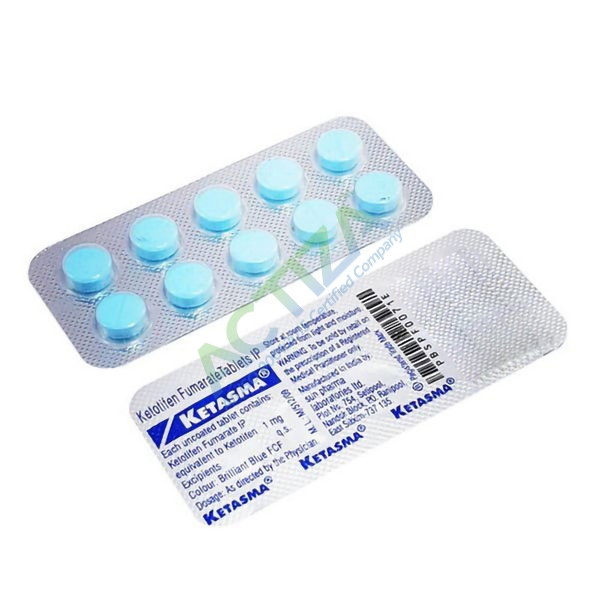
Active Ingredient Ketotifen Indication Asthma Manufacturer Sun Pharmaceutical Industries Ltd Strength:- 1mg Packaging 10 tablets in 1 strip
INQUIRE ABOUT Ketasma 1 Mg (Ketotifen)
What is Ketasma 1 mg? Ketasma 1 mg is a prescription tablet containing 1 mg of ketotifen.
Asthafen is an antihistamine that also stabilises mast cells.
Mast cells release the chemicals that drive allergic reactions.
It is made by Sun Pharmaceutical Industries Ltd. in India.
The originator brand of ketotifen is Zaditen.
It is used to prevent attacks of bronchial asthma.
It also helps allergic rhinitis, which causes sneezing and a runny nose.
It helps allergic conjunctivitis, which causes red and itchy eyes.
It is used for skin rashes, hives and itching.
It is described in its labelling as a non-bronchodilator medicine.
That means it does not open the airways directly.
It works by preventing the allergic reaction from starting.
It does not cure asthma or allergy.
It is not a steroid and not a reliever inhaler.
It is not recommended for children under three years of age.
Oral ketotifen is not approved by the US Food and Drug Administration.
Only ketotifen eye drops are sold in the United States.
It is not a treatment or prevention for anaphylaxis.
Severe allergic reactions need adrenaline and emergency care.
Use Albalon Eye drop 5 ml only for the condition your doctor prescribed.
How Ketasma 1 mg Works (Mechanism of Action) The action happens in five simple steps:
An allergen triggers mast cells in the airways, nose or skin.
Mast cells normally burst open and release histamine and other chemicals.
Ketotifen stabilises the mast cell so it releases less of them.
Ketotifen also blocks histamine H1 receptors on nearby cells.
Less histamine and less histamine signalling means a milder reaction.
What that means for the patient:
Airway inflammation builds up more slowly over time.
The airways become less reactive to triggers.
Attacks may become less frequent and less severe.
Nasal , eye and skin allergy symptoms also improve.
The benefit is preventive, not immediate.
Why it takes weeks rather than minutes:
Mast cell stabilisation builds up with repeated dosing.
The labelling states the effect takes several weeks to establish.
A single dose will not change airway reactivity.
Stopping early means the benefit never develops.
What it does not do:
It does not relax airway muscle like a reliever inhaler.
Its labelling states it will not abort established asthma attacks.
It is not effective for acute bronchospasm.
It does not replace inhaled corticosteroids.
It is absorbed almost completely after an oral dose.
Dosage Guide Always follow the dose written on your prescription.
Situation Typical Dose Timing Key Note Adults, usual dose 1 mg twice daily With food, morning and evening Ketasma is one tablet per dose Adults, increased dose May be raised to 2 mg twice daily With food Only on medical advice Patients prone to sedation May start at a lower evening dose Building up gradually Reduces early drowsiness Children over three years Usually 1 mg twice daily With food As directed by a doctor Children under three years Not recommended Not applicable Use a suitable alternative instead Existing asthma therapy Must be continued unchanged at first Alongside this medicine Do not stop anything yourself Reducing other asthma drugs Only after six to twelve weeks Gradually and under supervision Abrupt withdrawal can be dangerous Acute asthma attack Ketotifen has no role Not applicable Use a reliever inhaler immediately Diabetic patients The tablet is usually preferred As prescribed The syrup contains carbohydrate Epilepsy Use with caution As prescribed It may lower the seizure threshold Breastfeeding mothers Breastfeeding is not advised on this medicine Not applicable The drug is assumed to pass into milk Pregnancy Discuss with your doctor first As prescribed Caution is advised
How to read this table:
Your written prescription is the authority, not this page.
Taking it with food reduces stomach upset.
Never stop other asthma medicines when starting this one.
Never reduce a steroid inhaler or tablet on your own.
Do not increase the dose because benefit feels slow.
Slow onset is expected and not a sign of failure.
Missed dose and overdose rules:
Take a missed dose as soon as you remember.
Skip it if the next dose is almost due.
Never take two doses together to catch up.
Overdose causes drowsiness, confusion and disorientation.
It may also cause a fast heartbeat and low blood pressure.
Excitation or convulsions can occur, especially in children.
Treatment is supportive; seek medical help immediately.
How to Take Ketasma 1 mg Take the dose exactly as your doctor has prescribed it.
Swallow the tablet whole with a glass of water.
Take it with food to reduce stomach upset.
Take it at the same times each day, usually twice daily.
Keep taking your existing asthma medicines unchanged.
Continue your preventer inhaler exactly as prescribed.
Always carry your fast-acting reliever inhaler.
Use the reliever, not this tablet, during sudden breathlessness.
Do not drive until you know how the medicine affects you.
Avoid alcohol while taking this medicine.
Keep taking it daily even before you feel any benefit.
Do not stop it suddenly without medical advice.
Practical usage tips:
Early drowsiness usually eases within one to two weeks.
Taking the larger share of the dose at night can help.
Ask your doctor before changing the timing yourself.
Watch your weight, as appetite can increase over time.
Keep a note of how often you need your reliever inhaler.
Rising reliever use is an early sign of losing control.
Tell your doctor about any new bruising or bleeding.
That matters particularly if you take diabetes tablets.
Precautions Absolute Contraindications – Do Not Use Ketasma If You: Are allergic to ketotifen or any tablet ingredient.
Are having an acute asthma attack right now.
Need a medicine to open the airways quickly.
Are breastfeeding a baby.
Are seeking it to extend a clenbuterol or stimulant cycle.
Important limits on use:
It must never be used to reverse an acute attack.
It must not replace a reliever inhaler.
It must not replace a steroid inhaler without medical direction.
Existing asthma therapy must be continued when starting it.
Conditions You Must Disclose to Your Doctor Epilepsy or any history of seizures.
Diabetes, and any tablets you take for it.
Any blood disorder or low platelet count.
Any liver disease or abnormal liver tests.
Any kidney disease.
Any bladder problem or recurrent cystitis.
Any job requiring driving or operating machinery.
Any sedating medicine you already take.
Any regular alcohol use.
Lactose intolerance, since tablets typically contain lactose.
Pregnancy, planned pregnancy or breastfeeding.
Any recent change to your asthma control.
All prescription, herbal and over-the-counter products you use.
Food and Drink Precautions Take the tablet with food to reduce stomach upset.
Avoid alcohol entirely while taking this medicine.
Alcohol markedly deepens the drowsiness it causes.
The syrup form contains alcohol as well as carbohydrate.
Diabetic patients are usually given the tablet instead.
Watch portion sizes, since appetite often increases.
Avoid sedating herbal products such as valerian.
Ask your doctor before starting any new supplement.
Before-Use Safety Checklist Do you hold a valid prescription for Ketasma?
Do you understand this prevents attacks rather than stopping them?
Do you have a fast-acting reliever inhaler with you?
Do you know it takes several weeks to work?
Have you been told to continue your other asthma medicines?
Do you know never to reduce a steroid on your own?
Have you disclosed any epilepsy or seizures?
Have you told your doctor about any diabetes tablets?
Do you know to avoid driving until the effect is clear?
Have you arranged to avoid alcohol during treatment?
Have you checked the expiry date on the strip?
Do you know the emergency warning signs in Section 8?
Common and Less Common Side Effects Drowsiness is by far the most frequent effect.
Side Effect Frequency What It Feels Like What to Do Drowsiness or sedation Common (about 10% to 20%) Feeling sleepy, slowed or heavy Do not drive; usually eases in 1 to 2 weeks Dry mouth Common (about 1% to 2%) Reduced saliva and thirst Sip water; usually settles Dizziness Common (about 1% to 2%) Light-headed feeling Stand slowly; avoid driving Nausea Common (about 1% to 2%) Queasy stomach Take with food; report if persistent Headache Common (about 1% to 2%) Dull or throbbing head pain Rest and drink water; report if severe Increased appetite Common Feeling hungry more often Watch portions; weigh yourself regularly Weight gain Common Gradual gain over weeks or months Report to your doctor Irritability or nervousness Less common Feeling tense, restless or short-tempered Report to your doctor Excitability in children Less common Restlessness or agitation instead of sedation Report to your doctor Sleep disturbance Less common Difficulty sleeping or vivid dreams Report if it continues Skin rash Less common Red or itchy patches on the skin Stop and contact your doctor Constipation Less common Harder or less frequent stools Report if persistent Cystitis Rare Burning or frequency when passing urine Contact your doctor Raised liver enzymes Very rare No symptoms; found on a blood test Your doctor will advise on monitoring Hepatitis Very rare Yellow skin or eyes, dark urine, fatigue Seek urgent medical advice Low platelet count Rare Unusual bruising or bleeding Important with diabetes tablets; seek advice Seizures Rare Convulsion with loss of consciousness Emergency — call for help immediately Severe skin reaction Isolated cases Blistering or peeling skin Emergency — call for help immediately Severe allergic reaction Rare Swelling of face, lips or throat Emergency — call for help immediately
A note on drowsiness and on platelets:
Sedation affects roughly one in five to one in ten people.
It is more likely at higher doses and at the start of treatment.
It usually decreases within one to two weeks of use.
Reactions may be impaired during the first few days.
Do not take charge of vehicles or machinery until you know the effect.
Rare cases of low platelet count have been reported.
These occurred in people also taking oral diabetes tablets.
Labelling recommends monitoring platelets in that combination.
Report any unusual bruising or bleeding straight away.
Drug Interactions – Avoid or Use With Caution Combinations that increase drowsiness:
Alcohol in any amount.
Sedatives and sleeping tablets, including zopiclone and eszopiclone.
Benzodiazepines such as diazepam and lorazepam.
Other antihistamines, including those in cold remedies.
Opioid painkillers such as codeine and tramadol.
Sedating antidepressants and antipsychotic medicines.
Muscle relaxants and anti-anxiety medicines.
Combinations needing particular care:
Oral diabetes tablets such as metformin and gliclazide.
Any medicine that lowers the seizure threshold.
Any other medicine for asthma, which must be continued not stopped.
Interaction outcomes to understand:
Ketotifen potentiates sedatives, hypnotics, antihistamines and alcohol.
That combination can cause marked drowsiness and poor coordination.
Rare falls in platelet count occurred alongside oral diabetes tablets.
Platelet monitoring is recommended when both are taken together.
Ketotifen may lower the seizure threshold in susceptible people.
Stopping other asthma drugs too early can cause serious harm.
Catalogue note for the retailer:
Zopiclone and eszopiclone products appear in this range.
Each would add substantially to the drowsiness seen here.
Cross-link those pages so buyers see the combined effect.
Emergency Warning Signs – Seek Urgent Medical Help Call emergency services immediately if you or someone else has:
Breathlessness that is getting rapidly worse.
Difficulty speaking a full sentence in one breath.
A reliever inhaler that is no longer working.
Lips, face or fingertips turning blue or grey.
Drowsiness or exhaustion while struggling to breathe.
A silent chest, where wheezing suddenly stops.
A seizure or convulsion.
Swelling of the face, lips, tongue or throat.
Blistering or peeling skin anywhere on the body.
Extreme drowsiness that you cannot be roused from.
Contact your doctor the same day if you have:
Unusual bruising or bleeding that does not stop.
Yellowing of the skin or eyes.
Needing your reliever inhaler more often than usual.
Waking at night because of wheeze or cough.
Drowsiness that does not ease after two weeks.
Marked agitation or behaviour change in a child.
Critical instructions in an emergency:
Use your fast-acting reliever inhaler straight away.
Do not take an extra Ketasma tablet instead.
Tell every treating doctor that you take ketotifen.
State the dose and how long you have been taking it.
Mention any diabetes tablets or sedating medicines.
Mention any alcohol taken that day.
Bring the pack with you if that is possible.
Why Choose Ketasma 1 mg? Benefits of ketotifen when it is clinically appropriate:
A single tablet covers asthma prevention and allergy symptoms.
It treats nose, eye and skin allergy alongside the chest.
It is taken by mouth, so no inhaler technique is needed.
That suits people who struggle with inhalers or spacers.
It is not a steroid, so it avoids steroid side effects.
It works alongside inhalers rather than replacing them.
It is licensed for both asthma prevention and allergy.
Ketotifen has decades of clinical use behind it.
Sun Pharma is India’s largest pharmaceutical manufacturer.
Generic pricing keeps long-term therapy affordable.
Honest balance for the buyer:
It prevents attacks but cannot stop one that has begun.
It is never a substitute for a reliever inhaler.
The benefit takes several weeks to appear.
Drowsiness affects a substantial minority of users.
That drowsiness can affect driving and work safety.
Weight gain is a recognised effect of longer use.
Inhaled steroids remain the foundation of asthma treatment.
Other asthma medicines must be continued when starting this.
Treatment needs regular review with a doctor.
It is not licensed for weight loss or performance enhancement.
Any such use is off-label and unsupported by its labelling.
Storage Instructions Store at room temperature in a cool, dry place.
Keep tablets in the original strip until use.
Protect from direct sunlight, heat and moisture.
Do not store in the bathroom or near a sink.
Do not refrigerate or freeze the tablets.
Keep the pack out of sight and reach of children.
Children are particularly sensitive to an accidental dose.
Keep away from pets at all times.
Check the expiry date printed on the strip and carton.
Order refills early so daily therapy is not interrupted.
A gap in treatment means the benefit has to rebuild.
Do not use tablets that are chipped, discoloured or damp.
Do not transfer tablets into unlabelled containers.
Keep the strip intact until each tablet is needed.
Do not flush unused tablets down the toilet.
Return expired medicine to a pharmacy take-back scheme.
Sanjay Gangani
B.Pharm, CMO & Pharmacist
Licensed pharmacist (B.Pharm) with 12+ years in clinical pharmacy and patient care. Reviews every article for evidence-based accuracy before it is published on ACTIZA Store.



Reviews
There are no reviews yet.