

Loading cart...
1 / 3
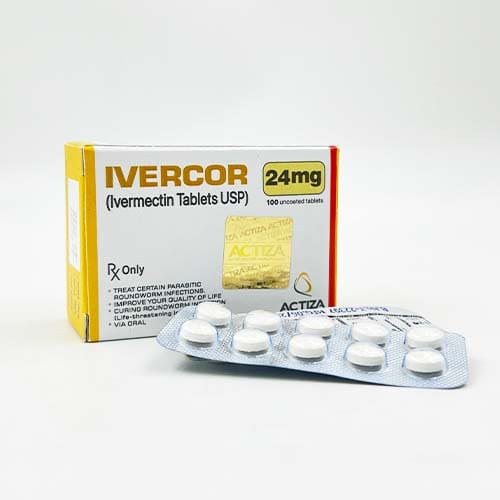
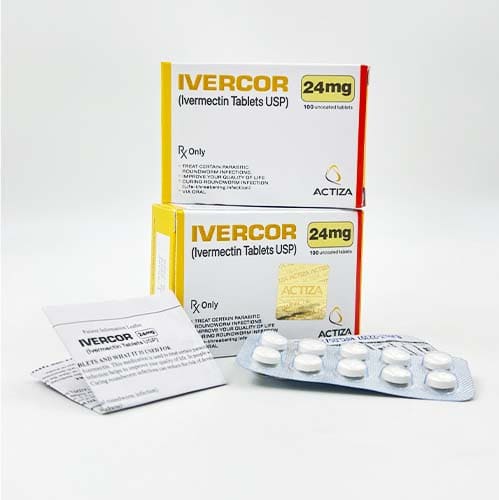
Ivercor 24 Mg (Ivermectin)
| Active Ingredient | Ivermectin |
|---|---|
| Indication | Parasitic infections, Anti Worm |
| Manufacturer | Actiza Pharmaceutical Pvt. Ltd. |
| Strength:- | 24mg |
| Packaging | 10 tablets in 1 strip |
| Dosage Form:- | Tablet |
| Country of Origin | India |
Ivercor 24 Mg (Ivermectin) | ||||
|---|---|---|---|---|
| Pack Size | Price | Quantity | Add To Cart | |
| 100 Tablet/s | $120 | |||
| 200 Tablet/s | $228 | |||
| 300 Tablet/s | $307 | |||
| 500 Tablet/s | $460 | |||
| 1000 Tablet/s | $820 | |||
Important Notices
What is Ivermectin?
Ivermectin is a prescription antiparasitic medicine used in humans. It belongs to the avermectin group, also called a macrocyclic lactone. Topical ivermectin products are also approved for head lice and rosacea.
The standard human tablet strength is 24 mg. Ivermectin is also on the WHO Essential Medicines List for strongyloidiasis and onchocerciasis.
Ivermectin was discovered from compounds linked to Streptomyces avermitilis. The Nobel Prize in Physiology or Medicine in 2015 was awarded to William C.
Campbell and Satoshi omura for their research that yielded avermectin and ivermectin. Their discovery changed the treatment of parasitic disease around the world.
Three safety notices must be clear on any ivermectin page. First, veterinary ivermectin products are not safe for humans because animal products may contain very different strengths and inactive ingredients.
Human poisoning and hospitalization have happened after people used horse or livestock ivermectin. Second, ivermectin is not approved or recommended for COVID-19 treatment or prevention.
Third, people who have lived in or traveled to West or Central Africa may have Loa loa infection, and ivermectin can cause severe neurologic reactions in patients with high Loa loa microfilarial load.
How Does Ivermectin Work? – Mechanism of Action
Step-by-Step Antiparasitic Mechanism:
Ivermectin works by acting on glutamate-gated chloride channels in parasites. These channels are found in many worms and arthropods, but not in the same way in the human central nervous system. Ivermectin binds strongly to these channels and keeps them open.
This lets too much chloride enter parasite nerve and muscle cells. The cell membrane becomes overpolarized, and the parasite becomes paralyzed.
Once this happens, the parasite cannot feed, move, reproduce, or avoid the host immune system. The immune system then helps clear it. Ivermectin may also increase inhibitory signaling through parasite GABA-related chloride channels, which adds to the paralysis effect.
Ivermectin is usually safe in humans at standard doses because these parasite target channels are not present in the same way in the human brain.
Also, the drug does not easily cross the blood-brain barrier at normal treatment doses. This is a main reason it can harm parasites without causing the same nerve effects in most human patients.
Why Ivermectin Has a Long Half-Life (~12 Days):
The wording here needs one careful note. The plasma half-life of ivermectin after oral use is usually much shorter, around 18 hours. Ivermectin spreads into body fat and tissues and leaves the body slowly.
Because of this, small amounts can stay in the body for many days. That is why people say it stays in the body for a long time, even though the amount in the blood drops sooner.
This wide spread in the body helps explain why one weight-based dose can often work well.
FDA-Approved Indications & Off-Label Uses
Ivermectin oral tablets have been approved by the FDA to treat intestinal strongyloidiasis due to Strongyloides stercoralis and onchocercias. These are the main approved human tablet indications on the FDA label.
Commonly Used Off-Label (Strong Evidence Base):
Several off-label uses have a strong or moderate evidence base in clinical practice and public health guidance.
These include:
Same Other Pills
Dosage – Weight-Based Dosing
Human ivermectin dosing is usually based on body weight. The main standard range is 150 to 200 micrograms per kilogram as a single oral dose, depending on the condition being treated.
The dose strength of the drug is 24 mg, hence its dose is based on patient body weight. Ivermectin should be taken with water while the patient’s stomach is empty to avoid any effect on drug absorption.
For strongyloidiasis, the usual oral dose is about 200 mcg/kg. FDA and CDC sources support this as first-line treatment.
Strongyloidiasis dosing (about 200 mcg/kg):
| Body Weight | Number of 3mg Tablets | Total Dose (mcg/kg approx.) |
|---|---|---|
| 15–24 kg | 1 tablet (3mg) | ~125–200 mcg/kg |
| 25–35 kg | 2 tablets (6mg) | ~171–240 mcg/kg |
| 36–50 kg | 3 tablets (9mg) | ~180–250 mcg/kg |
| 51–65 kg | 4 tablets (12mg) | ~185–235 mcg/kg |
| 66–79 kg | 5 tablets (15mg) | ~190–227 mcg/kg |
| 80 kg or more | 6 tablets (18mg) | ~200–225+ mcg/kg (200 mcg/kg dose) |
For onchocerc iasis, the usual oral dose is about 150 mcg/kg as a single dose, with repeat dosing every 3 to 12 months or every 6 months depending on the treatment setting and follow-up plan.
Onchocerciasis dosing (about 150 mcg/kg):
| Body Weight | Number of 3mg Tablets | Total Dose (mcg/kg approx.) |
|---|---|---|
| 15–25 kg | 1 tablet (3mg) | ~120–200 mcg/kg |
| 26–44 kg | 2 tablets (6mg) | ~136–231 mcg/kg |
| 45–64 kg | 3 tablets (9mg) | ~140–200 mcg/kg |
| 65–84 kg | 4 tablets (12mg) | ~143–185 mcg/kg |
| 85 kg or more | 5 tablets (15mg) | ~150–175+ mcg/kg (150 mcg/kg dose) |
How to Take Ivermectin – Step-by-Step:
Take ivermectin by mouth with a full glass of water. Swallow the tablets whole. The dose must match body weight. Most approved uses involve a single dose, but some conditions need repeat treatment.
For scabies, a second dose is often given 7 to 14 days later. For onchocerciasis, repeat doses may be needed every few months or yearly for long-term control. For strongyloidiasis, follow-up stool testing is often used to confirm cure.
Special Population Notes:
Children under 15 kg have limited safety data, so use is usually avoided unless a specialist advises it. Older people do not usually need a dose change, but they may be more likely to get side effects.
Ivermectin is processed by the liver, so extra care is needed in people with liver problems. It is usually avoided in pregnancy unless the benefit is greater than the risk.
Ivermectin also passes into breast milk. People with weak immune systems, such as those with HIV or organ transplants, may need repeat or longer treatment for strongyloidiasis.
Safety Information
At approved doses, ivermectin has a long and well-known human safety record. The drug has been used in millions of patients over more than 25 years of large-scale human treatment.
Still, safety depends on using the right product and the right dose. Veterinary ivermectin products should never be used in humans.
These products can contain different strengths and inactive ingredients, and human poisonings have happened after misuse. Another major safety issue is Loa loa co-infection.
In patients with high Loa loa microfilarial levels, ivermectin can trigger severe encephalopathy. This is why pre-treatment screening matters in people from endemic parts of West and Central Africa.
Side Effects
Side Effects in Strongyloidiasis Treatment (<4% overall incidence):
In strongyloidiasis treatment, the overall side-effect rate is low. Reported adverse effects include diarrhea, nausea, dizziness, fatigue, abdominal pain, and itching.
Mild increases in ALT/AST have also been reported in a small number of patients. These reactions are usually mild and short-lived.
Mazzotti Reaction (Onchocerciasis Treatment – ~10% of patients):
A Mazzotti reaction is not the same as an ivermectin allergy. Symptoms usually appear in the first 1 to 4 days after treatment and can include fever, headache, muscle pain, joint pain, swollen lymph nodes, itching, rash, and eye inflammation.
Supportive care often includes fluids, antihistamines, and pain relief, and some severe cases may need corticosteroids.
Serious Warnings – Seek IMMEDIATE Medical Attention:
Contraindications
The main formal contraindication is known hypersensitivity to ivermectin or to any part of the tablet. Other major concerns include body weight under 15 kg, lack of safety data in very small children, and high Loa loa microfilaremia, because of the encephalopathy risk.
Patients with major central nervous system disease or possible blood-brain barrier disruption also need careful review.
Use With Caution
Use ivermectin carefully in pregnancy, breastfeeding, older adults, immunocompromised patients, and people with hepatic impairment. These groups may need closer monitoring or specialist review.
Drug Interactions
Some interactions matter even though ivermectin is often given as a short course. Rare increases in INR have been reported with warfarin and other vitamin K antagonists, so clotting should be watched closely.
P-glycoprotein inhibitors such as ketoconazole, itraconazole, ritonavir, and erythromycin can increase ivermectin blood levels and may increase adverse effects.
P-gp inducers such as rifampicin may lower ivermectin exposure and reduce efficacy. CNS depressants, including alcohol, opioids, and benzodiazepines, may add to sedation risk at higher doses.
Colchicine toxicity is also a concern because of P-gp effects. Combining ivermectin with other antiparasitic drugs, especially in filarial disease, should be done only under specialist supervision because reaction risk may rise.
Storage & Handling
Store ivermectin tablets at 20-25°C room temperature. Protect them from moisture, heat, and direct light. Keep the tablets in the original blister packaging until use.
Do not store them in a humid place such as a bathroom. Keep them away from children and pets, and do not use them after the expiry date.
Ivermectin’s Role in Global Health
Ivermectin has had a major role in global public health. It was part of the work honored by the 2015 Nobel Prize. Today, ivermectin is one of the most important antiparasitic drugs in medicine.
Since 1987, Merck’s Mectizan Donation Program has supplied ivermectin for large treatment programs against river blindness and lymphatic filariasis. Merck says the program has provided more than 4.4 billion treatments since 1987 and now reaches more than 300 million people each year.
WHO continues to include ivermectin in major public health programs. Annual or repeated mass treatment has sharply lowered the burden of onchocerciasis in endemic areas and has supported control programs for lymphatic filariasis and other neglected tropical diseases.
In this sense, ivermectin is not just an individual treatment. It is also a drug with a huge population-level impact.
Conclusion
Ivermectin is an FDA-approved human antiparasitic medicine with many years of real-world use. Oral tablets are approved for strongyloidiasis and onchocerciasis.
The same active ingredient is also used in approved topical products for head lice and rosacea. It works by acting on parasite chloride channels. It results in paralysis and death of the parasite without affecting the human nervous system at normal dosages.
Its value is especially clear in strongyloidiasis, river blindness, scabies management, and global control programs. But correct use is critical.
Human ivermectin must be dosed by body weight, taken the right way, and never replaced with veterinary products. It is also not approved for COVID-19. Patients with possible Loa loa exposure need special caution before treatment.
In short, ivermectin is one of the most important antiparasitic medicines ever developed, but it should be used only in pharmaceutical-grade human form, for the right indication, and with proper medical guidance.
FAQ
Q1:- What dose of ivermectin do humans take?
Ans:- Human ivermectin dosing is weight-based. For strongyloidiasis: 200 mcg/kg as a single dose. For onchocerciasis: 150 mcg/kg as a single dose, repeated annually. For scabies: 200 mcg/kg, repeated at day 7–14. Each tablet contains 3mg. The correct number of tablets depends on your body weight – always follow your doctor’s prescription.
Q2:- How does ivermectin kill parasites?
Ans:- Ivermectin binds selectively to glutamate-gated chloride channels (GluCl) found in invertebrate nerve and muscle cells. This causes paralysis and death of parasites including nematodes, mites, and lice. It is safe in humans because these GluCl channels are absent from the mammalian central nervous system, and ivermectin does not cross the blood-brain barrier at standard doses.
Q3:- Can ivermectin treat scabies?
Ans:- Yes, oral ivermectin at 200 mcg/kg is an effective scabies treatment, though off-label. A single dose kills active mites. A second dose 7–14 days later is recommended to kill newly hatched mites (ivermectin has no ovicidal effect). The two-dose oral regimen has similar efficacy to a single application of 5% permethrin cream. It is preferred for crusted scabies.
Q4:- Can I use veterinary ivermectin for humans?
Ans:- No. Veterinary ivermectin products (horse paste, cattle pour-on, dog tablets) contain different concentrations and inactive ingredients than human formulations. These have caused serious poisoning, hospitalisations, and neurological harm in humans who have self-medicated. Only use pharmaceutical-grade ivermectin manufactured specifically for human use.
Q5:- How long does ivermectin stay in your body?
Ans:- Ivermectin has a terminal elimination half-life of approximately 12 days. It remains detectable in the body for about 3 weeks after a single dose. Its long half-life is due to extensive tissue distribution (it is highly lipophilic). This extended presence is what allows a single dose to control parasite populations effectively over a longer period.
Reviews
There are no reviews yet.