

Loading cart...
Dulane 30 Mg (Duloxetine)
Medically reviewed by Sanjay Gangani, B.Pharm, CMO & Pharmacist
| Active Ingredient | Duloxetine |
|---|---|
| Indication | Depression, Anxiety disorder and Neuropathic pain |
| Manufacturer | Sun Pharmaceutical Industries Ltd |
| Strength:- | 30mg |
| Packaging | 10 Capsule DR in 1 strip |
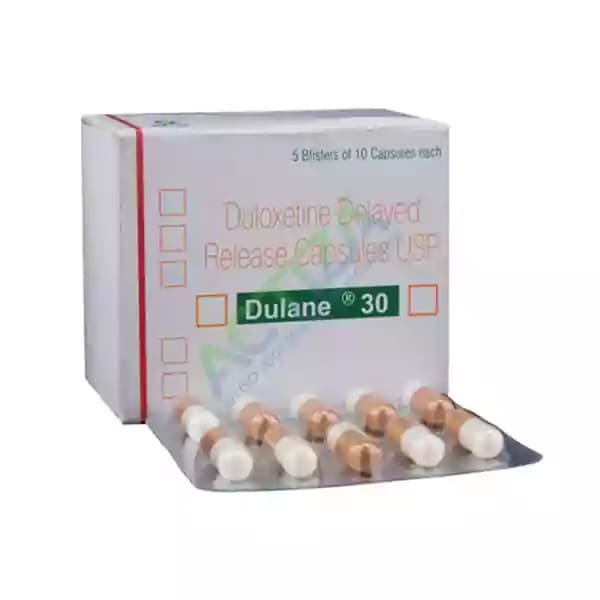
Dulane 30 Mg (Duloxetine) | ||||
|---|---|---|---|---|
| Pack Size | Price | Quantity | Add To Cart | |
| 50 Capsule/s | $80 | |||
| 100 Capsule/s | $110 | |||
| 200 Capsule/s | $140 | |||
| 300 Capsule/s | $160 | |||
What Is Dulane 30
- Dulane 30 is a prescription antidepressant capsule.
- Each capsule contains duloxetine 30 mg.
- It is a delayed-release capsule, often written as Capsule DR.
- Sun Pharmaceutical Industries Ltd markets it in India.
- It is supplied as a strip of 10 capsules.
- Duloxetine belongs to the SNRI class.
- SNRI means serotonin–noradrenaline reuptake inhibitor.
- The same molecule is sold worldwide as Cymbalta.
- Major depressive disorder in adults.
- Generalised anxiety disorder.
- Diabetic peripheral neuropathic pain.
- Fibromyalgia.
- Chronic musculoskeletal pain, including chronic low back pain.
- Chronic pain from osteoarthritis of the knee.
- Stress urinary incontinence, under the European and Indian licence only.
How Dulane 30 Works (Mechanism of Action)
- Nerve cells communicate using chemical messengers.
- Two of these messengers are serotonin and noradrenaline.
- After a signal passes, the sending nerve reabsorbs them.
- This reabsorption is called reuptake.
- Duloxetine blocks the reuptake of both messengers.
- More serotonin and noradrenaline stay in the nerve gap.
- Signalling in mood circuits strengthens over several weeks.
- Mood, drive and anxiety gradually improve.
- The spinal cord carries pain signals to the brain.
- The brain sends descending signals that dampen that traffic.
- These descending pathways run on serotonin and noradrenaline.
- Duloxetine boosts both messengers in those pathways.
- The spinal cord then filters out more pain signalling.
- The nerve damage itself is unchanged.
- Only the volume of the pain signal is reduced.
Dosage Guide
A doctor sets the dose. The table shows standard adult ranges only.
| Situation | Starting dose | Usual target | Note |
|---|---|---|---|
| Major depressive disorder | 30 mg once daily | 40 to 60 mg daily | Optional 1-week lead-in |
| Generalised anxiety (adult) | 30 mg once daily | 60 mg once daily | Optional 1-week lead-in |
| Generalised anxiety (65+) | 30 mg once daily | 60 mg once daily | Hold 30 mg for 2 weeks |
| Fibromyalgia | 30 mg once daily | 60 mg once daily | Hold 30 mg for 1 week |
| Chronic musculoskeletal pain | 30 mg once daily | 60 mg once daily | Hold 30 mg for 1 week |
| Diabetic nerve pain | 60 mg once daily | 60 mg once daily | 30 mg only if tolerability is a worry |
| Maximum studied dose | – | 120 mg daily | No added benefit above 60 mg |
| Severe kidney disease | Avoid | Avoid | Avoid if GFR is below 30 mL/min |
| Any chronic liver disease | Avoid | Avoid | Avoid in cirrhosis and hepatic impairment |
- Duloxetine is tapered, never stopped in one step.
- A common approach halves the dose every one to two weeks.
- The 30 mg capsule is itself a common taper rung from 60 mg.
- Some patients taper to alternate-day 30 mg before stopping.
- Any taper plan must come from the prescriber.
How To Take Dulane 30
- Swallow the capsule whole with a full glass of water.
- Do not chew the capsule.
- Do not crush the capsule.
- Do not open the capsule and sprinkle the pellets on food.
- Do not mix the contents into juice, milk or any liquid.
- Take it at roughly the same time each day.
- It can be taken with or without food.
- Taking it with food may reduce nausea in the first week.
- Many people prefer the morning, because of possible sleep disturbance.
- Keep taking it even once you feel better.
If you miss a dose
- Take it as soon as you remember on the same day.
- If the next dose is near, skip the missed one.
- Never take two capsules together to catch up.
- Repeated missed doses can trigger withdrawal symptoms.
- Duloxetine breaks down in stomach acid.
- The pellets inside carry an acid-resistant coating.
- That coating lets the drug pass the stomach unharmed.
- It then dissolves in the small intestine.
- Chewing or crushing destroys the coating.
- The dose is then partly inactivated and absorption becomes unpredictable.
Precautions
Absolute contraindications
- Known allergy to duloxetine or any capsule ingredient.
- Current use of a monoamine oxidase inhibitor (MAOI) for a psychiatric illness.
- Within 14 days of stopping such an MAOI.
- Starting an MAOI within 5 days of stopping duloxetine.
- Current treatment with linezolid.
- Current treatment with intravenous methylene blue.
Conditions to disclose to your doctor
- Any liver disease, hepatitis or cirrhosis.
- Heavy or regular alcohol use.
- Severe kidney disease or dialysis.
- High blood pressure, treated or untreated.
- Heart disease or a history of stroke.
- Glaucoma, especially narrow-angle glaucoma.
- Bipolar disorder or any past manic episode.
- Epilepsy or any history of seizures.
- A bleeding disorder, or use of blood thinners.
- Low blood sodium, or use of diuretics.
- Difficulty passing urine, or prostate enlargement.
- Diabetes, because blood sugar control can shift.
- Pregnancy, planned pregnancy or breastfeeding.
- Any history of suicidal thoughts or self-harm.
- All other medicines, including herbal and over-the-counter products.
Food and drink precautions
| Item | Advice | Reason |
|---|---|---|
| Alcohol | Avoid completely | Raises liver injury risk and increases drowsiness |
| St John’s wort | Avoid | Serotonergic herb; raises serotonin syndrome risk |
| Grapefruit juice | No major issue | Duloxetine is not a significant CYP3A4 substrate |
| Caffeine | Moderate intake | May add to jitteriness and insomnia early on |
| Tobacco smoking | Tell your doctor | Smoking induces CYP1A2 and lowers drug levels |
| Heavy meals | No restriction | Food may be taken to soften early nausea |
| Fluids | Drink normally | Helps with dry mouth and constipation |
Before-use safety checklist
- Confirm the prescription names duloxetine 30 mg.
- Confirm no MAOI has been taken in the last 14 days.
- Confirm linezolid is not being used.
- Declare any liver problem or regular alcohol use.
- Have blood pressure measured before starting.
- List every other medicine, including painkillers.
- Agree a plan for who to contact if mood worsens.
- Check the strip for damage and the expiry date.
- Agree the review date with the prescriber.
- Agree in advance how the drug will be stopped later.
Side Effects
Common side effects, with trial rates
| Side effect | On duloxetine | On placebo | Practical note |
|---|---|---|---|
| Nausea | 23% | 8% | Worst in week one; often fades |
| Headache | 14% | 12% | Usually mild |
| Dry mouth | 13% | 5% | Sip water; sugar-free gum helps |
| Somnolence (sleepiness) | 10% | 3% | Avoid driving until known |
| Constipation | 9% | 4% | Fibre and fluids help |
| Fatigue | About 9% | Lower | Often settles after two weeks |
| Dizziness | About 9% | Lower | Stand up slowly |
| Insomnia | About 9% | Lower | Morning dosing may help |
| Diarrhoea | About 9% | Lower | Keep fluids up |
| Decreased appetite | 7% | 2% | Monitor weight |
| Hyperhidrosis (sweating) | 6% | 1% | Often persists while on treatment |
Less common and serious side effects
| Effect | What to know |
|---|---|
| Raised blood pressure | Can occur at any dose; needs periodic checks |
| Orthostatic hypotension | Dizziness on standing; falls and fainting reported |
| Sexual dysfunction | Reduced libido, delayed orgasm, ejaculation problems |
| Urinary hesitation or retention | Difficulty starting or emptying the bladder |
| Hyponatraemia | Low blood sodium; more likely in older adults on diuretics |
| Abnormal bleeding | Bruising, nosebleeds, gastrointestinal bleeding |
| Hepatotoxicity | Raised liver enzymes; rare fatal liver failure reported |
| Serotonin syndrome | Agitation, fever, tremor, fast heart rate, stiffness |
| Severe skin reactions | Stevens-Johnson syndrome has been reported |
| Angle-closure glaucoma | Eye pain, halos, blurred vision, red eye |
| Mania or hypomania | Can be triggered in undiagnosed bipolar disorder |
| Seizures | Rare; greater risk with a seizure history |
| Worsened glycaemic control | Blood sugar may shift in diabetes |
| Discontinuation syndrome | Dizziness, electric-shock sensations, nausea, irritability |
Drug Interactions – Avoid Or Use With Care
| Medicine or substance | Action | Reason |
|---|---|---|
| MAOIs (selegiline, phenelzine) | Contraindicated | Severe, sometimes fatal serotonin reactions |
| Linezolid | Contraindicated | Acts as a reversible MAOI |
| Intravenous methylene blue | Contraindicated | Acts as a reversible MAOI |
| Thioridazine | Avoid | Duloxetine raises its level; QT prolongation risk |
| Fluvoxamine | Avoid | Strong CYP1A2 inhibitor; raises duloxetine sharply |
| Ciprofloxacin, enoxacin | Avoid | CYP1A2 inhibitors; raise duloxetine levels |
| Other SSRIs and SNRIs | Avoid | Additive serotonin load |
| Tramadol, fentanyl, pethidine | Caution | Serotonin syndrome and seizure risk |
| Triptans for migraine | Caution | Serotonin syndrome risk |
| St John’s wort | Avoid | Serotonergic herbal product |
| NSAIDs and aspirin | Caution | Increased bleeding, including gastrointestinal |
| Warfarin and anticoagulants | Caution | Increased bleeding risk; monitor |
| Tricyclic antidepressants | Caution | Duloxetine inhibits CYP2D6 and raises their levels |
| Metoprolol, flecainide, propafenone | Caution | CYP2D6 substrates; levels may rise |
| Diuretics | Caution | Added risk of low blood sodium |
| Alcohol | Avoid | Liver injury risk and added sedation |
| Sedatives and benzodiazepines | Caution | Added drowsiness |
| Antimuscarinics for bladder | Caution | Added risk of urinary retention |
Emergency Warning Signs
Stop and seek urgent medical care if any of these appear.
- Yellow eyes or skin, dark urine, or pain under the right ribs.
- Any new or worsening thoughts of suicide or self-harm.
- Agitation with fever, tremor, muscle stiffness or a racing heart.
- A spreading rash, blisters, or peeling skin.
- Mouth, eye or genital ulcers with a rash.
- Sudden eye pain, halos around lights, or rapid vision loss.
- A fit or seizure.
- Confusion, severe weakness or unsteadiness, which may signal low sodium.
- Black stools, vomiting blood, or unexplained heavy bruising.
- Inability to pass urine.
- Fainting, or severe dizziness on standing.
- Unusually elevated mood, racing speech or no need for sleep.
Why Choose Dulane 30
- It delivers the exact titration dose most guidelines begin with.
- One molecule can address both low mood and chronic pain.
- That can replace two separate prescriptions in some patients.
- Once-daily dosing supports adherence.
- The delayed-release pellet design protects the drug from stomach acid.
- Sun Pharma is among India’s largest regulated manufacturers.
- The 30 mg strength is also the standard step-down rung for tapering.
- Widely stocked, so refills are rarely a problem.
- Priced around ₹194 to ₹211 per strip of 10 at major portals.
Honest limitations
- It is not an instant treatment. Benefit takes weeks.
- Nausea in the first week is common.
- It cannot be used in liver disease or severe kidney disease.
- It cannot be stopped suddenly.
- Alcohol must be avoided throughout treatment.
Storage Instructions
- Store below 30 °C.
- Keep in a dry place, away from the bathroom.
- Protect from direct sunlight and heat.
- Leave capsules in the original blister until the dose is due.
- Do not refrigerate or freeze.
- Do not transfer capsules into unlabelled pill boxes for long periods.
- Keep well out of reach of children.
- Do not use after the printed expiry date.
- Return unused capsules to a pharmacy for disposal.
- Do not flush capsules or throw them in household waste.

B.Pharm, CMO & Pharmacist
Licensed pharmacist (B.Pharm) with 12+ years in clinical pharmacy and patient care. Reviews every article for evidence-based accuracy before it is published on ACTIZA Store.
Reviews
There are no reviews yet.