

Loading cart...
Voveran 50 Mg (Diclofenac)
Medically reviewed by Sanjay Gangani, B.Pharm, CMO & Pharmacist
| Active Ingredient | Diclofenac |
|---|---|
| Indication | Musculo-skeletal pain, Rheumatic pain, Pain relief |
| Manufacturer | Novartis India Ltd |
| Strength:- | 50 mg |
| Packaging | Strip of 15 tablet SR |
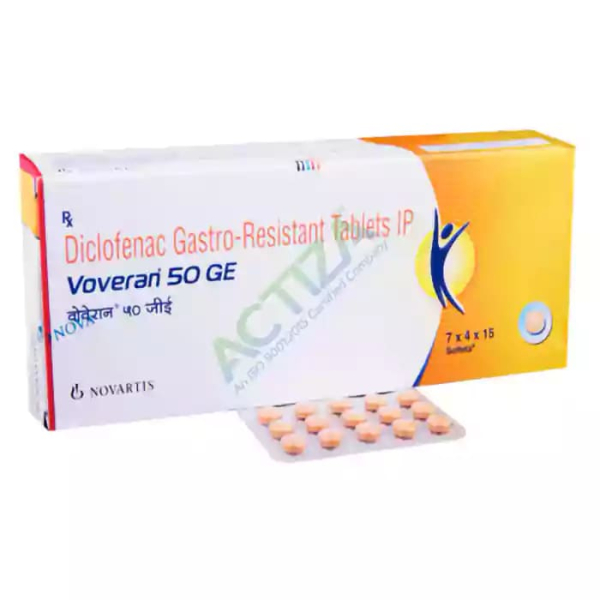
Voveran 50 Mg (Diclofenac) | ||||
|---|---|---|---|---|
| Pack Size | Price | Quantity | Add To Cart | |
| 60 Tablet/s | $11 | |||
| 90 Tablet/s | $16 | |||
| 120 Tablet/s | $21 | |||
What is Voveran 50 mg?
Important regulatory history
How Voveran Works (Mechanism of Action)
Step-by-step mechanism
Pharmacokinetics
| Property | Value |
|---|---|
| Absorption | Complete after the tablet passes the stomach |
| Peak plasma level after 50 mg | About 1.5 µg/mL at around 2 hours |
| Effect of food | Delays gastric passage; amount absorbed unchanged |
| First-pass loss | About half of the dose |
| Plasma protein binding | 99.7%, mainly to albumin |
| Synovial fluid | Levels stay above plasma for up to 12 hours |
| Metabolism | Glucuronidation and hydroxylation in the liver |
| Plasma half-life | 1 to 2 hours |
| Excretion | About 60% in urine as conjugates |
| Excreted unchanged | Less than 1% |
| Age-related differences | None relevant |
Dosage Guide
Only a prescriber may set the dose. These figures reproduce the approved label and are reference only.
Adult dosing
| Situation | Daily dose | Divided into |
|---|---|---|
| Starting dose | 100 to 150 mg/day | 2 or 3 doses |
| Mild cases or long-term therapy | 75 to 100 mg/day | 2 or 3 doses |
| Primary dysmenorrhoea, usual | 50 to 150 mg/day | Divided doses |
| Primary dysmenorrhoea, maximum | Up to 200 mg/day | Divided doses |
| Nocturnal pain or morning stiffness | Add a bedtime suppository | Total still 150 mg/day |
Stopping treatment
How to Take Voveran 50 mg
Missed dose
Realistic expectations
Precautions
Absolute contraindications
Food and drink precautions
| Item | Advice |
|---|---|
| Food | Follow your own pack insert; see section 4 |
| Milk | Commonly advised in India to reduce stomach upset |
| High-fat meals | Delay absorption; do not reduce it |
| Alcohol | Avoid. It sharply raises ulcer and bleeding risk |
| Spicy or strongly acidic foods | May worsen stomach irritation |
| Fluids | Stay well hydrated to protect the kidneys |
| Fasting or low fluid intake | Raises kidney injury risk |
| Salt intake | Keep moderate; diclofenac retains fluid |
| Potassium supplements and salt substitutes | Avoid unless the doctor advises |
| Herbal blood thinners (ginkgo, garlic, fish oil) | Avoid; additive bleeding risk |
| Cholestyramine or colestipol | Separate doses; see section 7 |
Before-use safety checklist
Side Effects
Common side effects (up to 1 in 10)
| Side effect | System | Practical guidance |
|---|---|---|
| Nausea | Gastrointestinal | Follow your pack’s food advice |
| Vomiting | Gastrointestinal | Report if persistent |
| Diarrhoea | Gastrointestinal | Maintain hydration |
| Indigestion (dyspepsia) | Gastrointestinal | Report if persistent |
| Abdominal pain | Gastrointestinal | Report if severe |
| Flatulence | Gastrointestinal | Usually self-limiting |
| Reduced appetite | Gastrointestinal | Monitor weight |
| Headache | Nervous system | Report if severe |
| Dizziness | Nervous system | Avoid driving |
| Vertigo | Ear | Move slowly; avoid heights |
| Raised liver enzymes | Liver | Needs blood test review |
| Rash | Skin | Stop and seek advice |
Uncommon side effects (up to 1 in 100)
| Side effect | Note |
|---|---|
| Heart attack (myocardial infarction) | Rate reflects long-term use at 150 mg/day |
| Heart failure | Emergency |
| Palpitations | Medical review |
| Chest pain | Emergency |
Facts the label makes explicit
Drug Interactions – Avoid or Use With Caution
High-risk combinations requiring monitoring
| Drug | Risk |
|---|---|
| Warfarin or acenocoumarol | Serious bleeding; monitor INR |
| Heparin or low molecular weight heparin | Serious bleeding risk |
| Antiplatelets, including low-dose aspirin | Higher gastrointestinal bleeding risk |
| SSRIs and SNRIs | Higher gastrointestinal bleeding risk |
| Corticosteroids | Markedly higher ulcer risk |
| ACE inhibitors, ARBs and beta-blockers | Reduced effect; kidney failure risk |
| Diuretics | Reduced effect; kidney failure risk |
| Potassium-sparing diuretics and potassium salts | Hyperkalaemia risk |
| Trimethoprim | Hyperkalaemia risk |
| Ciclosporin and tacrolimus | Nephrotoxicity; use lower NSAID doses |
| Lithium | Levels rise; monitor serum lithium |
| Digoxin | Levels rise; monitor serum digoxin |
| Methotrexate | Toxicity rises, especially within 24 hours |
| Phenytoin | Levels rise; monitor |
| Metformin and other antidiabetics | Monitor glucose; rare metabolic acidosis |
| Quinolone antibiotics | Rare reports of convulsions |
| CYP2C9 inhibitors (voriconazole, sulfinpyrazone) | Diclofenac levels rise |
| CYP2C9 inducers (rifampicin) | Diclofenac levels fall |
| Colestyramine or colestipol | Reduced absorption |
Emergency Warning Signs
The label specifically instructs patients to seek immediate help for cardiac and stroke symptoms.
Call emergency services immediately
Stop the tablet and seek same-day review
Why Choose Voveran 50 mg
Clinical advantages
Why the 50 mg strength is used
Honest limitations you must weigh
Storage Instructions

B.Pharm, CMO & Pharmacist
Licensed pharmacist (B.Pharm) with 12+ years in clinical pharmacy and patient care. Reviews every article for evidence-based accuracy before it is published on ACTIZA Store.
Reviews
There are no reviews yet.