...

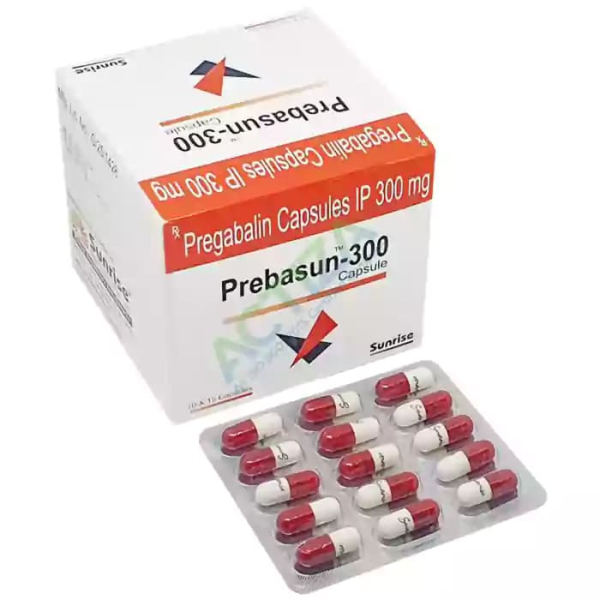
Prebasun 300 Mg (Pregabalin)

Medically reviewed by Sanjay Gangani, B.Pharm, CMO & Pharmacist

Active Ingredient Pregabalin
Indication Neuropathic pain
Manufacturer Sunrise Remedies Pvt Ltd
Strength:- 300mg
Packaging 15 Tablets in Strip

Prebasun 300 Mg (Pregabalin)

Pack Size Price Price/unit Quantity Add To Cart
90 Capsule/s $86 $0.96/Piece
180 Capsule/s $153 $0.85/Piece
300 Capsule/s $225 $0.75/Piece

WHAT IS PREBASUN 300 MG

  • Prebasun 300 mg is a pregabalin capsule.

  • Each capsule contains 300 mg of pregabalin.

  • Pregabalin is a prescription medicine for nerve pain and seizures.

  • It belongs to a group called gabapentinoids.

  • It is not an ordinary painkiller or anti-inflammatory.

  • It treats pain caused by damaged or irritated nerves.

  • That includes diabetic nerve pain in the feet and legs.

  • Prebasun 450 mg includes nerve pain after shingles.

  • It includes nerve pain after a spinal cord injury.

  • It is used as add-on treatment for certain seizures.

  • In Europe it is also approved for generalised anxiety disorder.

  • It works over days to weeks, not within minutes.

  • It can cause physical dependence and is misused by some people.

HOW IT WORKS (MECHANISM OF ACTION)

Step by step

  • Damaged nerves become overexcitable and fire too easily.

  • Nerve endings release signalling chemicals when calcium enters.

  • Pregabalin binds the alpha-2-delta subunit of calcium channels.

  • That subunit is an auxiliary part of the calcium channel.

  • Binding reduces calcium entry into the nerve ending.

  • Less calcium means less release of excitatory chemicals.

  • Those chemicals include glutamate, noradrenaline and substance P.

  • Nerve signalling therefore settles down.

  • Fewer pain signals reach the brain.

  • In epilepsy, the same effect limits seizure spread.

Two facts that drive every dosing rule

  • Pregabalin is barely metabolised by the liver.

  • It has negligible plasma protein binding.

  • So pharmacokinetic drug interactions are unlikely.

  • It is cleared almost entirely by the kidneys, unchanged.

  • So the dose must be cut when kidney function falls.

  • No dose change is needed in liver impairment.

  • It is not an opioid and does not act on opioid receptors.

  • It is not a benzodiazepine, although it can sedate like one.

  • It does not bind GABA receptors, despite the similar name.

  • It does not reduce inflammation.

  • It will not help ordinary muscle or joint pain.

DOSAGE GUIDE

Every dose is set by a doctor. Pregabalin is titrated upward over weeks and must never be stopped suddenly.

  • Every daily dose is divided into two or three doses.

  • A 300 mg capsule twice daily gives the 600 mg maximum.

  • Reaching that maximum takes at least two weeks of titration.

  • In anxiety, the need for treatment should be reassessed regularly.

  • Older patients often need a lower dose for this reason.

  • Never stop pregabalin suddenly.

  • Abrupt stopping can cause convulsions.

  • It can also cause insomnia, headache, nausea and anxiety.

  • It can also cause diarrhoea, sweating and depression.

  • Outside epilepsy, treatment should be as short as possible.

  • Children and adolescents under 18: not established, no dose given.

  • It can also cause diarrhoea, sweating and depression.

  • Liver impairment: no dose adjustment needed.

  • Take it with or without food.

HOW TO TAKE IT

Taking the capsule

  • Take it only on a doctor’s prescription.

  • Swallow the capsule whole with water.

  • Do not open, chew or crush the capsule.

  • It can be taken with or without food.

  • Take it at the same times every day.

  • Space two daily doses about 12 hours apart.

  • Space three daily doses about 8 hours apart.

  • Keep taking it even once symptoms improve.

  • Expect days to weeks before the full effect.

  • Dizziness, drowsiness and headache are very common at the start.

  • They usually settle as the body adjusts.

  • Do not drive until you know how it affects you.

  • Do not operate complex machinery.

  • Get up slowly from sitting or lying.

  • Falls have been reported, especially in older people.

Supply continuity, which matters at this dose

  • Reorder before the last strip is finished.

  • Do not skip doses to make a strip last longer.

  • Do not stop because symptoms have improved.

  • Tell the clinic at once if you cannot obtain a refill.

  • Coming off 600 mg a day needs a planned three-week taper.

  • Never drink alcohol with it; the effects add up.

  • Never combine it with an opioid without prescriber contact.

  • Never combine it with sedatives without medical advice.

  • Never raise your own dose.

  • Never stop it suddenly.

  • Never share your capsules with anyone else.

PRECAUTIONS

Absolute contraindications

  • Hypersensitivity to pregabalin or any excipient.

  • Stop it immediately if the face, mouth or airway swells.

  • Stop it immediately if a severe skin reaction develops.

Conditions to disclose to your doctor

  • Any kidney disease, or dialysis.

  • Congestive heart failure or cardiovascular compromise.

  • Any lung or neurological disease affecting breathing.

  • Sleep apnoea or any breathing problem during sleep.

  • Current treatment with opioid painkillers.

  • Current treatment with benzodiazepines or sleeping tablets.

  • Any history of drug or alcohol misuse.

  • Any history of depression or suicidal thoughts.

  • Diabetes, since weight gain may need a treatment change.

  • Any eye disease or previous vision loss.

  • Constipation, or opioid treatment causing it.

  • Spinal cord injury, or anti-spasticity treatment.

  • Pregnancy, planned pregnancy or breastfeeding.

  • Older age, which raises the falls and breathing risk.

Pregnancy, stated plainly

  • Pregabalin should not be used in pregnancy unless clearly necessary.

  • Women able to become pregnant must use effective contraception.

  • A Nordic study covered over 2,700 first-trimester exposures.

  • Major congenital malformations occurred in 5.9% of exposed pregnancies.

  • The unexposed comparison figure was 4.1%.

  • The adjusted prevalence ratio was 1.14, range 0.96 to 1.35.

  • That result was not statistically significant.

  • Pregabalin passes into breast milk; the infant effect is unknown.

Food, drink and lifestyle precautions

  • No food restrictions; take it with or without food.

  • Avoid alcohol completely; pregabalin potentiates its effects.

  • Do not use recreational sedatives with it.

  • Weigh yourself regularly; weight increase is common.

  • Watch for swelling of the ankles and feet.

  • Diabetic patients should monitor blood sugar if weight rises.

  • Eat enough fibre and fluid; constipation is common.

  • Do not drive until you know the effect on you.

  • Tell every doctor and dentist that you take it.

Before-use safety checklist

  • Do you have a prescription from a registered practitioner?

  • Has the cause of your symptoms been diagnosed?

  • Has your kidney function been measured?

  • Is your creatinine clearance 60 mL/min or more?

  • Have you already titrated up through lower strengths?

  • Is the intended daily dose within the cap for your condition?

  • Are you taking any opioid or sedative medicine?

  • Do you have any lung or breathing condition?

  • Could you be pregnant, and are you using contraception?

  • Has a taper plan been agreed for when you stop?

  • Do you have a reliable supply for the whole course?

  • Do you know which symptoms need emergency care?

SIDE EFFECTS

About 12% of patients stopped treatment because of side effects, compared with 5% on placebo.

SystemEffects
BloodLow neutrophil count
MetabolicLow blood sugar, loss of appetite
PsychiatricHallucinations, depression
Nervous systemFainting
Heart and circulationFast heartbeat, low or high blood pressure, heart failure
RespiratoryBreathlessness
SkinRash, hives, excessive sweating
Liver and urinaryRaised liver enzymes, urinary incontinence

Rare and very rare side effects

Frequency bandEffects
RareAngioedema, allergic reaction, suicidal ideation and behaviour
RareDisinhibition, convulsions, QT prolongation, pancreatitis
RareJaundice, renal failure, rhabdomyolysis, vision loss
Rare, skinStevens-Johnson syndrome and toxic epidermal necrolysis
Very rareHepatitis, liver failure
Frequency not knownDrug dependence, respiratory depression
  • Insomnia, headache, nausea and anxiety.

  • Diarrhoea, nervousness and depression.

  • Suicidal ideation, pain, sweating and dizziness.

  • Convulsions, which can occur without a history of epilepsy.

  • These are why the taper must be gradual.

  • Dependence and tolerance can occur at therapeutic doses.

  • Risk is higher with a history of substance misuse.

  • Risk is higher with a mental health disorder.

  • Pregabalin is a Schedule V controlled substance in the United States.

  • It became a Schedule H1 drug in India in May 2026.

  • Monitor for signs of misuse, abuse or dependence.

  • Drowsiness, confusion, agitation and restlessness.

  • Seizures have been reported.

  • Coma has occurred rarely.

  • Treatment is supportive and may include haemodialysis.

DRUG INTERACTIONS – AVOID WITH

The dangerous combinations

Medicine groupEffectInstruction
Opioid painkillersRespiratory failure, coma and deaths reported after marketingAvoid unless the prescriber has judged it necessary
Oxycodone specificallyAdditive impairment of thinking and movementAvoid
Benzodiazepines and lorazepamPregabalin may potentiate the effectAvoid
Sleeping tabletsAdded sedation and breathing depressionAvoid
AlcoholPregabalin may potentiate the effectAvoid completely

The FDA breathing warning

  • In December 2019 the FDA warned about serious breathing difficulties.

  • The warning covered gabapentinoids as a class.

  • Highest risk is in patients taking opioids.

  • Also in patients taking other central nervous system depressants.

  • Also in patients with underlying respiratory disease.

  • Also in elderly patients.

  • The advice is to start low and adjust for kidney function.

  • It also advises monitoring for sedation and breathing problems.

  • No clinically relevant interaction with phenytoin or carbamazepine.

  • No clinically relevant interaction with valproic acid or lamotrigine.

  • No clinically relevant interaction with gabapentin.

  • Oral contraceptives are not affected at steady state.

  • Its risks come from added sedation, not from changed blood levels.

EMERGENCY WARNING SIGNS

Signs of angioedema or a severe reaction

  • Swelling of the face, lips, gums, tongue or throat.

  • Difficulty breathing or swallowing.

  • Wheezing or a tight chest.

  • Widespread blistering, peeling skin or mouth sores.

  • A spreading rash with fever and feeling very unwell.

  • Very slow or shallow breathing.

  • Long pauses in breathing, especially during sleep.

  • Being hard to wake, or unresponsive.

  • Blue or grey lips or fingertips.

  • Severe confusion with heavy drowsiness.

  • Contact a doctor or poisons service immediately.

  • Take the pack so the dose is known.

  • Do not wait for symptoms to appear.

Mental health warning signs

  • New or worsening thoughts of self-harm or suicide.

  • New or worsening depression.

  • Sudden agitation, irritability or aggression.

  • Hallucinations or loss of touch with reality.

  • These need medical attention the same day.

  • A seizure, especially after a missed or stopped dose.

  • Unexplained muscle pain, tenderness or weakness.

  • Dark or cola-coloured urine with muscle pain.

  • Severe upper abdominal pain radiating to the back.

  • Yellowing of the eyes or skin.

  • Passing much less urine than usual.

  • Rapid leg swelling with breathlessness.

  • Sudden loss or blurring of vision.

WHY CHOOSE THIS MEDICINE

Points in favour of the molecule

  • Pregabalin is a first-line option for several nerve pain conditions.

  • Ordinary painkillers often do not help nerve pain at all.

  • It covers peripheral and central neuropathic pain in Europe.

  • It is also approved as add-on treatment for partial seizures.

  • It is barely metabolised, so enzyme interactions are few.

  • No dose change is needed in liver impairment.

  • It is taken two or three times a day, not more often.

  • A 300 mg capsule reduces the capsule count at the maximum dose.

  • Dizziness, drowsiness and headache are very common.

  • About 12% of patients stop because of side effects.

  • Weight gain and ankle swelling are common.

  • It can cause dependence at normal therapeutic doses.

  • Coming off 600 mg a day needs at least three weeks.

  • It is misused, which is why India tightened its control.

  • This strength needs full kidney function.

Points specific to this brand

  • I could not verify the manufacturer from an independent source.

  • I found no mainstream Indian retail listing for it.

  • I found no package insert for it online.

  • Verify the carton before you make any claim about the brand.

  • Do not describe it as a general painkiller.

  • Do not describe it as non-habit-forming.

  • Do not describe it as a sleep aid or relaxant.

  • Do not describe it as safe to combine with opioids.

  • Do not promote it for anxiety outside a prescription context.

  • Do not name a manufacturer you have not verified.

STORAGE INSTRUCTIONS

  • Print the storage instruction from your own carton.

  • The reference SmPC requires no special storage conditions.

  • A common Indian instruction is to store below 30 C.

  • Keep the capsules in the original blister until use.

  • Protect them from moisture and from light.

  • Do not store them in a bathroom cabinet.

  • Do not transfer them into an unlabelled container.

  • Keep them out of the sight and reach of children.

  • Do not use after the expiry date on the pack.

  • Return unused or expired capsules to a pharmacy.

  • Do not pass unused capsules to anyone else.

  • Keep retail stock in a secure, controlled location.

  • Investigate any discrepancy promptly.

  • Keep the register and prescription copies for three years.

  • Dispose of expired stock through a documented route.

  • Flag unusually large or frequent orders for pharmacist review.

Sanjay Gangani

Sanjay Gangani

B.Pharm, CMO & Pharmacist

Licensed pharmacist (B.Pharm) with 12+ years in clinical pharmacy and patient care. Reviews every article for evidence-based accuracy before it is published on ACTIZA Store.

Reviews

There are no reviews yet.

Be the first to review “Prebasun 300 Mg (Pregabalin)”

Your email address will not be published. Required fields are marked *

This site uses Akismet to reduce spam. Learn how your comment data is processed.

All Categories

Shopping Cart

0
×

Loading cart...