

Loading cart...
Mefloquine 250 Mg (Mefloquine)
Medically reviewed by Sanjay Gangani, B.Pharm, CMO & Pharmacist
| Active Ingredient | Mefloquine |
|---|---|
| Indication | Malaria |
| Manufacturer | Intas Pharmaceuticals Ltd |
| Strength:- | 250mg |
| Packaging | 2 tablets in strip |
| Dosage Form:- | Tablet |
| Country of Origin | India |
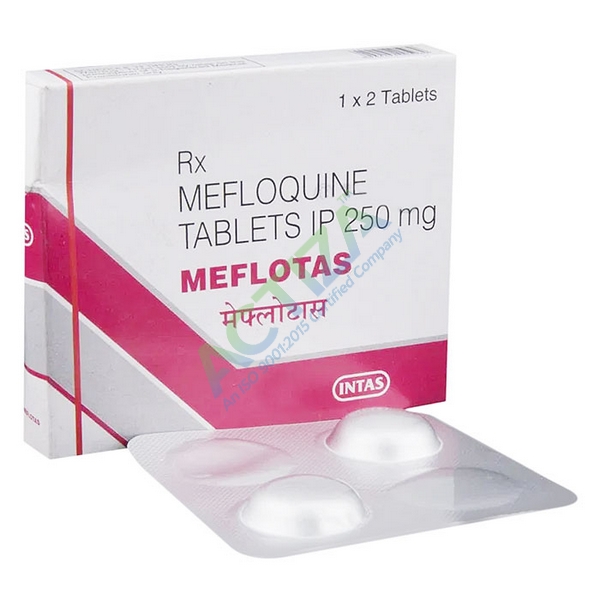
Mefloquine 250 Mg (Mefloquine) | ||||
|---|---|---|---|---|
| Pack Size | Price | Quantity | Add To Cart | |
| 50 Tablet/s | $55.5 | |||
| 100 Tablet/s | $96.2 | |||
| 200 Tablet/s | $162.8 | |||
What is Mefloquine 250 mg
Product identity
| Field | Detail |
| Generic name | Mefloquine (as mefloquine hydrochloride) |
| Strength on carton | 250 mg |
| Actual drug content | 228.0 mg base (US) or 250 mg base (UK) |
| Dosage form | Film-coated or plain tablet, oral |
| Drug class | Quinoline-methanol antimalarial |
| Primary use | Malaria prophylaxis and treatment |
| Dosing frequency | Once weekly for prevention |
| Indian brands checked | Mefliam (Cipla), Meflar (Acron), Mqf |
| Mefliam pack and MRP | Pack of 6, MRP Rs. 295.01 (Rs. 276.57 current) |
| Meflar pack and MRP | Strip of 10, MRP Rs. 380.00 |
| Mqf pack and MRP | Strip of 2, MRP Rs. 86.06 |
| Prescription status | Prescription required |
| Reference labels used | US FDA label and UK SmPC |
How it works (mechanism of action)
Dosage guide
Doses below are from the official labels. Your doctor decides yours.
Adult prevention (prophylaxis)
| Item | US FDA label | UK SmPC |
| Weekly dose | One 250 mg tablet | One tablet, about 5 mg/kg |
| First dose | 1 week before arrival | 10 days before departure |
| Second dose | One week later | 3 days before departure |
| During the stay | Same day each week | Same day each week |
| After leaving | Continue 4 weeks | Continue 4 weeks |
| Minimum course | Not specified | 6 weeks |
| Maximum duration | Not specified | 12 months |
Child prevention, by body weight
| Body weight | US FDA label weekly dose | UK SmPC weekly dose |
| 5 to 19 kg | Limited experience under 20 kg | One quarter tablet |
| 20 to 30 kg | Half tablet (125 mg) | Half tablet |
| 30 to 45 kg | Three quarter tablet (187.5 mg) | Three quarter tablet |
| Over 45 kg | One tablet (250 mg) | One tablet |
Treatment of uncomplicated malaria
| Regimen source | Adult total dose | How it is given |
| US FDA label | 1250 mg, five tablets | Single oral dose |
| US CDC | 1250 mg total | 750 mg, then 500 mg after 6 to 12 hours |
| UK SmPC | 20 to 25 mg/kg | Two or three doses, 6 to 8 hours apart |
| UK SmPC, over 60 kg | Six tablets | Split across the doses above |
How to take it
Precautions
Absolute contraindications
Conditions to disclose to your doctor
Food and drink precautions
Before-use safety checklist
Side effects
Common side effects
| Side effect | What to do |
| Dizziness | Avoid driving and report it to your doctor |
| Nausea | Take the dose after a fuller meal |
| Vomiting | Follow the repeat-dose rules in section 4 |
| Headache | Report if severe or persistent |
| Diarrhoea | Keep fluids up and tell your doctor |
| Abdominal pain | Report if persistent |
| Loss of appetite | Monitor and report weight loss |
| Muscle pain | Report if it limits movement |
| Fatigue | Rest and report if it worsens |
| Ringing in the ears | Stop and contact your doctor |
| Skin rash | Stop and contact your doctor |
| Fever and chills | May be malaria itself, seek review |
Less common but serious side effects
| Side effect | Why it matters |
| Anxiety or panic | May be an early sign of a serious reaction |
| Depression | May persist for months after stopping |
| Nightmares or insomnia | Recognised early warning sign |
| Confusion | Recognised early warning sign |
| Paranoia or mistrust | Needs the drug stopped and reviewed |
| Hallucinations | Needs urgent medical review |
| Suicidal thoughts | Needs emergency medical help |
| Vertigo or loss of balance | May be persistent or permanent |
| Convulsions | Needs emergency care |
| QT prolongation on ECG | A heart rhythm risk |
| Liver injury | Watch for jaundice and dark urine |
| Agranulocytosis | Low white cells, infection risk |
| Aplastic anaemia | Bone marrow failure, rare |
Drug interactions – avoid with
| Drug or group | Why it must be avoided or watched |
| Halofantrine | Contraindicated now and for 15 weeks after |
| Ketoconazole | Raises levels, QT risk, same 15-week window |
| Quinine or quinidine | ECG abnormalities, wait 12 hours after quinine |
| Chloroquine | ECG abnormalities and seizure risk |
| Antiarrhythmic drugs | Added QT prolongation |
| Beta-blockers | Added QT prolongation |
| Calcium channel blockers | Added QT prolongation |
| Antihistamines | Added QT prolongation |
| Tricyclic antidepressants | QT risk and lower seizure threshold |
| Phenothiazines | Added QT prolongation |
| Valproate, carbamazepine | Their levels may fall, monitor |
| Phenobarbital, phenytoin | Their levels may fall, monitor |
| SSRIs and bupropion | Lower the seizure threshold |
| Antipsychotics | Lower the seizure threshold |
| Tramadol | Lowers the seizure threshold |
| Rifampicin | Lowers mefloquine levels |
| Efavirenz | May change mefloquine levels |
| Propranolol | One report of cardiopulmonary arrest |
| Oral live typhoid vaccine | Finish it 3 days before the first dose |
| Anticoagulants | Check response before travel |
| Diabetes medicines | Check response before travel |
Emergency warning signs
Why choose this medicine
Reasons it may not suit you
Storage instructions

B.Pharm, CMO & Pharmacist
Licensed pharmacist (B.Pharm) with 12+ years in clinical pharmacy and patient care. Reviews every article for evidence-based accuracy before it is published on ACTIZA Store.
Reviews
There are no reviews yet.