


Yes. There is a well-known link between diabetes and penis health. Over time, high blood sugar damages blood vessels and nerves. Living with diabetes can also contribute to psychological stress, anxiety or depression, which may affect sexual health.
Diabetes can affect sexual health through vascular and nerve damage, hormonal changes and psychological factors, which may contribute to erectile dysfunction and, in some men, low testosterone.
According to a study, diabetes and ED are very common together, and 52.5% of men with diabetes[1] suffered with ED. The NIDDK states that men with diabetes can get ED 10 to 15 years[2] before men without diabetes.
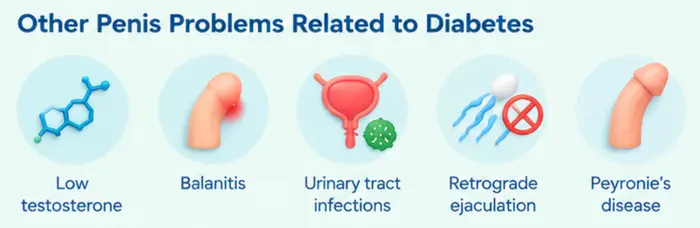
There are other penis problems related to diabetes. These include low testosterone, balanitis, urinary tract infections[2], retrograde ejaculation, and Peyronie’s disease.
Good blood sugar control can reduce the risk of some diabetes-related complications and may help manage these problems. Treatments exist for each of these conditions if they occur. ED can also be a sign of undiagnosed heart disease and/or diabetes.
How and Why Diabetes Damages Penile and Sexual health
Vascular Damage – Endothelial Dysfunction and Blood Flow
An erection depends on healthy arteries. High blood sugar damages the endothelium (lining of blood vessels), reduces nitric oxide-mediated relaxation and promotes the buildup of plaque. This reduces blood flow to the corpora cavernosa (erectile tissue of the penis).
Nerve Damage – Diabetic Autonomic & Peripheral Neuropathy
Autonomic neuropathy affects nerve signals that result in erection and control ejaculation. Peripheral neuropathy can lessen genital sensations.

Hormonal Effects – Diabetes and Low Testosterone
Type 2 diabetes, insulin resistance and obesity are associated with lower testosterone levels, which may affect libido and erectile function.
Psychological Effects – Depression, Anxiety, Stress
Living with a chronic illness can contribute to depression, anxiety and stress, which may further affect erections and sexual desire.
The bottom line – high blood sugar is the driver; control is protective
Persistently elevated blood glucose can contribute to several of these mechanisms. Keeping blood glucose within the recommended target range, maintaining a healthy weight, avoiding smoking and staying physically active can help reduce the risk of diabetes-related sexual and urogenital complications.
The main Penile & Urogenital Conditions Linked to Diabetes
| Condition | Cause / mechanism | Key symptoms | First-line treatment |
|---|---|---|---|
| Erectile dysfunction | Vascular and nerve damage, low testosterone, psychological factors | Trouble getting or keeping an erection | Glucose control, lifestyle, PDE5 inhibitors |
| Low testosterone | Insulin resistance, obesity | Low libido, fatigue, low mood | Weight loss; therapy if confirmed and symptomatic |
| Balanitis / thrush | Glucose-rich urine feeds Candida | Redness, itching, discharge | Antifungals, glucose control, hygiene |
| UTIs | High glucose favors bacteria | Painful, frequent urination | Antibiotics, glucose control |
| Fournier’s gangrene (rare) | Necrotizing perineal infection | Severe pain, swelling, fever | Emergency surgery, IV antibiotics |
| Retrograde ejaculation | Autonomic neuropathy of bladder neck | Dry orgasm, cloudy urine | Treat cause; fertility options |
| Peyronie’s disease | Fibrous plaque | Curvature, pain | Urology referral |
Erectile dysfunction (ED) – The Flagship
Diabetes and erectile dysfunction (ED) can occur together. Type 1 Diabetes had an ED prevalence of 37.5%[1], and Type 2 Diabetes had 66.3%. Men with diabetes had 3.62 times the odds of ED, compared to men in the control group.

Causes/mechanisms
Damage to the arteries, neuropathy, low testosterone and psychological stress occur together.
Symptoms
Difficulty in achieving or maintaining an erection, or decreased firmness.
Treatment (PDE5i → injections/VED → implants)
Management typically includes blood glucose control and lifestyle measures, with PDE5 inhibitors commonly used as first-line medical treatment when appropriate. If PDE5 inhibitors are ineffective or unsuitable, options may include intracavernosal injections, vacuum erection devices and, for refractory cases, penile prosthesis surgery.
In men with diabetes, PDE5 inhibitors may be less effective in some cases, so a clinician may consider other treatment options if the response is inadequate.
Low testosterone (hypogonadism)
Estimates of the prevalence of low testosterone vary for a number of reasons, as diabetes and low testosterone are linked. The reasons include how testosterone is defined (total versus free), the cutoff, and whether obesity is present in the study population.
One study found that 43% of men with type 2 diabetes[3] had low total testosterone, compared to 7% of men with type 1 diabetes[3].
Symptoms include decreased libido, increased fatigability and moodiness. Diagnosis generally requires compatible symptoms together with consistently low morning testosterone levels confirmed by repeat testing.
For men with obesity and low testosterone, weight management is an important part of treatment.
Balanitis & genital thrush (Candida)
Balanitis is inflammation of the glans (head of the penis) and may be caused by Candida infection, particularly in men with diabetes.
This can cause redness, itching, discharge, and soreness. It occurs most often in uncircumcised men.
Treatment includes antifungal medication, blood sugar control, and improved hygiene. Recurrent balanitis may warrant assessment for underlying conditions such as diabetes, as well as other possible causes.
Why high blood sugar causes it
Glucose in the urine feeds the yeast under the foreskin, and high glucose levels weaken the local immune system.
SGLT2 inhibitors
SGLT2 inhibitors increase glucose excretion in the urine and are associated with an increased risk of genital mycotic infections. A real-world cohort showed a 2.47-fold higher risk of genital mycotic infection within 30 days compared to DPP-4 inhibitors.
Phimosis as a complication
Repeated infections can scar the foreskin, making retraction even more difficult and painful. In such cases, circumcision may be necessary.
Urinary tract infections & Fournier’s gangrene (rare emergency)
People with diabetes are more prone to urinary tract infections, and good blood glucose control may help reduce the risk. Fournier’s gangrene is a necrotising infection of the perineum and is rare.
Between March 2013 and May 2018, the FDA identified 12 reported cases of Fournier’s gangrene in patients taking SGLT2 inhibitors, including 7 men and 5 women.
This condition presents with a combination of severe genital or perineal pain and swelling or inflammation with fever and should be considered a medical emergency.

Retrograde ejaculation & reduced sensation
NIDDK notes that diabetes may cause retrograde ejaculation, in which semen enters the bladder instead of being expelled through the penis. Retrograde ejaculation is generally not dangerous, but it can affect fertility.
Penile neuropathy can also reduce the sensation in the penis.
Peyronie’s disease (penile curvature)
Diabetes has been associated with an increased risk of Peyronie’s disease, a condition characterised by fibrous plaques and penile curvature.
One study of men with diabetes and ED reported Peyronie’s disease in 20.3% of participants; this finding should not be interpreted as the prevalence among all men with diabetes.
Reduced libido
Low sex drive has many potential causes and usually is multifactorial. Low testosterone, fatigue, depression, and some medications are among the possible causes. Treatment depends on the underlying cause.
Symptoms to watch for
Is ED an early warning sign of diabetes or heart disease?
Yes, in some cases. The Mayo Clinic notes that ED can be associated with blood-vessel dysfunction and reduced blood flow, and that it may occur before symptoms of cardiovascular disease become apparent.
Because penile arteries are smaller than many other arteries, erectile dysfunction may become apparent before symptoms of cardiovascular disease. ED is a reason to assess the whole of cardiometabolic health of the individual, and not just the ED symptom.
Risk factors that make it worse

How doctors diagnose these problems
History and questionnaires such as the IIEF-5 (SHIM) are used for diagnosis. Depending on the clinical situation, testing may include HbA1c, blood glucose and morning total testosterone. A repeat testosterone test may be needed to confirm a low result, with LH and FSH testing when clinically indicated.
Exams of the genitalia and/or swab and urine culture may follow. A post-ejaculation urine test is ordered to evaluate for retrograde ejaculation. BP and cholesterol levels are also assessed.
Treatment & management
ED Treatment Options Compared
| Option | How it works | Notes / cautions |
|---|---|---|
| Glycemic control + lifestyle | Reduces vessel and nerve damage | Foundation of treatment; may partly reverse ED |
| PDE5 inhibitors (sildenafil, tadalafil, vardenafil, avanafil) | Relax smooth muscle to increase blood inflow | First-line; nitrate contraindication; may work less well in diabetes |
| Intracavernosal injections | Directly relax erectile tissue | Second-line; priapism risk |
| Vacuum erection device | Draws blood in; ring maintains it | Non-invasive; bruising possible |
| Testosterone therapy | Corrects confirmed low testosterone | Only if symptomatic and consistently low |
| Penile prosthesis | Surgically implanted device | For refractory ED; infection risk, higher in diabetes |
Sildenafil and tadalafil are PDE5 inhibitors. They are contraindicated with all organic nitrates. The combination with organic nitrates can cause a significant decrease in blood pressure.
Alpha-blockers should also be used with caution. All decisions relating to medication choices and doses should be made by a licensed clinician.
Other management points:
Can you prevent or reverse it? What the evidence shows
Prevention of ED is to keep HbA1c, blood pressure and cholesterol levels in their target ranges. This includes maintaining an ideal body weight, regular exercise, smoking cessation, and attending annual reviews. The earlier the intervention for ED, the better the chances of success.
In clinical studies, a modified lifestyle with weight loss and exercise improved erectile function. Improvements in weight, physical activity and cardiovascular health may improve erectile function by supporting vascular health and blood flow.
ED itself is generally not life-threatening, but it can be associated with underlying cardiovascular or metabolic disease, and longstanding nerve or tissue damage may not be completely reversible.
When to see a doctor
Severe genital pain, swelling, or redness with a fever, nausea, and/or feeling very unwell needs to be seen immediately.
FAQ
Q1:- Can diabetes affect penis health?
Ans:- Yes. Diabetes can impact penis health through a few different pathways. The first is through damage to blood vessels and nerves. Low testosterone can also occur and has many impacts as well. Some examples of this would be erectile dysfunction, reduced sensitivity, balanitis, and penile curvature. Good blood sugar control and healthy lifestyle habits can help prevent and improve this.
Q2:- Can diabetes cause erectile dysfunction?
Ans:- Yes. Erectile dysfunction is a common sexual problem among men with diabetes. One study reported ED in 52.5% of men with diabetes. NIDDK notes that ED may occur 10-15 years earlier in men with diabetes than in men without diabetes.
Q3:- Is diabetes-related ED reversible?
Ans:- Yes, especially if it is in the earlier stages. Some lifestyle and health improvements can help prevent further damage and improve erectile function. Established damage may not be reversible, but improvements can still be made with certain treatments.
Q4:- Why does diabetes cause genital itching or thrush in men?
Ans:- Genital itching in men with diabetes may be caused by balanitis or a Candida infection. Diabetes can increase susceptibility to genital infections, particularly when blood glucose levels are poorly controlled. High blood sugar allows glucose to be in the urine and balanitis to occur. Good blood sugar control and infection control can help this.
Q5:- Can controlling blood sugar improve erections?
Ans:- Yes. Good blood glucose control may support vascular and nerve health and can help improve overall sexual health. Good blood glucose control may also help reduce the risk of diabetes-related complications, including some genital infections and cardiovascular complications.
Q6:- Does diabetes lower testosterone?
Ans:- Low testosterone is more commonly associated with type 2 diabetes, particularly in men with obesity or insulin resistance. Various studies have shown a range of impacts, and one study showed that 43% of the subjects had low total testosterone. Low testosterone may contribute to low libido, fatigue and erectile difficulties. Diagnosis requires the presence of symptoms and low testosterone levels in the morning.
Q7:- Can diabetes cause permanent ED?
Ans:- Yes, high blood sugar can damage nerves and blood vessels. However, ED is not always permanent, and the chances for improvement are better with early treatment. Long-standing ED can still be treated, although the appropriate treatment depends on the underlying cause and severity.
Q8:- What is the best ED treatment for men with diabetes?
Ans:- Managing blood glucose, weight and other cardiovascular risk factors is an important part of ED treatment in men with diabetes. PDE5 inhibitors are commonly used as first-line medical treatment when appropriate. With inadequate response to treatment, second-line therapy may include the use of injectable medications or vacuum devices. These treatments are not to be used in conjunction with nitrate medications.
Q9:- Is ED an early sign of diabetes or heart disease?
Ans:- Yes, it can. ED may sometimes occur before symptoms of cardiovascular disease become apparent and can also be associated with undiagnosed diabetes. New or worsening ED warrants evaluation for underlying cardiovascular and metabolic risk factors.
Q10:- Can diabetes cause foreskin problems?
Ans:- Yes. Diabetes can increase the risk of balanitis and recurrent genital infections. Repeated inflammation can contribute to phimosis. Treatment depends on the cause and may include antifungal treatment and blood glucose management; severe or recurrent cases may require specialist assessment.
Q11:- Do diabetes medications affect penis health?
Ans:- Yes. SGLT2 inhibitors increase the risk of genital mycotic infections and have also been associated with the rare but serious condition Fournier’s gangrene. Genital redness, swelling, or pain need to be reported to the doctor immediately. Do not stop an SGLT2 inhibitor without speaking to your healthcare professional.
Q12:- Can diabetes cause retrograde ejaculation?
Ans:- Yes, this is due to autonomic neuropathy. The muscle that controls the bladder neck is weakened and allows semen to flow back into the bladder. The ejaculate is very small, and urine is cloudy. Retrograde ejaculation is generally not dangerous, but it can affect fertility. It is best to see a urologist for this.
Disclaimer: This article is for educational use only. It should not be used to make decisions about your health or treatment. Always consult with your doctor for health concerns.
- https://onlinelibrary.wiley.com/doi/10.1111/dme.13403
- https://www.niddk.nih.gov/health-information/diabetes/overview/preventing-problems/sexual-bladder-problems
- https://academic.oup.com/jcem/article/93/5/1834/2598879