Happy Diwali!•Our team is celebrating the festival of lights.•You can order and pay as usual; all orders ship from 16 November.Happy Diwali!•Our team is celebrating the festival of lights.•You can order and pay as usual; all orders ship from 16 November.Happy Diwali!•Our team is celebrating the festival of lights.•You can order and pay as usual; all orders ship from 16 November.
Happy Diwali!•Our team is celebrating the festival of lights.•You can order and pay as usual; all orders ship from 16 November.Happy Diwali!•Our team is celebrating the festival of lights.•You can order and pay as usual; all orders ship from 16 November.Happy Diwali!•Our team is celebrating the festival of lights.•You can order and pay as usual; all orders ship from 16 November.
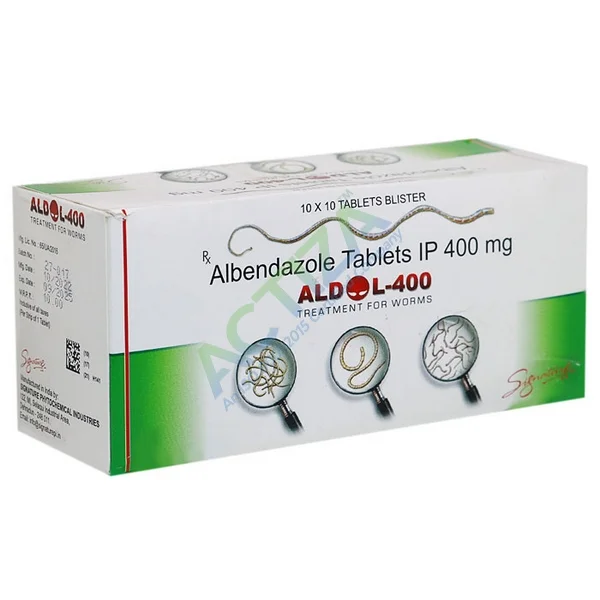
Albendazole is a benzimidazole anthelmintic a medicine that kills parasitic worms.
At 400 mg it is widely used as a single dose for common intestinal worm infections, including roundworm, hookworm, whipworm and threadworm.
It is approved in the US for parenchymal neurocysticercosis due to active lesions caused by larval forms of the pork tapeworm,
It is also approved for cystic hydatid disease of the liver, lung and peritoneum, caused by the larval form of the dog tapeworm.
Aldol 400mg is used in mass deworming programmes worldwide, and alongside ivermectin in lymphatic filariasis.
It must be taken with food.
Some people, particularly children, may experience difficulty swallowing the tablets.
It is a prescription medicine in many markets.
How It Works (Mechanism of Action)
Worms need a supply of energy to survive, chiefly glucose.
Their cells contain structures called microtubules, built from a protein called tubulin.
Albendazole binds to that tubulin and prevents the microtubules forming.
The worm can no longer take up glucose from its surroundings.
Its energy stores are depleted.
The worm becomes immobilised and dies.
For intestinal worms, the dead worms are then passed out in the stool.
Why human cells are largely unaffected:
albendazole binds far more strongly to parasite tubulin than to the equivalent human protein, which is the basis of its selectivity.
Why food matters so much:
albendazole itself is poorly soluble and poorly absorbed. It is converted in the liver to albendazole sulfoxide, the active form in tissues. A fatty meal increases absorption several-fold, which is essential when treating cysts in the liver, lung or brain and largely irrelevant when killing worms living in the gut.
Dosage Guide
Indication
Patient weight
Dose
Duration
Common intestinal worms
Adults and children over 2
400 mg as a single dose
One dose
Threadworm (pinworm)
–
400 mg single dose
A second dose after 2 weeks is often advised
Hydatid disease
60 kg or greater
400 mg twice daily with meals
28-day cycle, then a 14-day albendazole-free interval, for a total of 3 cycles
Hydatid disease
Less than 60 kg
15 mg/kg/day in divided doses twice daily with meals (max 800 mg/day)
As above
Neurocysticercosis
60 kg or greater
400 mg twice daily with meals
8 to 30 days
Neurocysticercosis
Less than 60 kg
15 mg/kg/day in divided doses twice daily with meals (max 800 mg/day)
8 to 30 days
All uses
–
Take with food
–
On threadworm:
reinfection is common because eggs survive on bedding, clothing and under fingernails. Treating the whole household at the same time, washing bedding, and strict handwashing are as important as the tablet.
How to Take It
Take it exactly as directed by your doctor.
Take the tablet with food – ideally a meal containing some fat.
Swallow with water.
If swallowing is difficult, ask your pharmacist – some people, particularly children, struggle with these tablets.
For a single-dose treatment, that is the whole course.
For a long course, take it twice daily with meals, exactly as scheduled.
Attend all blood test appointments if you are on a long course.
Complete the full course for tissue infections.
Do not take it if you might be pregnant – have a pregnancy test first.
Tell your prescriber immediately if you become pregnant.
Treat the whole household at the same time for threadworm.
Wash bedding, nightwear and towels on a hot wash.
Keep fingernails short and wash hands thoroughly.
Do not share this medicine with anyone else.
Precautions
Do Not Use If You
Are hypersensitive to albendazole or any benzimidazole.
Are pregnant, or think you might be, unless a doctor has weighed the risks.
Are breastfeeding, unless advised by a doctor.
Tell Your Doctor Before Taking If You
Could be pregnant, or are planning pregnancy a pregnancy test is required.
Are breastfeeding.
Have liver disease – increased risk of bone marrow suppression.
Have hepatic echinococcosis – the same increased risk.
Have any blood disorder, or low blood counts.
Have kidney problems.
Have had a reaction to a worm treatment before.
Have retinal lesions, if being treated for neurocysticercosis.
Are being treated for a brain or eye parasite.
Take any other medicine, including over-the-counter products.
Are giving it to a young child.
Interactions
Interacting medicine
Effect
Cimetidine
Raises albendazole sulfoxide levels in hydatid cyst fluid
Dexamethasone
Increases albendazole sulfoxide levels
Praziquantel
Increases albendazole sulfoxide levels
Theophylline
Studied; single-dose albendazole did not meaningfully alter theophylline pharmacokinetics
Some of these interactions are used deliberately – steroids are given alongside albendazole in neurocysticercosis, and the increase in drug levels is part of the treatment plan rather than a problem.
Monitoring for Long Courses
Test
When
Why
Pregnancy test
Before prescribing to women of reproductive potential
Albendazole may cause fetal harm
Blood count
At the start of each 28-day cycle, and every 2 weeks during therapy
Bone marrow suppression, aplastic anaemia, agranulocytosis
Blood count, more frequently
In liver disease or hepatic echinococcosis
Increased risk
Liver function
During therapy
Hepatitis and jaundice reported at high doses
Before-Use Checklist
I know whether this is a single dose or a long course.
I will take it with food.
I am not pregnant, and have had a test if required.
I am not breastfeeding, or have checked with my doctor.
My doctor knows about any liver disease or blood disorder.
Zentel 400 mg this is a long course, my blood monitoring is arranged.
If this is for neurocysticercosis, steroid and anticonvulsant cover is in place.
If this is for threadworm, the whole household is being treated.
I know a second dose after 2 weeks may be needed for threadworm.
I know the warning signs listed below.
Side Effects
A single dose for intestinal worms is generally very well tolerated. The risks below relate mainly to high-dose, long-course treatment.
Side Effect
Notes
Abdominal pain
Common
Nausea and vomiting
Common
Headache
Common; with single doses a week apart, headache and dizziness usually subside before the next dose
Dizziness
Common; usually transient
Diarrhoea
Reported
Raised liver enzymes
Reported at low dose; more with high dose
Hepatitis and jaundice
Reported with high-dose treatment
Reversible hair loss
Reported with longer courses
Fever
Reported in long courses
Bone marrow suppression
Long courses — see section 7
Aplastic anaemia
Rare but serious
Agranulocytosis
Rare but serious
Allergic reactions, including rash
Stop and seek advice
Seizures or raised intracranial pressure
In neurocysticercosis, from the inflammatory response
On headache and dizziness after a single dose:
these are the commonest complaints, and they typically settle on their own.
Persistent nausea with upper right abdominal pain.
Seizures.
Severe headache.
Visual disturbance.
Confusion.
Swelling of the face, lips, tongue or throat.
Difficulty breathing.
Widespread rash or blistering.
On neurocysticercosis:
as parasites in the brain die, the inflammatory response can cause seizures and raised pressure inside the skull. This is why steroid and anticonvulsant cover is required, and why the treatment is managed by a specialist.
If you become pregnant while taking albendazole, or discover you were pregnant when you took it, tell your prescriber. Published data on single-dose exposure is reassuring, but your doctor should know.
What to Know About This Medicine
Genuine advantages:
A single dose clears most common intestinal worm infections.
Inexpensive, and one of the most widely used medicines in the world.
Used in mass deworming programmes globally.
Effective against a broad range of worms.
Generally very well tolerated at single doses – the likelihood of significant risks in a healthy person receiving a single dose is low.
Also effective against tissue parasites that few other medicines reach.
It must be taken with food, or absorption is poor.
A pregnancy test is required before prescribing to women of reproductive potential.
Long courses require blood count and liver monitoring.
Bone marrow suppression, aplastic anaemia and agranulocytosis have been reported.
Hepatitis and jaundice have been reported at high doses.
Neurocysticercosis treatment requires steroid and anticonvulsant cover and specialist management.
Tablets can be difficult for children to swallow.
On deworming without a diagnosis:
routine deworming is standard public health practice in many countries. But persistent abdominal symptoms, weight loss or blood in the stool are not reasons to self-treat with a worm tablet – they need a diagnosis.
Bottom line:
at a single 400 mg dose this is one of the safest and most useful medicines available. The warnings on this page largely belong to the other use weeks of high-dose treatment for cysts in the liver, lungs or brain which is a specialist undertaking.
Storage Instructions
Store below 30°C in a cool, dry place.
Keep tablets in the original pack.
Protect from moisture and direct sunlight.
Do not store in the bathroom.
Do not transfer tablets into unlabelled containers.
Licensed pharmacist (B.Pharm) with 12+ years in clinical pharmacy and patient care. Reviews every article for evidence-based accuracy before it is published on ACTIZA Store.
Reviews
There are no reviews yet.
Be the first to review “Albendazole Tablet (Aldol 400Mg)” Cancel reply



Reviews
There are no reviews yet.