

Loading cart...
1 / 4
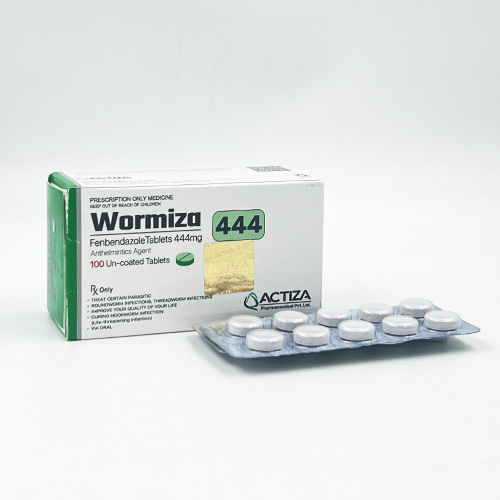
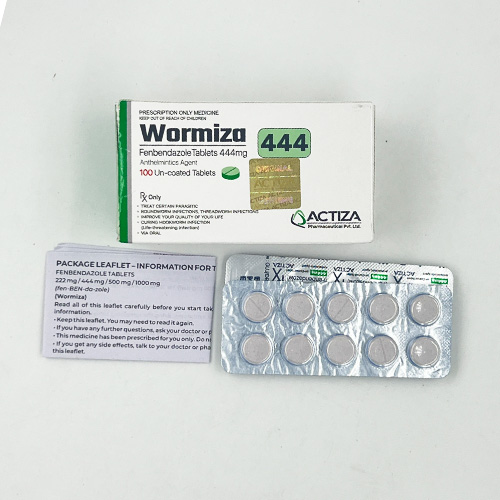
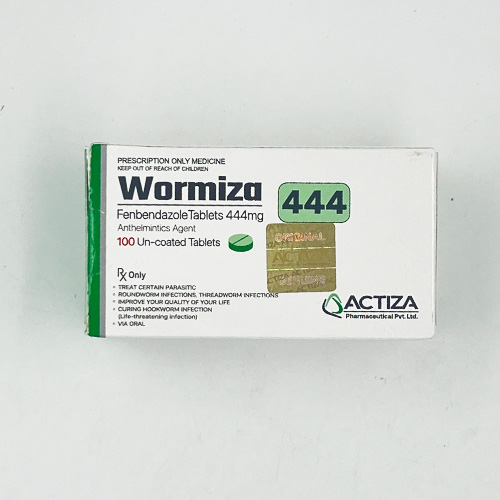
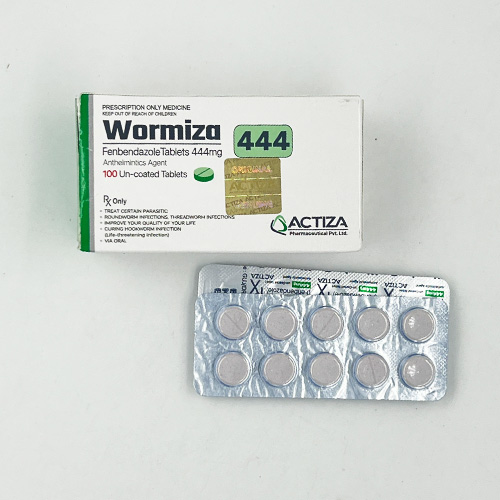
Wormiza 444 mg (Fenbendazole)
Medically reviewed by Sanjay Gangani, B.Pharm, CMO & Pharmacist
| Active Ingredient | Fenbendazole |
|---|---|
| Indication | Treatment of intestinal parasitic (worm) infections |
| Manufacturer | Actiza Pharmaceutical Pvt. Ltd. |
| Strength:- | 444mg |
| Packaging | Box of 100 un-coated tablets |
| Dosage Form:- | Tablet |
| Country of Origin | India |
Wormiza 444 mg (Fenbendazole) | ||||
|---|---|---|---|---|
| Pack Size | Price | Quantity | Add To Cart | |
| 100 Tablet/s | $38 | |||
| 200 Tablet/s | $68 | |||
| 300 Tablet/s | $92 | |||
Regulatory Status & Safety Notices
What is Wormiza 444 Mg?
Wormiza 444 Mg is a tablet form of fenbendazole. Fenbendazole is a benzimidazole antiparasitic. In simple terms, it belongs to the same broad drug family as mebendazole and albendazole, which are approved for human use in many places. Fenbendazole, however, is mainly used in animals, not in humans.
The chemical name of fenbendazole is methyl N-(6-phenylsulfanyl-1H-benzimidazol-2-yl)carbamate. After oral administration, most of the drug’s action is expected in the gastrointestinal tract, as the compound has low water solubility and low oral bioavailability. Poor absorption is one of the biggest limitations in human use.
So the simplest way to describe Wormiza 444 Mg is this: it is a fenbendazole tablet under investigation for human use, but it is not a standard approved human medicine.
Key Features of Wormiza 444 Mg
Wormiza 444 Mg has a few clear features. It contains fenbendazole, which is a benzimidazole anthelmintic. Its closest human-approved class relatives are mebendazole and albendazole.
Its best-known traditional role is as an antiparasitic against intestinal worms in animals. It is also being studied in preclinical cancer research, but that work is still early and has not been proven in humans.
Another key feature is the dose strength. 444 mg is one of the strengths often discussed in online human-use communities. But that does not mean it is a validated human dose. It is simply one of the amounts people talk about in anecdotal use.
The product should be stored at room temperature (15-30°C) and protected from moisture and light. That makes handling simple, but it does not change the main fact that human use remains investigational.
Composition
Each Wormiza 444 Mg tablet contains fenbendazole as the active ingredient. Fenbendazole belongs to the benzimidazole class. This class is known for targeting β-tubulin, a protein required for microtubule formation. That is the basis of its antiparasitic action.
Its class relationship matters because it helps explain why fenbendazole is often compared with mebendazole and albendazole. Those drugs are human-approved benzimidazoles with formal dosing and strong human data. Fenbendazole does not have that same level of human evidence.
Mechanism of Action
Antiparasitic Mechanism:
Fenbendazole binds to β-tubulin in parasites. This blocks the building of microtubules. Microtubules are needed for cell division, nutrient transport, glucose uptake, and normal cell structure. When the parasite cannot build microtubules, it loses function and eventually dies.
This effect is strongest where drug levels are highest, which is usually in the gut after oral dosing. That is why fenbendazole has long been useful as a veterinary deworming agent. Human cells are less affected because human tubulin does not bind the drug as strongly as parasite tubulin.
Proposed Anti-Cancer Mechanisms (Preclinical Research – NOT Clinically Proven):
Researchers have studied several possible anti-cancer actions in cell culture and animal models. These findings are interesting, but they are still preclinical only. A major problem is poor oral bioavailability.
Even if the drug works in a lab dish, human oral dosing may not create high enough levels in the blood or solid tumors. This is a major pharmacokinetic barrier that has not been solved in standard oral human use.
These include:
Antiparasitic Uses in Humans
Still, for humans, the usual approved benzimidazole choices are mebendazole and albendazole. They have formal approval, defined dosing, and strong human safety data. Fenbendazole does not. So any human antiparasitic use is still off-label and poorly standardized. Fenbendazole is not approved for human use, but based on class effect and veterinary experience, it has been discussed for intestinal parasites such as:
Benefits of Wormiza 444 Mg
The potential benefits of Wormiza 444 Mg should be described carefully.
First, fenbendazole is part of a well-known antiparasitic drug class. Second, it has a long history of use in animals. Third, it has attracted research interest due to its preclinical anticancer findings. These points explain why people search for it.
But these are not the same as proven human treatment benefits. The most honest way to say it is this: Wormiza 444 Mg may be useful to people researching benzimidazole compounds, especially those comparing fenbendazole with mebendazole or albendazole, but its real benefit in humans has not been established in completed trials.
Other Dosage
Dosage – What Is Known
There is no approved or validated human dosage for fenbendazole. What is discussed online comes from anecdotal use, not from formal human dose-finding trials.
These are not medical recommendations. They do not solve the core problem of low oral absorption. Even when the oral dose is increased, systemic exposure may still be too low for reliable effects outside the gut.
Commonly discussed patterns include:
Administration Notes:
If human use is being considered at all, regular ALT/AST monitoring is essential.
A few points are often mentioned in anecdotal use:
Known Side Effects in Humans
Because there are no large completed human trials, side-effect data are limited. What we know comes from case reports, class effects, and anecdotal reports.
Reported problems include:
The most serious documented risk is liver injury. Published reports describe severe drug-induced liver injury in humans taking fenbendazole. One reported case involved a woman with lung cancer whose severe liver injury was linked to fenbendazole and improved after the drug was stopped.
That is why liver monitoring is so important. Baseline ALT/AST should be checked before use, then checked again at about 4 weeks, and monthly thereafter if use continues. Stop the drug right away if jaundice, dark urine, fatigue, or right upper abdominal pain appear.
Safety Compared to Other Benzimidazoles:
Compared with mebendazole and albendazole, fenbendazole has a much weaker evidence base in humans. Mebendazole and albendazole have formal approval, standard human dosing, and decades of human safety data. Fenbendazole does not.
All three are in the same drug class, and all can raise liver concerns, but only mebendazole and albendazole have well-established human use profiles. Animal safety alone is not enough to prove human safety.
Contraindications & Cautions
The biggest caution is simple: if a patient already has a complex medical condition, the lack of strong human data makes unsupervised fenbendazole use risky.
Wormiza 444 Mg should be avoided or used with strong caution in these settings:
Drug Interactions
The most important rule is full disclosure. If someone is taking fenbendazole, all doctors involved in their care should know. This matters even more in cancer treatment, liver disease, and anticoagulant use.
Human interaction data are limited, but several concerns matter:
Storage & Handling
Store Wormiza 444 Mg at 15-30°C. Keep it away from moisture, heat, and direct light. Keep it in the original package until use. Keep it out of reach of children and pets. Do not use expired tablets.
Why Choose Wormiza 444 Mg?
Wormiza 444 Mg may be useful for buyers seeking a pharmaceutical-grade fenbendazole tablet manufactured under strict manufacturing standards, rather than a veterinary-labeled retail product.
This does not change the regulatory fact. It remains unapproved for human use by major human regulators. But for people researching fenbendazole as a molecule, a structured tablet product may be easier to review than mixed informal sources.
For some buyers, the value is in having:
Conclusion
Wormiza 444 Mg contains fenbendazole, a benzimidazole antiparasitic best known in veterinary medicine. Its core action is clear: it binds to β-tubulin, disrupts microtubules, and harms parasite survival. That same biology also drew interest in preclinical cancer research.
But the main clinical message is caution. Fenbendazole is not approved for human use, has no standard human dose, has poor oral bioavailability, and has a real risk of liver injury. Preclinical cancer results are interesting, but they are not proof of human benefit.
So the safest summary is this: Wormiza 444 Mg is best viewed as a research-oriented fenbendazole product, not a proven human medicine. Any human use should happen only under qualified medical supervision, with clear awareness of the risks and with proper monitoring in place.
FAQ
Q1:- What is fenbendazole used for in humans?
Ans:- Fenbendazole is a veterinary antiparasitic benzimidazole not approved for human use by the FDA or EMA. Some individuals use it off-label for intestinal parasites or as part of investigational cancer protocols. Approved alternatives for human antiparasitic treatment include mebendazole and albendazole. All human use should occur under medical supervision.
Q2:- Can fenbendazole cure cancer in humans?
Ans:- No. There is no clinical trial evidence that fenbendazole cures cancer in humans. Preclinical studies (in vitro, animal) show interesting anti-cancer mechanisms, but these have not been validated in human trials. Major cancer organisations including the American Cancer Society note that fenbendazole is unproven and potentially risky as a cancer treatment.
Q3:- Can fenbendazole damage the liver?
Ans:- Yes, case reports document liver injury in humans taking fenbendazole. One published case describes severe drug-induced liver injury in a cancer patient, which resolved after stopping fenbendazole. Liver enzyme elevation (ALT, AST) has been reported. Regular liver function monitoring is essential for anyone taking fenbendazole
Q4:- What is the difference between fenbendazole and Albendazole?
Ans:- Fenbendazole is used in animals and not approved for humans, while albendazole is approved for human use and has established safety, dosing, and effectiveness for treating parasitic infections.
Q5:- What are the risks of taking fenbendazole?
Ans:- Possible risks include liver damage, blood-related problems, drug interactions, incorrect dosing, and delaying proper medical treatment.

B.Pharm, CMO & Pharmacist
Licensed pharmacist (B.Pharm) with 12+ years in clinical pharmacy and patient care. Reviews every article for evidence-based accuracy before it is published on ACTIZA Store.
Reviews
There are no reviews yet.