Winolap Max Eye Drop (Olopatadine) Medically reviewed by Sanjay Gangani, B.Pharm, CMO & Pharmacist
Active Ingredient Olopatadine Indication Allergic eye disease Manufacturer Sun Pharmaceutical Industries Ltd Strength:- 0.7% Packaging 2.5 ml in 1 bottle Dosage Form:- Tablet Country of Origin India
INQUIRE ABOUT Winolap Max Eye Drop (Olopatadine)
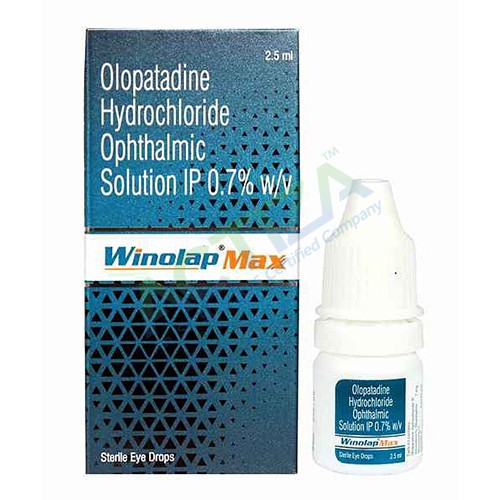
What is Winolap Max Eye Drop? Winolap Max is a prescription eye drop for eye allergies .
It contains olopatadine at a strength of 0.7% w/v.
Olopatadine is an antihistamine and a mast cell stabiliser.
It is marketed in India by Sun Pharmaceutical Industries Ltd.
It comes in a Winolap DS Eye Drop bottle.
Itching of the eyes caused by allergic conjunctivitis.
That allergy may be triggered by pollen, dust or animal fur.
Symptoms include itching, redness, watering and swelling.
It does not treat eye infections.
It does not treat dry eye.
It is for use in the eye only.
It must never be swallowed or injected.
How Olopatadine Works (Mechanism of Action) Mast cells there release histamine and other chemicals.
An allergen lands on the surface of the eye.
Histamine causes the itching, redness and watering.
Olopatadine blocks histamine and steadies the mast cells.
Blocking histamine relieves symptoms already present.
Stabilising mast cells reduces further chemical release.
That combination gives both quick and lasting relief.
Very little reaches the bloodstream from the eye.
Blood levels peak about two hours after a drop.
Its half-life in blood is about 3.4 hours.
It does not build up with repeated daily use.
Dosage Guide The dose below comes from approved olopatadine 0.7% labelling.
Situation Dose How Often Key Note Standard use One drop in each affected eye Once a day The 0.7% strength is once daily The plain 0.1% strength One drop Usually twice a day A different product entirely Children As for adults Once a day Established from 2 years upwards Aged 65 and over No adjustment needed Once a day Per the labels Kidney or liver problems No adjustment expected Once a day Not formally studied Using other eye drops Space them apart At least 5 minutes Per the Singapore registry Using an eye ointment too Apply the ointment last After the drops Drops first, ointment after Contact lens wearers Remove lenses first Before each dose Wait 5 minutes to reinsert If the eye is red Do not wear lenses at all Until redness settles Per the US label No improvement after two weeks Tell your doctor Not applicable Do not simply continue
A conflict between Indian listings:
One says to leave 5 to 10 minutes between eye products.
Another says to leave at least 15 minutes.
The Singapore registry states at least 5 minutes.
A longer gap is not harmful, so the safest course is simple.
Leave the longest interval any of your sources advises.
Closing the eyes for two minutes after the drop helps.
So does pressing gently at the inner corner of the eye.
Both keep more of the medicine in the eye.
How to Use Winolap Max Wash your hands before you start.
Remove contact lenses if you wear them.
Tilt your head back and look upwards.
Pull the lower eyelid down gently to form a pocket.
Squeeze one drop into that pocket.
Do not let the dropper tip touch your eye or eyelid.
Close your eyes gently for about two minutes.
Wipe away any excess with a clean tissue.
Replace the cap tightly straight away.
Wait at least five minutes before reinserting lenses.
Why the dropper tip matters:
Touching it can contaminate the tip and the solution.
A contaminated bottle can cause a serious eye infection.
Keep the bottle tightly closed when not in use.
Vision may blur briefly after the drop goes in.
Do not drive or use machinery until it clears.
Use it for as long as your doctor advises.
Do not share the bottle with anyone else.
Precautions Do Not Use It If You: Are allergic to olopatadine hydrochloride.
Are allergic to any other ingredient in the drops.
Are allergic to the plastic of the container.
The US label lists no contraindications at all.
The allergy warnings above come from Canadian labelling.
Contact Lenses and the Preservative The drops contain benzalkonium chloride as a preservative.
That preservative can be absorbed by soft contact lenses.
It is known to change the colour of soft lenses.
It can also cause irritation of the eye itself.
Remove lenses before each dose.
Wait at least five minutes before putting them back.
Do not wear lenses at all while the eye is red.
Pregnancy, Breastfeeding and Children Canadian labelling says not to use it while breastfeeding.
It may pass into breast milk.
Discuss pregnancy or planned pregnancy with your doctor.
One Indian listing advises avoiding it in pregnancy.
It cites limited safety information as the reason.
Safety has been established from 2 years of age.
Before-Use Checklist Has a doctor confirmed this is an eye allergy?
Do you know this is the 0.7% Max strength?
Do you know it is used once daily, not twice?
Do you wear contact lenses?
Do you use any other eye drops or ointments?
Are you pregnant or breastfeeding?
Do you know not to touch the dropper tip?
Do you know vision may blur briefly?
Side Effects Effects reported with olopatadine eye drops:
Side Effect Category What It Feels Like What to Do Blurred vision Common Vision unclear after the drop Wait before driving Burning or stinging Reported Brief discomfort on instilling Usually settles quickly Dry eye Reported Gritty or dry sensation Report if persistent Eye discomfort or irritation Reported Soreness or scratchiness Report if it worsens Abnormal sensation in the eye Reported Something in the eye feeling Report if persistent Headache Reported Head pain Report if persistent Altered taste Reported Bitter taste after the drop Usually brief and harmless Eyelid swelling or redness Reported Puffy or red eyelids Report to your doctor Worsening redness or pain Serious Eye becomes more inflamed Stop and seek advice Eye infection Serious Discharge, pain, vision change Seek medical assessment Allergic reaction Rare Swelling, rash, breathlessness Emergency — seek care
A note on frequencies:
The labels do not give percentages for most of these.
They are described as reported in clinical use.
Check the pack insert for the full list.
A small amount of the drop drains into the throat.
That can give a brief bitter taste.
Closing the eyes after the drop reduces it.
Using It With Other Eye Products Leave a gap between different eye drops.
The Singapore registry states at least five minutes.
Indian listings variously advise 5 to 10 or 15 minutes.
Follow the longest interval your sources advise.
Always apply eye drops before any eye ointment.
An ointment applied first would block the drop.
Tell your doctor about every eye product you use.
That includes lubricants bought without a prescription.
Warning Signs – Seek Medical Help Stop using it and seek advice if you have:
Eye pain that is new or worsening.
Redness that gets worse rather than better.
Discharge from the eye.
Any change in your vision that does not clear.
Swelling of the eyelids, face or lips.
A rash or difficulty breathing.
Symptoms have not improved after two weeks.
Symptoms return as soon as you stop.
You think you may have an eye infection instead.
An allergy drop will not treat an infection.
Continuing it could delay the right treatment.
A doctor can tell the two conditions apart.
Why Choose Winolap Max? Benefits when clinically appropriate:
One drop once a day is simple to remember.
The 0.7% strength was developed for once-daily use.
It blocks histamine and steadies mast cells together.
Very little of it reaches the bloodstream.
It does not accumulate with daily use.
It is established for children from 2 years of age.
Sun Pharma is a large, established manufacturer.
Honest balance for the buyer:
It costs about four times as much per mL as the 0.1% drop.
The 2.5 mL bottle is small compared with the 5 mL plain version.
It contains a preservative that affects soft contact lenses.
It treats allergy symptoms and nothing else.
A same-composition alternative is listed much cheaper.
Confusing Max with plain Winolap would change the dose sevenfold.
Storage Instructions Store below 30°C, per one Indian listing.
The originator label allows 2°C to 25°C.
Follow the storage statement on your own pack.
Keep the bottle tightly closed when not in use.
Keep it out of the sight and reach of children.
Check the expiry date before use.
Discard the bottle after the period stated on the pack.
Do not keep a part-used bottle for a future allergy season.
Sanjay Gangani
B.Pharm, CMO & Pharmacist
Licensed pharmacist (B.Pharm) with 12+ years in clinical pharmacy and patient care. Reviews every article for evidence-based accuracy before it is published on ACTIZA Store.



Reviews
There are no reviews yet.