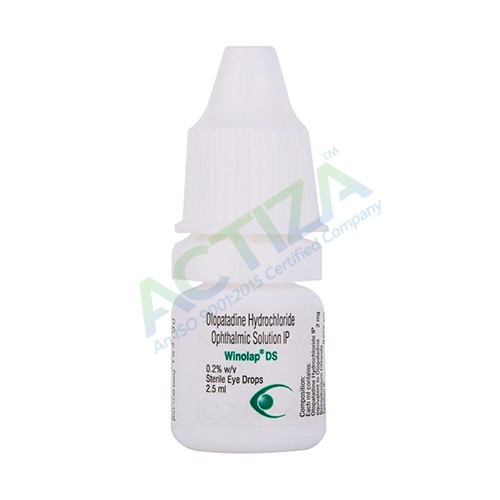
Winolap DS Eye Drop (Olopatadine) Medically reviewed by Sanjay Gangani, B.Pharm, CMO & Pharmacist
Active Ingredient Olopatadine Indication Allergic eye disease Manufacturer Sun Pharmaceutical Industries Ltd Strength:- 0.2% Packaging 2.5 ml in 1 bottle Dosage Form:- Tablet Country of Origin India
INQUIRE ABOUT Winolap DS Eye Drop (Olopatadine)
What is Winolap DS Eye Drop? Winolap DS is a sterile eye drop from Sun Pharma.
Each millilitre contains olopatadine 2 mg, which is 0.2% w/v.
DS stands for double strength.
It is double the strength of the plain Winolap drop.
Winolap max eye drop treats itchy eyes caused by eye allergy.
The medical name for that condition is allergic conjunctivitis.
Pollen from trees, grasses and weeds.
House dust and dust mites.
Animal hair and pet dander.
Mould spores.
What it does not treat Bacterial eye infections. Those need an antibiotic drop.
Viral pink eye. Antihistamines do not clear a virus.
ry eye disease . That needs a lubricating drop.
Irritation caused by wearing contact lenses.
Glaucoma or any rise in eye pressure.
How Winolap DS Works (Mechanism of Action) Olopatadine works in two separate ways at once.
Action one: it blocks histamine An allergen lands on the surface of the eye.
The body releases a chemical called histamine.
Histamine attaches to H1 receptors in the eye.
That attachment causes itching, redness and watering.
Olopatadine blocks those H1 receptors.
Histamine can no longer trigger the itch.
Action two: it stabilises mast cells Mast cells store histamine inside the eye tissue.
An allergy makes these cells burst open.
Olopatadine strengthens the mast cell wall.
Fewer cells burst, so less histamine is released.
This stops new symptoms before they begin.
Olopatadine reduces the movement of eosinophils.
Eosinophils are white cells that drive allergic swelling.
It also reduces how strongly those cells activate.
Dosage Guide Only a doctor may set the dose. This table follows the approved label.
Patient Group Dose Frequency Key Note Adults One drop in each affected eye Once daily Twice daily is not the approved schedule. Children aged 2 and over One drop in each affected eye Once daily Same dose as an adult. Children under 2 years Not established Not applicable Safety has not been studied. Older adults One drop in each affected eye Once daily No age-based reduction is needed. Only one eye affected One drop in that eye Once daily Do not treat the unaffected eye. Missed dose Take it when remembered Once daily Skip it if the next dose is near. After opening the bottle Continue as prescribed Once daily Discard four weeks after first opening.
How to Use Winolap DS Eye Drop Wash and dry your hands thoroughly.
Remove soft contact lenses before you start.
Check the solution. Do not use it if cloudy.
Tilt your head back and look up.
Pull the lower eyelid down to form a small pocket.
Squeeze one drop into that pocket.
Do not let the tip touch your eye or eyelid.
Close the eye gently for one to two minutes.
Press lightly on the inner corner of the eye.
Wipe away any liquid that runs onto the cheek.
Replace the cap tightly straight away.
Wait at least ten minutes before reinserting lenses.
Precautions Absolute contraindications – never use Known allergy to olopatadine.
Known allergy to benzalkonium chloride.
Known allergy to any other ingredient in the drop.
Children under two years of age.
Injection into the eye. It is for surface use only.
Swallowing the solution. It is not an oral medicine.
Conditions to disclose to your doctor Any eye infection, current or recent.
Severe dry eye disease .
Any eye injury or recent eye surgery.
Glaucoma or raised pressure inside the eye.
Daily contact lens wear of any kind.
Pregnancy, or any plan to become pregnant.
Breastfeeding.
Every other eye drop or eye ointment you use.
Food and drink precautions There are no food restrictions with this eye drop.
Meals do not affect how the drop works.
No alcohol restriction is stated on the approved label.
Very little of the drug reaches the bloodstream.
Ignore any page that gives mealtime instructions.
Mealtime advice belongs to tablets, not to eye drops.
Before-use safety checklist A doctor has confirmed the itch is from allergy.
An eye infection has been ruled out.
The carton reads olopatadine 0.2% w/v.
The strength has been checked against the prescription.
The seal is intact and the solution is clear.
The expiry date is still in the future.
Contact lenses have been removed.
The patient knows to use it once a day only.
The patient knows to discard it after four weeks.
Common and Less Common Side Effects Most people tolerate this drop well. Serious effects are rare.
Side Effect How Common What To Do Cold-like symptoms About 1 in 10 users Usually mild. Mention it at review. Sore throat About 1 in 10 users Usually mild and short lived. Brief blurred vision Common Wait until it clears before driving. Mild stinging on instilling Common Settles within a minute or two. Dry eye feeling Less common Report if it becomes troublesome. Eye irritation or burning Less common Report if it persists after a few doses. Headache Less common Usually mild. Report if it persists. Unusual taste in the mouth Less common Harmless. It passes quickly. Eyelid swelling Less common Stop and seek advice. It may be allergy. Eye redness that worsens Less common Stop and have the eye examined. Sensitivity to light Less common Report it to your doctor. Severe eye pain Rare but serious Stop at once. Seek urgent eye care. Sudden change in vision Rare but serious Stop at once. Seek urgent eye care. Signs of eye infection Rare but serious Stop at once. Seek urgent eye care.
Drug Interactions – Avoid or Separate Very little olopatadine reaches the bloodstream from an eye drop.
What You Use Action Needed Reason Any other eye drop Leave five to ten minutes between them The second drop washes out the first. Any eye ointment Apply it last, after all drops Ointment blocks later drops from entering. Soft contact lenses Remove first. Wait ten minutes to replace The preservative is absorbed by lenses. Another antihistamine eye drop Do not use both together There is no added benefit. Irritation rises. Steroid eye drops Only on medical advice A missed infection can worsen quickly. Oral antihistamine tablets Usually allowed Tell the doctor you use both. Glaucoma eye drops Keep them well separated Spacing protects each drop’s effect.
Emergency Warning Signs Stop the drop and seek urgent eye care for any of these.
Signs that need urgent attention Severe or increasing pain in the eye.
Sudden loss or blurring of vision that does not clear.
Seeing flashes of light or many new floaters.
Thick yellow or green discharge from the eye.
The eyelids becoming stuck together on waking.
Marked swelling of the eyelid or around the eye.
Redness that keeps worsening despite treatment.
A feeling that something is stuck in the eye.
Strong sensitivity to normal indoor light.
Signs of a serious allergic reaction Swelling of the face, lips, tongue or throat.
Difficulty breathing or swallowing.
A widespread rash or hives on the body.
Dizziness with a fast heartbeat.
The itch has not improved after three days of use.
Symptoms return quickly after each dose.
You find you want to use it more than once daily.
A new symptom appears that was not there before.
Why Choose This Medicine? – An Honest Assessment One drop lasts a full day. That helps people remember it.
It both stops current itch and prevents new itch.
Relief usually starts within minutes of the drop.
It is approved for children from two years of age.
Very little of the drug enters the bloodstream.
Serious side effects are rare in normal use.
It costs far less than many newer allergy drops.
Market Status of Olopatadine 0.2% Eye Drops Year United States Moved from prescription to over the counter 2020 United States, 0.1% strength Also moved over the counter 2020 United States, 0.7% strength Also moved over the counter 2020 India Remains a prescription medicine Current
The honest caveats It relieves symptoms. It does not cure the allergy.
Symptoms return once the drop is stopped.
Avoiding the trigger remains the real long-term answer.
It will not help an eye problem that is not allergic.
Using it on an infected eye can delay proper treatment.
A red eye with discharge needs a doctor, not this drop..
Storage Instructions Store between 2 and 25 degrees Celsius, per the approved label.
One Indian listing states 4 to 25 degrees Celsius.
The approved lower limit is 2 degrees, not 4.
Keep the bottle tightly closed when not in use.
Keep it upright to stop the solution leaking.
Protect it from direct sunlight and heat.
Do not freeze the solution.
Do not store it in a bathroom cabinet.
Write the opening date on the carton.
Discard the bottle four weeks after first opening.
Discard it even if solution remains inside.
Never share an eye drop bottle with another person.
Sharing a bottle can pass an eye infection between people.
Sanjay Gangani
B.Pharm, CMO & Pharmacist
Licensed pharmacist (B.Pharm) with 12+ years in clinical pharmacy and patient care. Reviews every article for evidence-based accuracy before it is published on ACTIZA Store.



Reviews
There are no reviews yet.