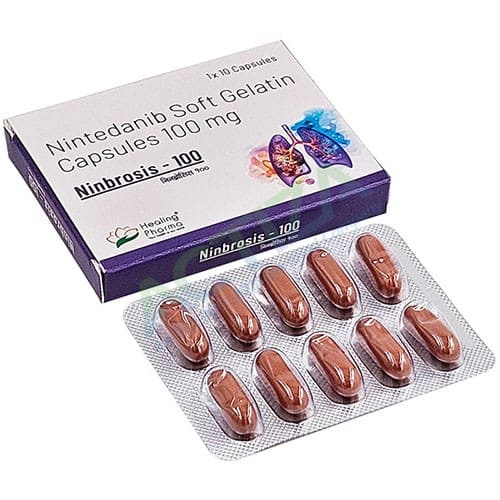
Nintedanib 100 mg Softgel Caps Medically reviewed by Sanjay Gangani, B.Pharm, CMO & Pharmacist
Active Ingredient Nintedanib Indication Idiopathic pulmonary fibrosis, Non-small cell lung cancer Manufacturer Healing Pharma, India Strength:- 100mg Packaging 10 soft gelatin capsules in 1 bottle Dosage Form:- Capsule Country of Origin India
INQUIRE ABOUT Nintedanib 100 mg Softgel Caps
What is Nintedanib 100 mg? Nintedanib is a prescription medicine for scarring of the lungs.
Each soft capsule contains Nintena 100 mg of nintedanib.
It belongs to a group called tyrosine kinase inhibitors.
It slows the process that stiffens and scars lung tissue.
Idiopathic pulmonary fibrosis, often shortened to IPF.
Other long-term lung fibrosis that is getting worse.
Lung fibrosis caused by systemic sclerosis.
The original brand is Ofev, from Boehringer Ingelheim.
Cipla sells it as Nintib and BDR Pharma as Nintenib.
Sun Pharma sells a version called Nintena.
It slows the disease but does not cure or reverse it.
It is not established for anyone under 18 years.
Treatment must be started by an experienced specialist.
How Nintedanib Works (Mechanism of Action) The action happens in five simple steps:
Lung fibrosis involves cells called fibroblasts multiplying.
They move into lung tissue and lay down scar material.
Growth factor receptors drive that process.
Nintedanib blocks several of those receptors at once.
Fibroblast growth and scar formation are slowed.
Which receptors it blocks:
Platelet-derived growth factor receptors, alpha and beta.
Fibroblast growth factor receptors 1 to 3.
Vascular endothelial growth factor receptors 1 to 3.
It also blocks several other related kinases.
Why that matters for side effects:
Blocking vascular receptors can raise the risk of bleeding.
It may also affect wound healing and blood pressure.
Blood levels peak 2 to 4 hours after a dose with food.
Food raises absorption by about 20%.
Its effective half-life is about 9.5 hours.
Over 90% leaves the body through bile and stool.
Dosage Guide All doses come from the originator’s professional information.
Situation Dose Timing Key Note Standard dose 150 mg twice daily About 12 hours apart The usual starting dose Cannot tolerate 150 mg 100 mg twice daily About 12 hours apart This is what the 100 mg capsule is for Cannot tolerate 100 mg either Stop treatment Not applicable The label directs discontinuation Mild liver impairment 100 mg twice daily About 12 hours apart Child-Pugh A only Moderate or severe liver impairment Not recommended Not applicable Child-Pugh B and C not studied After a liver test interruption Restart at 100 mg twice daily Once tests return to baseline May later increase to 150 mg Maximum daily dose 300 mg Never exceed Do not double up Missed dose Take the next scheduled dose At the usual time Do not take an extra capsule Mild or moderate kidney impairment No change needed As prescribed Severe impairment not studied Aged 75 and over No automatic change As prescribed More likely to need a reduction Under 18 years Not established Not applicable No data available After abdominal surgery Start no sooner than 4 weeks After surgery Reduces perforation risk
How doses are adjusted:
Side effects are managed by reducing or pausing the dose.
Treatment then resumes at 100 mg or 150 mg twice daily.
Liver enzymes above three times normal trigger a reduction or pause.
Liver test rises with symptoms such as jaundice mean stopping for good.
There is no specific antidote.
Reported effects were raised liver enzymes and stomach symptoms.
Treatment is paused and supportive care given.
How to Take Nintedanib Take one capsule with food, roughly every 12 hours.
Swallow the capsule whole with water.
Do not chew it, because the contents taste bitter.
Do not open or crush the capsule.
If the contents touch your skin, wash your hands thoroughly.
Have your liver tests done before starting treatment.
Repeat them during the first month of treatment.
Continue regular tests over the next two months.
Have them periodically after that, as your doctor directs.
Have your blood pressure checked from time to time.
Managing diarrhoea, which is common:
Treat it at the first signs, not after several days.
Drink enough fluid to avoid dehydration.
Your doctor may advise an antidiarrhoeal such as loperamide.
Tell your doctor if it does not improve.
Serious dehydration and salt imbalance have been reported.
Unusual tiredness or loss of appetite.
Discomfort under the right side of the ribs.
Dark urine, or yellowing of the skin or eyes.
Precautions Contraindications in the Label Allergy to nintedanib or any ingredient of the capsule.
Allergy to peanuts or to soya.
Pregnancy.
Each 100 mg capsule contains 1.2 mg of soya lecithin.
Soya products can cause severe allergic reactions.
People allergic to peanut protein face a higher risk.
Conditions Needing Care or Monitoring Any liver problem, which changes the dose or rules it out.
A bleeding tendency, or treatment with full-dose blood thinners.
Recent heart attack or stroke.
Known coronary artery disease, which needs heart monitoring.
High blood pressure or a history of aneurysm.
Previous abdominal surgery or stomach ulcers.
Diverticular disease of the bowel.
Treatment with steroids or anti-inflammatory painkillers.
Any planned surgery, because wound healing may be impaired.
Severe pulmonary hypertension, where it should not be used.
Kidney problems, as kidney failure has been reported.
Pregnancy, Contraception and Breastfeeding It must not be used during pregnancy.
A pregnancy test is required before treatment starts.
Highly effective contraception is needed during treatment.
It must continue for at least 3 months after the last dose.
Vomiting or diarrhoea can stop the contraceptive pill working.
Another highly effective method should then be used as well.
Breastfeeding should be stopped during treatment.
Tell your doctor immediately if you become pregnant.
Before-Use Checklist Has a specialist started and supervised this treatment?
Do you know whether you are on 150 mg or 100 mg?
Have your liver tests been done before starting?
Do you have any allergy to peanut or soya?
Could you be pregnant, and is contraception in place?
Do you take blood thinners or anti-inflammatory painkillers?
Have you had abdominal surgery in the last 4 weeks?
Do you know the liver warning symptoms?
Do you have a plan for managing diarrhoea?
Side Effects Frequencies come from the originator’s own label and trials.
Side Effect Frequency What It Feels Like What to Do Diarrhoea Very common Loose, frequent stools Treat at first signs; keep hydrated Nausea Very common Queasy stomach Take with food; report if persistent Abdominal pain Very common Stomach ache Report if severe or sudden Raised liver enzymes Very common No symptoms; seen on blood tests Detected by scheduled testing Vomiting Common to very common Being sick May need dose change if persistent Reduced appetite and weight loss Common to very common Eating less, losing weight Report; monitor weight Bleeding Common Most often nosebleeds Report any unusual bleeding Headache Common Head pain Report if persistent Rash Common Skin eruption Report to your doctor High blood pressure Uncommon to common Usually no symptoms Checked at review visits Drug-induced liver injury Uncommon to common Tiredness, jaundice, dark urine Urgent liver tests needed Heart attack Uncommon Chest pain, breathlessness Emergency – call for help Pancreatitis or colitis Uncommon Severe abdominal pain Emergency – seek care Low platelet count Uncommon Easy bruising or bleeding Blood tests will show it Kidney failure Uncommon or not known Reduced urine, swelling Seek medical assessment Gut perforation Reported Sudden severe abdominal pain Emergency – treatment is stopped Aneurysm or artery tear Not known Severe sudden pain Emergency – call for help
How common diarrhoea really is:
In the fibrosis trials, 62% to 76% of patients had diarrhoea.
Among those on placebo, 18% to 32% had it.
Severe diarrhoea affected about 2% to 4% of patients.
It led to a dose reduction in 11% to 22% of patients.
It led to stopping treatment in 4% to 7% of patients.
Most cases began within the first three months.
These occurred in 13% to 23% of treated patients.
They occurred in 3% to 6% of those on placebo.
Most were reversible when the dose was reduced or paused.
Most liver events happened in the first three months.
Drug Interactions Nintedanib is carried by a transporter called P-glycoprotein.
Medicines that raise nintedanib levels:
Ketoconazole, which raised exposure about 1.6 times in a study.
Erythromycin and ciclosporin are also named in the label.
Patients on these need close monitoring for side effects.
Rifampicin, which halved exposure in a study.
Carbamazepine and phenytoin, used for epilepsy.
St John’s wort, a herbal remedy.
An alternative medicine should be considered where possible.
What the label says about other interactions:
Interactions through liver CYP enzymes are considered unlikely.
It does not change how the contraceptive pill is absorbed.
Bosentan did not alter nintedanib levels.
No meaningful interaction was found between the two.
But their side effects are similar and may add together.
The label says the benefit-risk of combining them is not established.
Emergency Warning Signs – Seek Urgent Medical Help Seek urgent medical help for:
Sudden, severe abdominal pain, which may signal a gut perforation.
Chest pain or breathlessness, which may signal a heart attack.
Sudden severe pain in the back, chest or abdomen.
Heavy or persistent bleeding from anywhere.
Vomiting blood, or black tarry stools.
Severe diarrhoea with dizziness or very little urine.
Yellowing of the skin or eyes.
Swelling of the face, lips or throat after a dose.
Contact your specialist promptly for:
Diarrhoea that does not settle with treatment.
Unusual tiredness, loss of appetite or dark urine.
Nosebleeds that keep recurring.
Marked weight loss.
A suspected pregnancy.
Severe liver injury with fatal outcome has been reported.
Fatal bleeding events have been reported after marketing.
Gut perforation and bowel ischaemia can also be fatal.
Treatment is stopped permanently after a perforation.
Why Choose Nintedanib? Benefits when clinically appropriate:
It slows the decline in lung function in pulmonary fibrosis.
It is licensed for three different fibrotic lung conditions.
The 100 mg strength keeps patients on treatment who cannot take 150 mg.
Dose reduction is an alternative to stopping altogether.
Indian generics cost about 69 to 75 rupees per capsule.
That is far below the price in many other countries.
It is taken as a capsule twice daily, with no injections.
Diarrhoea affects around two-thirds of patients.
Liver injury can be severe and has proved fatal.
Regular blood tests are mandatory, not optional.
Indian patients have higher blood levels of the drug.
It must not be used in pregnancy.
It slows the disease rather than curing it.
It must be started and supervised by a specialist.
Storage Instructions Store at or below 25°C.
Keep the capsules in the original pack.
That protects them from moisture.
Do not remove them from the blister until needed.
Keep out of the reach of children.
Check the expiry date; the shelf life is 3 years.
Dispose of unused capsules as local rules require.
Sanjay Gangani
B.Pharm, CMO & Pharmacist
Licensed pharmacist (B.Pharm) with 12+ years in clinical pharmacy and patient care. Reviews every article for evidence-based accuracy before it is published on ACTIZA Store.



Reviews
There are no reviews yet.