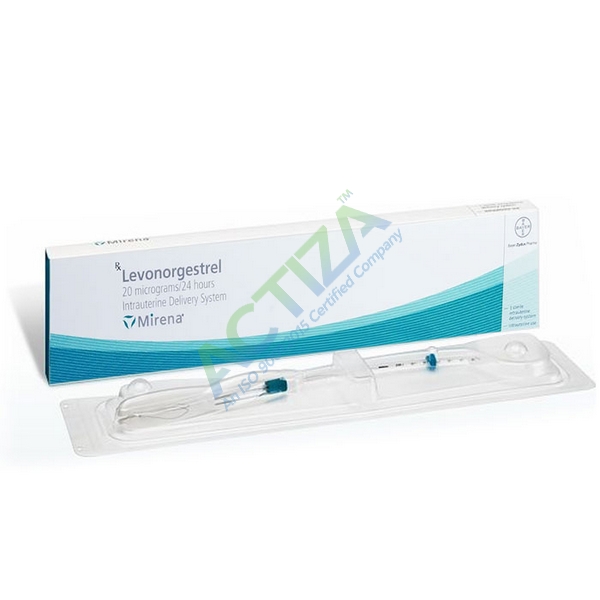
Mirena Intrauterine Delivery System (Device) Medically reviewed by Sanjay Gangani, B.Pharm, CMO & Pharmacist
Active Ingredient Levonorgestrel Indication Contraception Packaging 1 unit in pack Manufacturer Bayer Zydus Pharma
INQUIRE ABOUT Mirena Intrauterine Delivery System (Device)
What is Mirena? Mirena is a hormone-releasing system placed inside the womb.
It is a small, flexible, T-shaped plastic frame.
A reservoir on its stem holds 52 mg of levonorgestrel.
Levonorgestrel is a progestin often used in contraceptive pills.
Only small amounts of the hormone enter the blood.
It contains no oestrogen.
It prevents pregnancy for up to 8 years.
It also treats heavy menstrual bleeding for up to 5 years.
In some countries it protects the womb during oestrogen HRT.
It can be used whether or not a woman has had children.
A clinician can remove it at any time.
Two thin threads let the user check it is in place.
It is a Bayer product.
Other levonorgestrel systems exist with different strengths and durations.
How Mirena Works (Mechanism of Action) The label describes several local actions:
It thickens the mucus at the neck of the womb.
That makes it harder for sperm to enter the womb.
It reduces sperm movement and survival.
It thins the lining of the womb.
Together these actions prevent pregnancy.
What that means for the user:
Its effect is mainly local, inside the womb.
Ovulation continues in many users.
In one study, 45% of cycles were ovulatory after a year.
A thinner womb lining also reduces menstrual blood loss.
How well it works:
Fewer than 1 in 100 users became pregnant each year in trials.
The 5-year cumulative pregnancy rate was about 0.7 per 100.
For heavy periods, almost 9 in 10 women were treated successfully.
Their blood loss was reduced by more than half.
Timing and Duration Guide Fitting, timing and removal follow the FDA and Bayer labels.
Situation When It Can Be Fitted Back-Up Contraception Key Note Not using hormonal contraception Within the first 7 days of a period Not needed Pregnancy must be excluded Fitted after day 7 of the cycle Any time pregnancy is excluded Condoms or abstinence for 7 days As the clinician advises Switching from the pill, patch or ring Any time Continue old method for 7 days Or until the current cycle ends Switching from an injection Any time 7 days if over 13 weeks since injection As the clinician advises Switching from an implant or IUS Same day it is removed Not needed Any point in the cycle After first-trimester abortion or miscarriage Immediately Not needed Not after a septic abortion After childbirth, delayed fitting After at least 6 weeks 7 days if not in first week of a period Womb must have fully recovered Contraception duration Up to 8 years Not applicable Replace by the end of year 8 Heavy bleeding duration Up to 5 years Not applicable Replace by the end of year 5 HRT womb protection, where licensed Up to 4 years Not applicable Remove after 4 years Emergency contraception Not suitable Not applicable It cannot be used after sex
When it is removed:
Removal within the first 7 days of a period avoids a pregnancy gap.
At other times, start a new method 7 days before removal.
A new Mirena can be fitted straight after removal.
About 8 in 10 women trying to conceive do so within a year.
How Mirena Is Fitted A trained healthcare provider takes a full medical history first.
Pregnancy and sexually transmitted infections are excluded.
The clinician examines the womb’s size, shape and position.
The vagina and cervix are cleaned with antiseptic.
A slim tube carries Mirena through the cervix into the womb.
The tube is removed and the threads are trimmed.
Pain relief may be offered before fitting.
A follow-up check is due 4 to 6 weeks later.
Checks then continue at least once a year.
What to expect during and after fitting:
Some pain, bleeding or dizziness is common.
Fainting or a slow heartbeat can occur, especially if prone to it.
If symptoms last beyond 30 minutes, it may be misplaced.
Checking it yourself:
Feel for the threads about once a month.
Wash your hands first and do not pull on the threads.
If you cannot feel them, use condoms and see your clinician.
Tampons and menstrual cups can be used with care.
Precautions Contraindications – Mirena Must Not Be Used With: Pregnancy or suspected pregnancy.
Use as emergency contraception after sex.
A womb whose shape is distorted, including by fibroids.
Active pelvic inflammatory disease.
Past pelvic inflammatory disease, unless followed by a normal pregnancy.
Infection after childbirth or an infected abortion in the last 3 months.
Known or suspected cancer of the womb or cervix.
Known or suspected breast cancer, now or in the past.
Any other progestin-sensitive cancer.
Unexplained bleeding from the womb.
Untreated infection of the cervix or vagina.
Acute liver disease or a liver tumour.
A condition that makes pelvic infection more likely.
Another intrauterine device already in place.
Allergy to any component of the system.
Conditions to Discuss With Your Clinician A past heart attack or stroke.
Heart disease present from birth, or heart valve problems.
A blood clotting problem, or use of blood thinners.
High blood pressure.
Migraine, especially with visual disturbance.
Recent childbirth or current breastfeeding.
HIV or another sexually transmitted infection.
More than one sexual partner, or a partner with others.
A past ectopic pregnancy, tube surgery or pelvic infection.
All medicines, vitamins and herbal products you use.
Lifestyle Points Use condoms as well to protect against sexual infections.
Tampons and menstrual cups can be used carefully.
Neither partner should usually feel it during sex.
Tell your clinician if sex becomes painful.
Before-Fitting Checklist Has a trained clinician been arranged to fit it?
Has pregnancy been ruled out?
Have sexual infections been checked for where needed?
Have you disclosed any past pelvic infection?
Have you ever had breast cancer?
Do you know it will not protect against sexual infections?
Do you know the warning signs after fitting?
Has the package been checked as sealed and in date?
Side Effects and Risks Frequencies below come from FDA trial data in over 5,000 women.
Side Effect Frequency What It Feels Like What to Do Unscheduled bleeding or spotting 31.9% Bleeding between periods Common in the first 3 to 6 months Lighter periods 23.4% Less bleeding than before An expected effect Abdominal or pelvic pain 22.6% Aching low in the abdomen Report if severe or worsening No periods 18.4% Periods stop Rule out pregnancy if unsure Headache or migraine 16.3% Head pain Report severe or new migraine Vaginal discharge 14.9% Increased discharge Report if it smells or is unusual Heavier scheduled bleeding 11.9% Heavier periods at first Usually settles; report if not Vaginal inflammation or infection 10.5% Itching or soreness Seek treatment Breast pain 8.5% Sore breasts Report if persistent Back pain 7.9% Aching back Report if persistent Ovarian cyst About 8% Often none; sometimes pelvic pain Most clear within 2 to 3 months Acne 6.8% Spots on the skin Report if troublesome Painful periods 6.4% Cramping pain Report if severe Low mood 6.4% Feeling down Tell your clinician Expulsion 4.5% over 5 years Device comes out Use condoms and see your clinician Perforation of the womb Under 0.1% in trials Pain or bleeding; threads not felt May need surgery Pelvic inflammatory disease 0.6% Pain, fever, discharge Urgent antibiotic treatment Serious infection after fitting Rare Severe pain or fever in first days Emergency — seek care at once
About perforation and expulsion:
Perforation risk is higher within 6 weeks of giving birth.
It is also higher when a woman is breastfeeding at fitting.
In one large study, breastfeeding raised perforation risk by a third.
Expulsion risk is higher when fitted straight after delivery.
A sudden increase in bleeding may be a sign of expulsion.
About breast cancer:
Drug Interactions No drug interaction studies have been carried out with Mirena.
Medicines affecting the CYP3A4 enzyme can change blood hormone levels.
Its contraceptive effect acts directly inside the womb.
The label says that effect is unlikely to be altered this way.
Tell your clinician about blood thinners before fitting.
Tell every doctor you have an intrauterine system in place.
Emergency Warning Signs – Seek Urgent Medical Help Seek care immediately if you have:
Severe pain or fever in the first days after fitting.
Pain low in the abdomen with a missed period.
New bleeding after periods had stopped, with pain.
Unexplained fever, chills or flu-like symptoms.
A stroke or heart attack.
Yellowing of the skin or eyes.
See your clinician promptly if you:
Think you might be pregnant.
Cannot feel the threads, or feel more than the threads.
Have pelvic pain or pain during sex.
Have unusual vaginal discharge or genital sores.
Have severe or long-lasting bleeding.
Have very severe headaches or migraines.
May have been exposed to a sexual infection.
If pregnancy occurs with Mirena in place:
Ectopic pregnancy is a medical emergency.
Pregnancy in the womb also carries risks of infection and miscarriage.
Your clinician will usually advise removing the device.
Why Choose Mirena? Benefits when clinically appropriate:
Fewer than 1 in 100 users become pregnant each year.
One fitting provides contraception for up to 8 years.
Nothing needs to be taken or remembered daily.
It contains no oestrogen.
It can greatly reduce heavy menstrual bleeding.
It is fully reversible; fertility usually returns quickly.
It can be used while breastfeeding.
It is long established, first approved in the US in 2000.
Honest balance for the buyer:
It must be fitted and removed by a trained clinician.
Fitting can be painful and needs a follow-up visit.
Bleeding is often irregular for the first 3 to 6 months.
It does not protect against sexual infections.
It carries small risks of infection, perforation and expulsion.
It is not suitable for emergency contraception.
Storage Instructions Store at around 25°C.
Brief exposure between 15°C and 30°C is permitted.
Keep it in its sealed sterile package until fitting.
Do not use it if the package is damaged or open.
It is for single use only and must not be re-sterilised.
Fit it before the end of the month shown on the label.
Keep it out of reach of children.
Bring it unopened to the fitting appointment.
Sanjay Gangani
B.Pharm, CMO & Pharmacist
Licensed pharmacist (B.Pharm) with 12+ years in clinical pharmacy and patient care. Reviews every article for evidence-based accuracy before it is published on ACTIZA Store.



Reviews
There are no reviews yet.