

Loading cart...
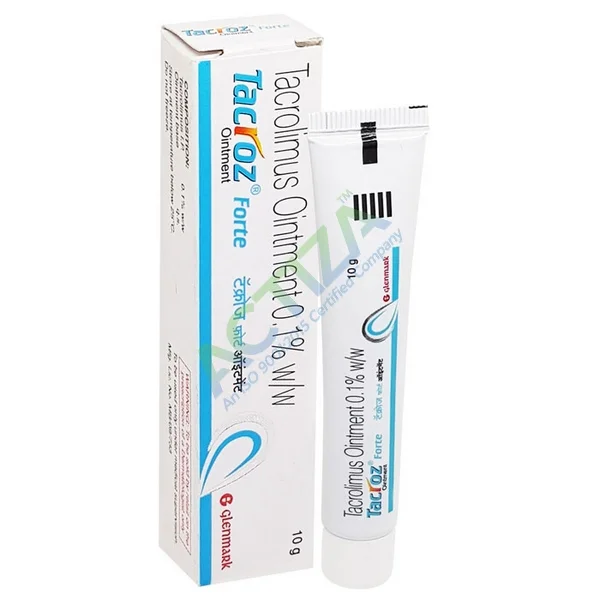
Tacroz Forte Ointment (Tacrolimus)
Medically reviewed by Sanjay Gangani, B.Pharm, CMO & Pharmacist
| Active Ingredient | Tacrolimus |
|---|---|
| Indication | Atopic dermatitis |
| Manufacturer | Glenmark Pharmaceuticals Ltd. |
| Strength:- | 0.1% |
| Packaging | 10 gm in 1 tube |
Tacroz Forte Ointment (Tacrolimus) | ||||
|---|---|---|---|---|
| Pack Size | Price | Quantity | Add To Cart | |
| 1 Tube | $12.5 | |||
| 3 Tube/s | $34 | |||
| 6 Tube/s | $66 | |||
What is Tacroz Forte Ointment?
- Tacroz Forte is an ointment containing tacrolimus 0.1% w/w.
- Tacrolimus is a macrolide immunosuppressant produced by Streptomyces tsukubaensis.
- It belongs to a class called topical calcineurin inhibitors, sometimes described as topical immunomodulators.
- It is used to manage moderate to severe atopic dermatitis (eczema) in adults.
- It relieves inflammation, redness, itching and lesions associated with eczema.
- It is made by Glenmark Pharmaceuticals in India, and is equivalent to Protopic.
- It is supplied in 10 g, 20 g and 40 g tubes.
- It is not a steroid. It is a steroid-free topical immunomodulator.
- It is for external use only — not for ophthalmic use.
- It is a prescription-only medicine.
Note on other uses: some listings mention use in conditions such as oral lichen planus or facial sebopsoriasis. These are outside the approved indication, and should only be undertaken on specialist direction.
How It Works (Mechanism of Action)
The precise mechanism in atopic dermatitis is not fully established — the approved information states that the mechanism of action of tacrolimus in atopic dermatitis is not known.
What is understood:
- In eczema, certain immune cells in the skin become overactive.
- Under normal conditions those cells protect the body.
- In eczema they release chemicals that cause swelling, redness and severe itching.
- Tacrolimus inhibits calcineurin, an enzyme T-lymphocytes need in order to activate.
- This stops those cells releasing the inflammatory chemicals.
- Redness, itching and inflammation reduce.
Why it differs from a steroid: corticosteroids act broadly and, used long term on thin skin, cause skin atrophy, telangiectasia and striae. Tacrolimus acts more selectively on T-cells and does not cause skin thinning.
How much is absorbed: systemic absorption is low. In adults treating an average of 53% of body surface area, exposure is approximately 30-fold less than that seen with systemic tacrolimus in transplant patients, and bioavailability is less than 0.5%.
How to Use It
| Point | Guidance |
|---|---|
| Application | Apply a thin layer to affected areas twice daily |
| Area | Only areas affected by eczema — not unaffected skin |
| Duration | Short-term; discontinue when symptoms have cleared |
| Continuation | Commonly continued for about a week after clearing |
| Reassess if | No improvement within 6 weeks |
| Long-term continuous use | Avoid |
| Occlusive dressings | Do not use |
| Children under 16 | Use the 0.03% strength, not this one |
| Children under 2 | Do not use either strength |
| Sunlight | Minimise or avoid |
| Eyes | Not for ophthalmic use |
| Infected skin | Treat the infection first |
Use only on areas that have eczema. Applying it more widely increases exposure without benefit, and runs against the boxed warning.
How to Apply It
- Wash and dry your hands.
- Clean and dry the affected skin.
- Apply a thin layer to the affected areas only.
- Rub it in gently and completely.
- Wash your hands afterwards, unless treating your hands.
- Do not cover the area with a bandage or occlusive dressing.
- Ordinary clothing over the area is fine.
- Avoid getting it in the eyes or mouth. If contact occurs, wipe off and rinse with water.
- Minimise sun exposure on treated areas.
- Avoid alcohol while using it — see the next section.
- Apply twice daily as directed.
- Stop when the eczema has cleared.
- Tell your doctor if there is no improvement within 6 weeks.
- Do not share this medicine with anyone else.
Precautions
o Not Use If You
- Are allergic to tacrolimus or any of the other ingredients in the formulation.
- Are under 16 years of age — the 0.03% strength is the appropriate one for ages 2 to 15.
- Are under 2 years of age — neither strength should be used.
- Are immunocompromised, whether from a condition or from medicines.
- Have an active viral or bacterial infection at the application site.
- Have a malignant or potentially malignant skin lesion at the site.
- Have Netherton’s syndrome, lamellar ichthyosis, generalised erythroderma or cutaneous graft-versus-host disease.
Tell Your Doctor Before Using If You
- Have any weakened immune system, or take immunosuppressive medicines.
- Have had skin cancer, or any other cancer.
- Have extensive eczema covering large areas.
- Have any skin infection, including cold sores or impetigo.
- Have swollen glands (lymphadenopathy).
- Have kidney problems.
- Have an allergy to macrolide antibiotics.
- Are pregnant, might be, or are breastfeeding.
- Are using any other treatment on the same area.
- Are receiving phototherapy or UV treatment.
Practical Precautions
| Item | Consideration |
|---|---|
| Alcohol | May cause facial flushing or skin irritation while using tacrolimus ointment |
| Sunlight and UV | Minimise or avoid; long-term effect on UV-exposed skin unknown |
| Occlusive dressings | Do not use — may promote systemic absorption |
| Application area | Limit to affected skin only |
| Lymphadenopathy | Swollen glands should be investigated |
| Skin infections | Treat before starting |
| Strength | 0.1% is adults only |
| Vaccination | Discuss timing with your doctor |
Side Effects
| Side Effect | Notes |
|---|---|
| Burning or tingling sensation at the application site | Very common, especially in the first few days |
| Itching at the site | Very common; usually settles within a week |
| Irritation | Common |
| Redness or warmth at the site | Common |
| Dryness | Common |
| Rashes | Reported |
| Skin tingling or soreness | Common |
| Flushing or skin irritation after alcohol | A recognised and distinctive effect |
| Increased sensitivity to hot and cold | Reported |
| Skin infections, including folliculitis and cold sores | Reported |
| Herpes simplex outbreaks | Reported |
| Acne | Reported |
| Headache | Reported |
| Flu-like symptoms | Reported |
| Swollen glands (lymphadenopathy) | Report to your doctor |
| Bullous impetigo, osteomyelitis, septicaemia | Reported post-marketing; serious |
| Acute renal failure | Rare; reported post-marketing |
| Lymphoma, basal cell carcinoma, squamous cell carcinoma, malignant melanoma | Reported post-marketing — see the boxed warning |
On the initial burning: this is the most common complaint and the commonest reason people stop. It typically improves within the first week as the skin heals. The 0.1% strength may cause more initial burning than the 0.03%. Tell your doctor if it is severe or persists beyond a week.
It does not cause skin thinning, which is its main advantage over long-term topical steroids.
When to Seek Medical Advice
Stop using the ointment and seek medical advice if you develop:
- Severe or worsening burning, stinging or pain at the site.
- Spreading redness, warmth, pus or crusting — signs of skin infection.
- Cold sores or widespread blistering, which can spread rapidly on eczematous skin.
- A widespread rash or hives.
- Swelling of the face, lips, tongue or throat.
- Difficulty breathing.
Contact your doctor if:
- There is no improvement after 6 weeks — the diagnosis should be reassessed.
- You develop swollen glands.
- Any new or changing skin lesion appears, particularly a mole or a sore that will not heal.
- Your eczema worsens rather than improving.
- You develop fever or feel generally unwell.
On swollen glands: patients who develop lymphadenopathy while using tacrolimus ointment should have the cause investigated. Transplant patients on systemic immunosuppression are at increased risk of lymphoma, which is why this is taken seriously even though absorption from the ointment is low.
On new skin lesions: given the boxed warning, any new or changing skin lesion on or near a treated area deserves prompt assessment rather than watchful waiting.
What to Know About This Medicine
Genuine advantages:
- Effective in moderate to severe atopic dermatitis that has not responded to other topical treatments.
- Does not cause skin thinning, unlike long-term topical corticosteroids.
- Suitable for long-term maintenance without steroid side effects, used intermittently.
- Particularly useful on the face, eyelids, neck and skin folds.
- Systemic absorption is very low — bioavailability under 0.5%.
- The 0.1% strength offers greater potency for adults with more severe disease.
- Available in 10 g, 20 g and 40 g tubes.
Important limitations:
- It carries a boxed warning on long-term safety and reported malignancies.
- It is adults only. Children aged 2 to 15 need the 0.03% strength.
- It is a second-line treatment, not a first choice.
- Continuous long-term use should be avoided.
- Burning and itching on application are very common in the first few days, and may be more marked at this strength.
- Alcohol can cause facial flushing while using it.
- Sun exposure on treated areas should be minimised.
- It must not be used with occlusive dressings, on infected skin, or in immunocompromised patients.
- Reassessment is required if there is no improvement in 6 weeks.
Where it fits in eczema care: emollients remain the foundation and should continue alongside. Topical steroids are usually first-line for flares. Tacrolimus has a specific role where steroids have failed, are unsuitable, or where the site makes long-term steroid use unwise.
Bottom line: a genuinely useful medicine for difficult adult eczema, particularly on the face — used in short courses, on affected skin only, with a clear review point at 6 weeks.
Storage Instructions
- Store below 25°C, or as stated on the pack.
- Keep the tube tightly closed.
- Do not freeze.
- Protect from direct sunlight.
- Do not store in a hot car or steamy bathroom.
- Keep the cap on to prevent contamination.
- Keep out of the sight and reach of children — this strength is not for them.
- Never store the 0.1% and 0.03% tubes together, since they look similar and are for different age groups.
- Check the expiry date before use.
- Do not use after the expiry date.
- Note any in-use shelf life stated on the pack after opening.
- Never share this medicine with anyone else.
- Return unused ointment to a pharmacy for disposal.
Medical Disclaimer:- Tacroz Forte 0.1% (tacrolimus) is a prescription ointment used for moderate to severe eczema in adults. It should be used under medical supervision, preferably for short-term or intermittent treatment. Avoid continuous long-term use, infected skin and excessive sun exposure. It is not suitable for children under 16 at this strength. Report swollen glands or unusual skin changes to your doctor. Seek medical advice if symptoms do not improve within 6 weeks.

B.Pharm, CMO & Pharmacist
Licensed pharmacist (B.Pharm) with 12+ years in clinical pharmacy and patient care. Reviews every article for evidence-based accuracy before it is published on ACTIZA Store.
Reviews
There are no reviews yet.