

Loading cart...
Acivir DT 800 Mg (Acyclovir)
Medically reviewed by Sanjay Gangani, B.Pharm, CMO & Pharmacist
| Active Ingredient | Aciclovir/Acyclovir |
|---|---|
| Indication | Herpes labialis, Genital herpes infection, Chickenpox |
| Manufacturer | Cipla Limited |
| Strength:- | 800mg |
| Packaging | 5 tablets in 1 strip |
| Dosage Form:- | Tablet |
| Country of Origin | India |
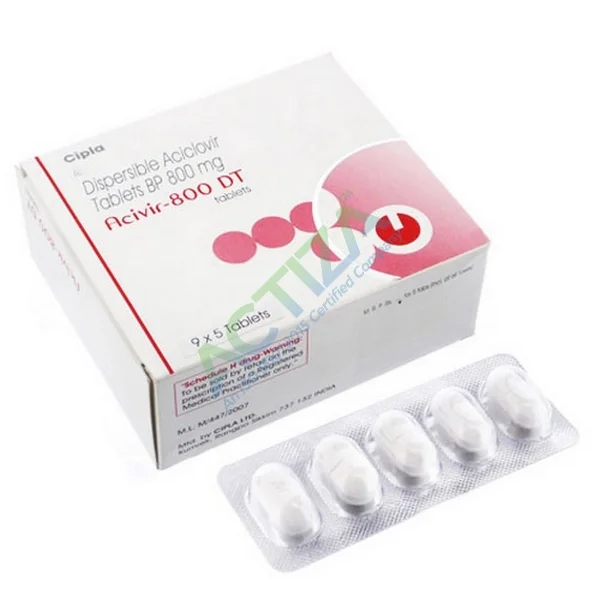
Acivir DT 800 Mg (Acyclovir) | ||||
|---|---|---|---|---|
| Pack Size | Price | Quantity | Add To Cart | |
| 30 Tablet/s | $24.42 | |||
| 60 Tablet/s | $45.88 | |||
| 90 Tablet/s | $65.12 | |||
What is Acivir DT 800 mg
Product identity
| Field | Detail |
| Brand name | Acivir DT 800 mg Tablet |
| Generic name | Aciclovir, also spelt acyclovir |
| Strength | 800 mg per tablet |
| Dosage form | Dispersible tablet |
| Drug class | Nucleoside analogue antiviral |
| Company | Cipla Limited |
| Manufacturing site listed | Cipla Ltd, Kumrek, Rangpo, Sikkim 737132 |
| Country of origin | India |
| Pack size | Strip of 5 tablets |
| MRP (listed) | About Rs. 197.71 for 5 tablets |
| Main labelled use at this strength | Herpes zoster, that is shingles |
| Second labelled use at this strength | Chickenpox in children aged 6 and over |
| Legal status in India | Prescription only, Schedule H |
How it works (mechanism of action)
Why it spares healthy cells
Key pharmacokinetics
| Parameter | Value from the reference label |
| Oral bioavailability | 10% to 20% |
| Terminal half-life in adults | 2.8 to 4.1 hours |
| Half-life in chronic renal failure | Mean about 19.5 hours |
| Plasma protein binding | Low, 9% to 33% |
| Main elimination route | Unchanged in urine |
| Mechanism of renal excretion | Filtration and tubular secretion |
| Removal by haemodialysis | Effective; used in symptomatic overdose |
Dosage guide
Doses are from the reference label. Only a prescriber may set yours.
Where the 800 mg strength is used
| Indication | Dose | Frequency | Duration | Notes |
| Herpes zoster, shingles | 800 mg | Five times daily | 7 days | About every 4 hours, no night dose |
| Chickenpox, age 6 and over | 800 mg | Four times daily | 5 days | Age-based alternative regimen |
| Chickenpox, weight-based | 20 mg per kg | Four times daily | 5 days | Capped at 800 mg per dose |
| Shingles, clearance 10 to 25 mL/min | 800 mg | Three times daily | Per prescriber | About every 8 hours |
| Shingles, clearance under 10 mL/min | 800 mg | Twice daily | Per prescriber | About every 12 hours |
Where lower strengths are used instead
| Indication | Dose | Frequency | Duration |
| Genital herpes, treatment | 200 mg | Five times daily | 5 days |
| Genital herpes, suppression | 200 mg | Four times daily | Reviewed periodically |
| Genital herpes, suppression alternative | 400 mg | Twice daily | Reviewed periodically |
| Chickenpox, age 2 to under 6 | 400 mg | Four times daily | 5 days |
| Chickenpox, under 2 years | 200 mg | Four times daily | 5 days |
How to take it
A practical five-dose timetable
| Dose | Example time | Gap from the previous dose |
| First | About 7 am | On waking |
| Second | About 11 am | About 4 hours |
| Third | About 3 pm | About 4 hours |
| Fourth | About 7 pm | About 4 hours |
| Fifth | About 11 pm | About 4 hours |
Precautions
Absolute contraindications
Conditions to disclose to your doctor
| Condition or circumstance | Why it matters |
| Any kidney disease | The dosing frequency must be reduced |
| Dialysis treatment | Haemodialysis removes the drug |
| Age over 65 | Higher risk of neurological side effects |
| Poor fluid intake or dehydration | Raises the kidney risk |
| Any previous severe drug rash | Severe skin reactions are reported |
| Previous reaction to valaciclovir | A contraindication |
| Any neurological condition | Confusion and tremor are reported |
| Confusion or memory problems | Neurological effects are reversible but serious |
| A weakened immune system | Different regimens may apply |
| Advanced HIV disease | A separate indication exists |
| Bone marrow transplant | A separate indication exists |
| Low blood counts | Very rare blood effects are reported |
| Any liver disease | Reversible liver enzyme rises are reported |
| Pregnancy or possible pregnancy | Discuss benefit and risk |
| Breastfeeding | Discuss with the prescriber |
| Difficulty swallowing tablets | This is a dispersible form |
Food and drink precautions
Before-use safety checklist
Common and less common side effects
By frequency, from the reference label
| Frequency | Side effect | What to do |
| Common | Headache | Report if severe |
| Common | Dizziness | Sit down; avoid driving |
| Common | Nausea | Take with food |
| Common | Vomiting | Report; keep up fluids |
| Common | Diarrhoea | Keep up fluids |
| Common | Abdominal pain | Report if severe |
| Common | Itching | Report before the next dose |
| Common | Rash, including light sensitivity | Report; avoid strong sun |
| Common | Fatigue | Rest; often from the illness too |
| Common | Fever | Often from the illness itself |
| Uncommon | Hives | Stop and seek advice |
| Uncommon | Diffuse hair loss | Link to the drug is uncertain |
| Rare | Anaphylaxis | Emergency care |
| Rare | Shortness of breath | Emergency care |
| Rare | Angioedema | Emergency care |
| Rare | Reversible rises in bilirubin and liver enzymes | Blood test finding |
| Rare | Raised blood urea and creatinine | Kidney function check |
| Very rare | Anaemia | Blood count check |
| Very rare | Low white cell count | Blood count check |
| Very rare | Low platelet count | Blood count check |
| Very rare | Confusion | Stop and seek care |
| Very rare | Tremor | Stop and seek care |
| Very rare | Hallucinations | Stop and seek care |
| Very rare | Convulsions | Emergency care |
| Very rare | Coma | Emergency care |
| Very rare | Hepatitis or jaundice | Stop and seek care |
| Very rare | Severe skin reactions | Stop and get emergency care |
| Very rare | Acute kidney failure | Emergency care |
The neurological effects are reversible but need action
Drug interactions – avoid with
| Drug or group | Effect | Action |
| Valaciclovir | Same active drug after conversion | Do not combine |
| Any other aciclovir product | Duplicate therapy | Do not combine |
| Probenecid | Can reduce aciclovir renal clearance | Disclose; monitor |
| Other medicines cleared by tubular secretion | Shared elimination route | Disclose; monitor |
| Nephrotoxic medicines | Added kidney risk | Disclose; monitor |
| Non-steroidal anti-inflammatory drugs | Added kidney risk when dehydrated | Disclose; monitor |
| Ciclosporin or tacrolimus | Added kidney risk | Specialist review |
| Diuretics | Can worsen dehydration | Keep fluid intake up |
Emergency warning signs
Stop the tablet and get emergency care
| Warning sign | Possible cause |
| Swelling of face, lips or tongue | Angioedema |
| Difficulty breathing or wheezing | Anaphylaxis |
| Widespread hives with faintness | Anaphylaxis |
| Blistering or peeling skin | Toxic epidermal necrolysis |
| Painful mouth or eye sores with rash | Stevens-Johnson syndrome |
| Crops of small pustules on red skin | Acute generalised pustulosis |
| Rash with fever and swollen glands | DRESS reaction |
| Target-shaped skin lesions | Erythema multiforme |
| Sudden confusion or hallucinations | Neurological reaction |
| A seizure | Neurological reaction |
| Unresponsiveness or coma | Neurological reaction |
| Passing very little urine | Acute kidney failure |
| Yellowing of the eyes or skin | Hepatitis or jaundice |
| Unexplained bruising or bleeding | Low platelet count |
| Fever with sore throat and mouth ulcers | Low white cell count |
Shingles warning signs needing urgent review
| Warning sign | Why it is urgent |
| Rash near or around an eye | Risk to sight; needs same-day eye review |
| Blurred vision or eye pain | Risk to sight |
| Rash on the tip of the nose | May signal eye involvement |
| Rash in or around the ear | Risk to hearing and facial nerve |
| New facial weakness | Facial nerve involvement |
| Rash spreading widely over the body | Possible immune problem |
| Severe headache with neck stiffness | Possible nervous system spread |
| Rash becoming hot, swollen and spreading | Bacterial skin infection |
Why choose this medicine
Clinical reasons a prescriber may select aciclovir
Reasons specific to the 800 mg dispersible tablet
Storage instructions
| Instruction | Detail |
| Place | A dry place, protected from light, heat and moisture |
| Temperature | Store below 30 degrees Celsius |
| Container | Keep tablets in the original strip until use |
| Dispersible tablets and moisture | Especially vulnerable; keep sealed |
| Bathroom storage | Avoid; humidity ruins dispersible tablets |
| Refrigeration | Not required; do not freeze |
| Children | Store well out of sight and reach |
| Expiry | Do not use after the printed expiry date |
| Crumbling tablets | Discard tablets that are soft or crumbling |
| Prepared dispersion | Take it straight away; do not store it |
| Part-used strips | Do not keep for a future episode |
| Sharing | Never share; strengths differ by indication |
| Disposal | Return unused tablets to a pharmacy |

B.Pharm, CMO & Pharmacist
Licensed pharmacist (B.Pharm) with 12+ years in clinical pharmacy and patient care. Reviews every article for evidence-based accuracy before it is published on ACTIZA Store.
Reviews
There are no reviews yet.