Doverin 80 Mg (Drotaverine) Medically reviewed by Sanjay Gangani, B.Pharm, CMO & Pharmacist
Active Ingredient Drotaverine Indication Menstrual pain, Abdominal pain Manufacturer Intas Pharmaceuticals Ltd Strength:- 80mg Packaging 10 tablets in 1 strip
INQUIRE ABOUT Doverin 80 Mg (Drotaverine)
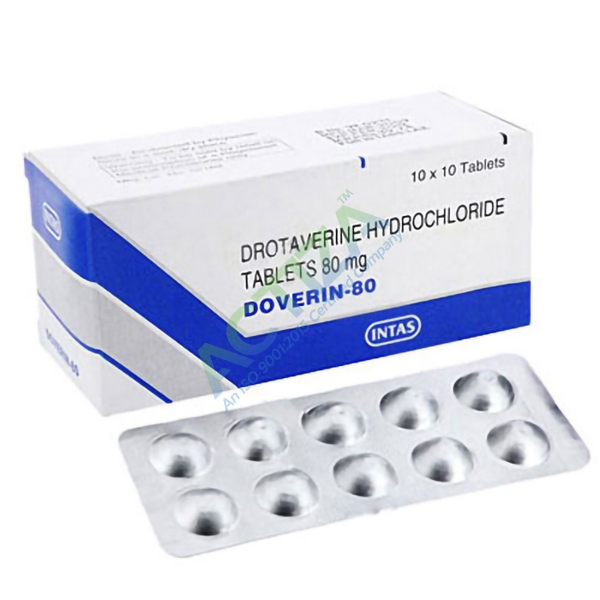
What is Doverin 80 mg Doverin 80 mg is a prescription tablet containing drotaverine 80 mg.
Drotaverine is a smooth muscle antispasmodic.
Smooth muscle lines the gut, bile ducts and urinary tract.
When that muscle cramps, it causes gripping pain.
Doverin 40 mg relaxes the cramping muscle.
It is taken when spasm-type pain occurs.
It is not a painkille r in the ordinary sense.
It does not reduce inflammation.
Product identity Field Detail Brand name Doverin 80 mg Tablet Generic name Drotaverine, as drotaverine hydrochloride Strength 80 mg per tablet Dosage form Oral tablet, swallowed whole Drug class Musculotropic antispasmodic; papaverine derivative Company Intas Pharmaceuticals Ltd Address listed Chinubhai Centre, Off Nehru Bridge, Ashram Road, Ahmedabad 380009 Country of origin India Pack size Strip of 10 tablets MRP (listed) About Rs. 96.08 to Rs. 109 Primary use Relief of smooth muscle spasm Maximum daily dose, reference label 240 mg Legal status in India Prescription only, Schedule H ATC code A03AD02 (drotaverine) WHO defined daily dose 0.1 g, oral or parenteral
There is no United States or European Union central approval.
So no FDA or EMA label exists for this molecule.
The content here comes from two national authorisations.
Both are named wherever their content is used.
It is not a painkiller like paracetamol or ibuprofen.
It is not an anti-inflammatory drug.
It is not an antibiotic for a urine or gut infection.
It is not a treatment for the cause of the spasm.
It is not for a child under six years.
It is not a drug to take more of when pain persists.
How it works (mechanism of action) Smooth muscle cells line the gut, bile ducts and ureters.
Their contraction depends on calcium entering the cell.
A messenger called cyclic AMP helps keep them relaxed.
An enzyme family called phosphodiesterase destroys cyclic AMP.
Drotaverine inhibits phosphodiesterase in smooth muscle.
Cyclic AMP therefore builds up inside the cell.
Raised cyclic AMP lowers the calcium available for contraction.
The muscle relaxes and the cramp eases.
Some antispasmodics work by blocking nerve signals.
Those are called anticholinergic or neurotropic agents.
They bring dry mouth, blurred vision and urinary retention.
Drotaverine acts on the muscle cell itself instead.
So it avoids most of those anticholinergic effects.
That is the main argument made for using it.
Its relationship to papaverine
Drotaverine is classified as a papaverine derivative.
Papaverine is an older opium-derived smooth muscle relaxant.
Drotaverine is not an opioid and is not a narcotic.
It has no pain-blocking action on nerves.
Its effect is limited to relaxing smooth muscle.
It does not relieve pain that is not caused by spasm.
It does not treat an infection, a stone or an ulcer.
It does not remove the need to find the cause.
Persistent or severe abdominal pain needs investigation.
Masking such pain with repeat doses is unsafe.
Dosage guide Figures are from the reference labels. Only a prescriber may set your dose.
Patient group Dose Frequency Daily maximum Notes Adults 120 to 240 mg a day Divided into 2 or 3 doses 240 mg With 80 mg tablets, 2 or 3 a day Adults, at the ceiling 80 mg Three times daily 240 mg No further increase is permitted Severe liver impairment Not for use Not applicable Not applicable Contraindicated Severe kidney impairment Not for use Not applicable Not applicable Contraindicated Severe heart failure Not for use Not applicable Not applicable NYHA class III to IV excluded Low blood pressure Caution Prescriber decision Per prescriber Blood pressure may fall further Breastfeeding Not recommended Not applicable Not applicable Excluded on one reference label Pregnancy Only after medical advice Prescriber decision Per prescriber Caution is advised Children under 6 years Not for use Not applicable Not applicable Stricter of the two labels
Three tablets a day means roughly every eight hours.
Two tablets a day means roughly every twelve hours.
Keep the spacing even rather than clustering doses.
Do not add a dose because an earlier one seemed weak.
Count the tablets taken in each 24-hour period.
The approved use is symptomatic relief of cramping pain.
That implies short courses tied to symptoms.
The reference leaflet advises medical advice for long-term use.
It says that applies when taken alongside other medicines.
Recurrent or persistent pain needs a diagnosis, not repeat packs.
How to take it Confirm the prescriber intended the 80 mg strength.
Confirm how many tablets a day, and for how many days.
Take one tablet by mouth with a glass of water.
Swallow the tablet whole.
Do not crush, break or chew it.
Space the doses evenly through the day.
Do not exceed three tablets in any 24 hours.
Stand or sit up slowly, since blood pressure can fall.
Do not drive if you feel dizzy or lightheaded.
Stop and seek advice if pain worsens or changes character.
Drotaverine relaxes smooth muscle in blood vessel walls too.
That can lower blood pressure as a side effect.
The reference leaflet lists hypotension as a rare effect.
It advises caution if blood pressure is already low.
Retail pages warn of a sudden drop in blood pressure.
So rise slowly and avoid standing for long periods early on.
Missed dose Take the missed tablet when you remember it.
If the next dose is nearly due, skip the missed one.
Never take two tablets together to catch up.
Doubling up risks the overdose arrhythmia described above.
Sudden severe abdominal pain needs assessment, not a tablet.
So does pain with fever, vomiting or a rigid abdomen.
So does pain with blood in the stool or urine.
So does pain that keeps returning over weeks.
An antispasmodic can hide a condition needing surgery.
Precautions Absolute contraindications Known allergy to drotaverine.
Known allergy to any excipient in the tablet.
Severe liver impairment or liver failure.
Severe kidney impairment or kidney failure.
Severe heart failure.
Heart failure of NYHA class III or IV with reduced ejection fraction.
Breastfeeding.
Children under six years, on the stricter reference label.
The reference tablet contains lactose as an excipient.
The leaflet says to consult a doctor if you have sugar intolerance.
That matters for galactose or lactose intolerance.
Ask the pharmacist whether the Indian tablet also contains lactose.
No excipient list was published on the Indian listings found.
Conditions to disclose to your doctor Condition or medicine Why it matters Any liver disease Severe impairment is contraindicated Any kidney disease Severe impairment is contraindicated Any heart failure Severe heart failure is contraindicated Known low ejection fraction NYHA III to IV is excluded Low blood pressure Blood pressure may fall further Fainting or dizzy spells Hypotension is a listed effect Any heart rhythm problem Overdose can cause arrhythmias Taking levodopa for Parkinson disease Its effect may be reduced Parkinson disease of any severity Rigidity and tremor may worsen Lactose or galactose intolerance The reference tablet contains lactose Pregnancy or possible pregnancy Use only after medical advice Breastfeeding Excluded on one reference label Any long-term medicine Long-term combined use needs advice Recurrent abdominal pain Needs a diagnosis, not repeat courses Any child in the household Overdose deaths have been reported
Levodopa is the main treatment for Parkinson disease.
Drotaverine may reduce its antiparkinsonian effect.
Rigidity and tremor may worsen as a result.
The leaflet advises caution with the combination.
So a Parkinson diagnosis must be disclosed before use.
This interaction is rarely mentioned on retail pages.
Food and drink precautions No specific food restriction is stated on the reference leaflet.
Take it with a glass of water.
Taking it with food may ease any stomach upset.
Avoid alcohol, which can add to dizziness.
Alcohol can also lower blood pressure further.
Drink fluids normally unless told otherwise.
Avoid large meals during an episode of gut spasm.
If sugar intolerance applies, ask about the lactose content.
Before-use safety checklist Confirm a registered doctor prescribed drotaverine.
Confirm the strip reads 80 mg, not 40 mg.
Confirm how many tablets a day were intended.
Confirm the total will not exceed three tablets a day.
Confirm the cause of the pain has been considered.
Confirm you have no severe liver or kidney disease.
Confirm you have no severe heart failure.
Confirm your blood pressure is not unusually low.
Confirm you are not taking levodopa.
Confirm you are not breastfeeding.
Confirm you are not pregnant, or have taken advice.
Confirm no child can reach the strip.
Confirm the expiry date and that the strip is intact.
Common and less common side effects By frequency, from the reference leaflet
Frequency Side effect What to do Rare Nausea Take with food Rare Constipation Increase fluids and fibre Rare Headache Report if severe Rare Dizziness Sit down; do not drive Rare Insomnia Report to your prescriber Rare Palpitations Report to your prescriber Rare Low blood pressure Rise slowly; report if faint Rare Allergic reaction with skin swelling Stop and seek care Rare Hives Stop and seek care Rare Rash Stop and seek advice Rare Itchy skin Stop and seek advice Not known Vertigo, a spinning sensation Sit down; report it
The reference leaflet lists no very common or common effects.
Every listed effect falls in the rare category.
That reflects a limited safety dataset as much as good tolerance.
Nausea and vomiting.
Dry mouth.
Vertigo, described as a spinning sensation.
Dizziness.
A sudden drop in blood pressure needs a doctor at once.
A serious allergic reaction needs a doctor at once.
The serious risk sits in overdose, not ordinary use
The Swiss report names cardiac arrhythmias in overdose.
It states those arrhythmias can be fatal.
It records that several deaths have been reported.
That is why the 240 mg daily ceiling matters.
It is also why the pack must be kept from children.
Drug interactions – avoid with Drug or group Effect Action Levodopa Antiparkinsonian effect may be reduced Use with caution; disclose Levodopa combinations for Parkinson disease Rigidity and tremor may worsen Use with caution; disclose Any blood pressure lowering medicine Added fall in blood pressure Disclose; monitor Nitrates or other vasodilators Added fall in blood pressure Disclose; monitor Alcohol Added dizziness and blood pressure fall Avoid Sedatives or sleeping tablets Added dizziness Disclose; monitor Other antispasmodics Duplicate therapy Do not combine without advice Any long-term medicine Combined long-term use needs advice Seek advice first
What the reference labels do not tell us
Neither label publishes a long list of interactions.
That reflects a limited dataset, not proven safety.
The Swiss report notes the clinical data were not reassessed.
So treat the absence of an interaction entry with care.
Disclose every medicine, supplement and herbal product.
Every prescription medicine you take.
Every over-the-counter painkiller or antacid.
Any Parkinson disease medicine.
Any blood pressure tablet.
Any herbal or ayurvedic digestive preparation.
Emergency warning signs Stop the tablet and get emergency care
Warning sign Possible cause Fast, irregular or pounding heartbeat Cardiac arrhythmia Fainting or near-fainting Severe low blood pressure Collapse after a dose Severe low blood pressure Swelling of the face, lips or tongue Allergic reaction with angioedema Difficulty breathing or wheezing Severe allergic reaction Widespread hives with faintness Severe allergic reaction Sudden severe abdominal pain A condition needing urgent assessment Abdominal pain with fever and vomiting Possible surgical emergency A rigid, board-like abdomen Possible perforation Blood in the stool or vomit Gastrointestinal bleeding Blood in the urine with loin pain Urinary tract emergency Yellowing of the eyes or skin Biliary obstruction or liver problem
In suspected overdose
Do not wait to see whether symptoms settle.
Go to hospital, taking the strip and carton.
Tell the staff how many tablets were taken and when.
Mention that fatal arrhythmias are described in overdose.
Ask for cardiac monitoring to be considered.
This applies especially if a child took the tablets.
Colicky pain can come from a stone, a blockage or appendicitis.
Relieving the spasm does not treat any of those.
A patient who feels better may delay going to hospital.
That delay is where the real harm often lies.
Use it for diagnosed spasm, not as a holding measure.
Why choose this medicine Clinical reasons a prescriber may select drotaverine
It acts directly on the smooth muscle cell.
It avoids most anticholinergic effects of older antispasmodics.
So dry mouth and urinary retention are less of a problem.
It has a licensed use in functional gastrointestinal cramping.
It is taken by mouth, two or three times a day.
It is not an opioid and is not a controlled substance.
It is widely available and inexpensive in India.
Two tablets a day give 160 mg, inside the labelled range.
Three tablets a day give 240 mg, the labelled maximum.
It halves the tablet count against a 40 mg strength.
It suits a patient already settled on a higher daily dose.
A 40 mg strength remains better for starting or stepping down.
When a prescriber will choose otherwise Situation Likely preference Reason Pain not caused by spasm A different class entirely No effect on other pain Undiagnosed abdominal pain Investigation first Risk of masking a diagnosis Severe liver or kidney disease A different option Contraindicated Severe heart failure A different option Contraindicated Low blood pressure A different option Blood pressure may fall further Taking levodopa A different option Antiparkinsonian effect may fall Breastfeeding A different option Not recommended A child under six A paediatric option Excluded on the stricter label Needing a low starting dose The 40 mg strength 80 mg is an adult step Period pain specifically Discuss the evidence Not an approved Swiss indication
Honest limitations
There is no FDA or EMA central approval for this molecule.
The Swiss regulator did not reassess the clinical data.
Its product information says efficacy was only briefly assessed.
Several claimed uses were not granted in that review.
All listed side effects fall in the rare category only.
That reflects a limited dataset as much as good tolerance.
Overdose can cause fatal arrhythmias, with deaths reported.
No excipient list was published on the Indian listings found.
One listing shows the product out of stock.
Storage instructions Instruction Detail Temperature, Indian listings Below 30 degrees, or 15 to 30 degrees Temperature, reference leaflet Below 25 degrees Celsius Working rule Keep below 25 degrees where possible Container Keep tablets in the original blister pack Light Protect from direct light Moisture Protect from moisture; keep in a dry place Bathroom storage Avoid; humidity degrades tablets Refrigeration Not required; do not freeze Children Keep out of sight and reach; overdose can be fatal Pets Keep away from pets Expiry Do not use after the printed expiry date Damaged tablets Discard chipped, soft or discoloured tablets Sharing Never share with another person Disposal Do not flush; return to a pharmacy
Most storage advice mentions children as a formality.
Here the Swiss report records deaths from overdose.
A small number of tablets could be dangerous to a child.
Keep the strip in a high, closed cupboard.
Do not leave loose tablets in a bag or bedside drawer.
Return unused tablets rather than keeping a supply.
Sanjay Gangani
B.Pharm, CMO & Pharmacist
Licensed pharmacist (B.Pharm) with 12+ years in clinical pharmacy and patient care. Reviews every article for evidence-based accuracy before it is published on ACTIZA Store.



Reviews
There are no reviews yet.