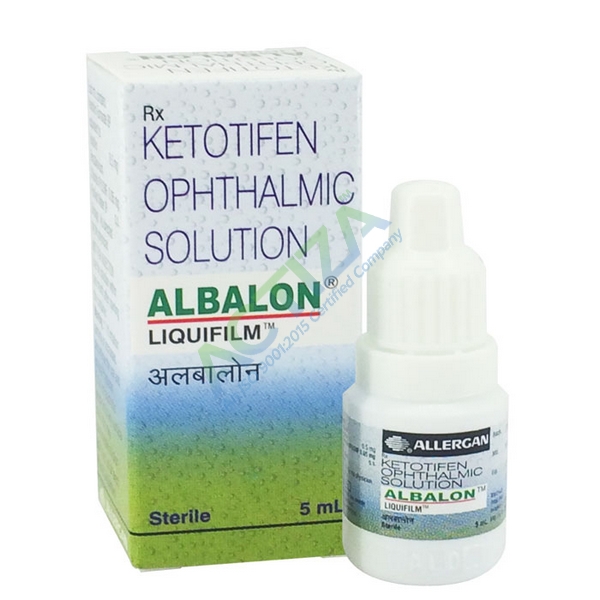
Albalon Eye drop 5 ml (Ketotifen) Medically reviewed by Sanjay Gangani, B.Pharm, CMO & Pharmacist
Active Ingredient Ketotifen Indication Allergic eye disease Manufacturer Allergan India Pvt Ltd Strength:- 5ml Packaging 5 ml in 1 packet
INQUIRE ABOUT Albalon Eye drop 5 ml (Ketotifen)
What is Albalon Eye Drops? Albalon is a sterile solution instilled directly into the eye.
The manufacturer’s document lists naphazoline hydrochloride as the ingredient.
Each millilitre contains 1 milligram of naphazoline hydrochloride.
That is a strength of 0.1 percent.
Naphazoline is a topical ocular vasoconstrictor.
A vasoconstrictor narrows the small blood vessels in the eye.
Narrowed vessels carry less blood, so the eye looks less red.
It is used for temporary relief of eye redness and minor irritation.
Albalon is a trademark of Allergan, an AbbVie company.
In India it is marketed by Allergan India Pvt. Ltd. in Bangalore.
Betoact is supplied in a 5 millilitre dropper bottle.
It treats the appearance of redness, not its underlying cause.
It is not an antibiotic and does not treat eye infection.
It is not a lubricant and does not treat dry eye.
Albalon Liquifilm is a separate product with its own labelling.
Use Albalon only as your doctor or pharmacist has directed.
How Albalon Eye Drops Works (Mechanism of Action) The action happens in five simple steps:
Irritation makes the small blood vessels of the eye widen.
Widened vessels carry more blood, which looks like redness.
Naphazoline stimulates alpha-adrenergic receptors on those vessels.
Stimulating those receptors makes the vessel walls tighten.
Less blood flows through, so the white of the eye looks clearer.
What that means for the user:
Redness fades quickly, usually within a few minutes.
Minor irritation and watering may also ease.
Minor irritation and watering may also ease.
The cause of the irritation remains untreated.
Why prolonged use causes a problem:
Blood vessels adapt to repeated constriction over days.
They then widen more strongly when the drop wears off.
The eye looks redder than before, prompting another dose.
That cycle is known as rebound redness.
Eye specialists advise only a few consecutive days of use.
The manufacturer’s document caps use at 14 days unadvised.
What it does not do:
It does not block the allergic reaction itself.
It does not relieve itching the way an antihistamine does.
It does not treat infection, injury or dry eye.
It does not replace a proper eye examination.
Dosage Guide Follow the instructions your doctor or pharmacist gives you.
Situation Typical Approach Timing Key Note Adults and children over 12 One or two drops into the affected eye Only as directed Do not exceed the stated frequency Children under 12 years Do not use Not applicable The labelling excludes this age group No response within 48 hours Stop and seek medical advice Within two days Persisting redness needs assessment Symptoms recur after treatment Seek medical advice Promptly Recurrence suggests another cause Maximum duration Not beyond 14 days Unless a doctor directs otherwise Longer use risks rebound redness Short courses preferred A few consecutive days only As advised Specialists often advise about three days Narrow-angle glaucoma Do not use Not applicable It can trigger an acute attack Contact lens wearers Remove lenses before instilling Wait before reinserting Ask your pharmacist how long to wait After opening the bottle Discard after four weeks Not applicable Even if solution remains Pregnancy or breastfeeding Discuss with your doctor first As advised Caution is recommended
How to read this table:
Eye drop frequency should come from a professional, not a website.
Using drops more often does not clear redness faster.
Frequent use is what produces the rebound cycle.
Redness lasting beyond two days needs proper assessment.
Redness with pain or vision change is never minor.
Missed dose and overdose rules:
These drops are used as needed, so missed doses rarely apply.
Do not put in extra drops to make up for a missed one.
Swallowing the solution is dangerous, especially for a child.
In children it can cause central nervous system depression.
That can progress to coma and a marked fall in body temperature.
Keep the bottle well out of reach of children at all times.
Seek emergency help immediately if any is swallowed.
How to Use Albalon Eye Drops Wash and dry your hands thoroughly first.
Check the solution is clear and not discoloured.
Remove contact lenses before instilling the drops.
Tilt your head back and look upwards.
Gently pull the lower eyelid down to form a small pocket.
Squeeze the bottle to release one drop into that pocket.
Do not let the dropper tip touch your eye or eyelid.
Do not let it touch your fingers or any surface.
Close the eye gently for one to two minutes.
Press lightly on the inner corner of the eye.
That reduces how much drains into the body.
Wipe away any excess with a clean tissue.
Replace the cap tightly straight away.
Wait before reinserting contact lenses, as advised.
Practical usage tips:
Touching the dropper tip can contaminate the whole bottle.
A contaminated bottle can cause a serious eye infection.
Never share an eye drop bottle with another person.
Wait about five minutes between two different eye drops .
Vision may blur briefly after instilling a drop.
Do not drive until your vision is clear again.
Write the opening date on the bottle label.
That makes the four-week discard date easy to track.
Precautions Absolute Contraindications – Do Not Use Albalon If You: Are allergic to naphazoline or any ingredient in the solution.
Have narrow-angle or angle-closure glaucoma.
Have a shallow anterior chamber in the eye.
Are under 12 years of age.
Have an eye injury, or anything in the eye.
Have eye pain rather than simple redness.
Have any change in your vision.
Redness with pain or reduced vision is not a minor problem.
It can signal infection, injury or raised eye pressure.
Those need same-day assessment, not a decongestant drop.
Conditions You Must Disclose to Your Doctor Any form of glaucoma or raised eye pressure.
Any family history of glaucoma.
Long-sightedness, which can mean a narrow drainage angle.
Any heart condition or irregular heartbeat.
High blood pressure .
An overactive thyroid gland.
Diabetes
Any antidepressant, especially a monoamine oxidase inhibitor.
Any recent eye surgery or eye injury.
Whether you wear contact lenses.
Any other eye drops or ointments you use.
Pregnancy, planned pregnancy or breastfeeding.
All prescription and over-the-counter products you use.
Food and Drink Precautions No food restriction applies to eye drops.
The solution must never be swallowed.
Keep it away from food and drink containers.
Store it where a child cannot mistake it for a drink.
Limit alcohol, which can worsen eye dryness and redness.
Reduce caffeine if you have palpitations while using it.
Stay hydrated, as dryness itself causes redness.
Before-Use Safety Checklist Have you confirmed the active ingredient on the carton?
Does the carton match the version described on the page?
Are you or the user aged twelve years or over?
Have you been told you have glaucoma or narrow angles?
Is there eye pain rather than simple redness?
Has your vision changed in any way?
Have you removed your contact lenses?
Do you know not to use it beyond the stated period?
Have you told your doctor about any heart condition?
Have you checked the expiry date on the bottle?
Have you written the opening date on the label?
Do you know the emergency warning signs in Section 8?
Common and Less Common Side Effects Most effects are local and settle quickly.
Side Effect Frequency What It Feels Like What to Do Stinging or burning Common Brief sharp feeling on instilling Usually passes in seconds Transient blurred vision Common Vision hazy for a minute or two Do not drive until it clears Eye irritation Common Gritty or uncomfortable feeling Report if it persists Watering of the eye Common Reflex tearing after a drop Usually settles quickly Pupil dilation Less common Enlarged pupil, light sensitivity Report to your doctor Rebound redness With prolonged use Eye redder than before between doses Stop and seek advice; do not redose Dryness of the eye Less common Gritty, dry sensation Consider lubricating drops instead Headache Less common Dull ache after use Report if it repeats Dizziness Less common Light-headed feeling Report to your doctor Fast heartbeat Less common Racing or pounding pulse Stop and seek medical advice Raised blood pressure Less common Usually no symptoms Relevant if you have hypertension Nausea Less common Queasy stomach Report if it repeats Hypersensitivity reaction Reported Rash, swelling, allergic dermatitis Stop and contact your doctor Acute angle-closure glaucoma Rare Severe eye pain, halos, blurred vision Emergency — seek immediate eye care CNS depression in children Rare but serious Drowsiness progressing to coma Emergency — call for help immediately Low body temperature in children Rare but serious Cold, floppy, unresponsive child Emergency — call for help immediately
Two risks deserve particular attention:
Rebound redness is the commonest problem with decongestant drops.
It develops when the drops are used for too many days.
The eye becomes redder between doses than it was originally.
Users then apply more drops, which deepens the cycle.
Breaking the cycle requires stopping, with medical support.
Swallowing by a child is the other serious risk.
The labelling warns of central nervous system depression.
That can progress to coma and marked cooling of the body.
Store the bottle well out of reach at all times.
Drug Interactions – Avoid or Use With Caution Tell your doctor before combining Albalon with these:
Monoamine oxidase inhibitors, a class of antidepressant.
Tricyclic antidepressants.
Medicines for high blood pressure.
Beta-blockers, including beta-blocker eye drops.
Other decongestants, whether in eye drops or nasal sprays.
Oral decongestants in cold and flu remedies.
Stimulants, including high-caffeine products.
Any other eye drop, which should be spaced apart.
Interaction outcomes to understand:
Decongestants can raise blood pressure when absorbed.
Combining several decongestants multiplies that effect.
Monoamine oxidase inhibitors can cause a sharp blood pressure rise.
Two eye drops given together wash each other out.
Leave about five minutes between different eye drops.
Preservatives can build up if several drops are used.
Emergency Warning Signs – Seek Urgent Medical Help Seek same-day eye care immediately if you have:
Severe eye pain rather than mild irritation.
Seeing halos or rainbow rings around lights.
Sudden blurring or loss of vision.
A hard, intensely red and painful eye.
Eye pain with nausea, vomiting or headache.
A pupil that stays enlarged and will not react.
Anything stuck in the eye, or an eye injury.
Thick discharge with light sensitivity.
Call emergency services immediately if:
A child has swallowed any of the solution.
A child becomes unusually drowsy or floppy.
A child feels cold and cannot be roused.
Anyone has slowed or shallow breathing after ingestion.
There is swelling of the face, lips or throat.
Critical instructions in an emergency:
Take the bottle with you so the ingredient can be checked.
Say which active ingredient the carton names.
State how much was used or swallowed, and when.
Say whether the person has glaucoma or narrow angles.
Do not put in more drops while awaiting help.
Acute angle closure can damage sight within hours.
Why Choose Albalon Eye Drops? Benefits when it is clinically appropriate:
Redness fades quickly, usually within minutes.
The drop acts locally rather than throughout the body.
A small 5 millilitre bottle is easy to carry.
The dropper delivers a consistent drop size.
Albalon is a long-established Allergan brand.
Allergan is a specialist eye care company.
It is useful for short-lived, minor redness.
Generic pricing keeps a short course affordable.
Honest balance for the buyer:
It treats the appearance of redness, not its cause.
It does not relieve itching the way an antihistamine does.
Prolonged use causes rebound redness that is hard to break.
It must not be used beyond the stated period unadvised.
It can trigger acute glaucoma in susceptible eyes.
It is not suitable for children under twelve.
Redness lasting more than two days needs assessment.
Lubricating drops are often a better first step for dryness.
An antihistamine drop is better for allergic itching.
Storage Instructions Store below 25°C unless the carton states otherwise.
Keep the bottle tightly closed between uses.
Protect from direct sunlight and heat.
Do not refrigerate or freeze the solution.
Do not store in the bathroom or near a sink.
Write the date of opening on the bottle label.
Discard any unused contents four weeks after opening.
Discard it even if solution remains in the bottle.
Do not use solution that is cloudy or discoloured.
Do not use a bottle whose seal was already broken.
Never touch the dropper tip to any surface.
Keep the bottle well out of sight and reach of children.
Swallowing by a child can cause coma and low body temperature.
Keep away from pets at all times.
Check the expiry date on the bottle and carton.
Return unused drops to a pharmacy take-back scheme.
Sanjay Gangani
B.Pharm, CMO & Pharmacist
Licensed pharmacist (B.Pharm) with 12+ years in clinical pharmacy and patient care. Reviews every article for evidence-based accuracy before it is published on ACTIZA Store.



Reviews
There are no reviews yet.