Pitocin 10 iu Injection (Oxytocin) Medically reviewed by Sanjay Gangani, B.Pharm, CMO & Pharmacist
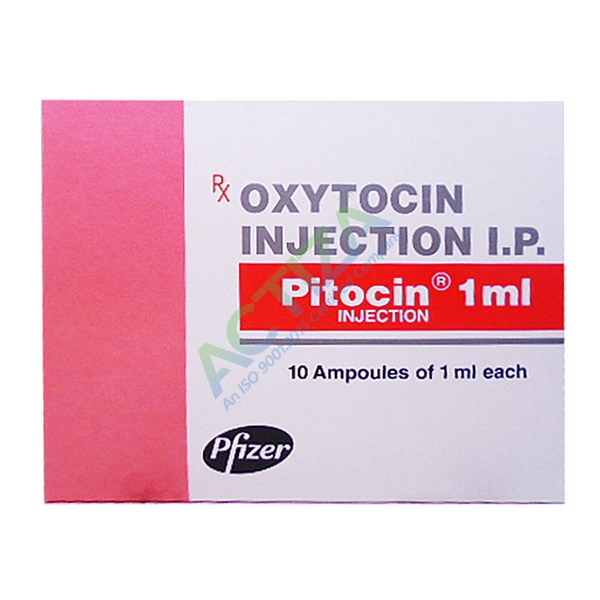
Active Ingredient Oxytocin Indication induction of labor Manufacturer Pfizer India Ltd Strength:- 1 ml Packaging 10 Ampoules in pack
INQUIRE ABOUT Pitocin 10 iu Injection (Oxytocin)
What is Pitocin 10 IU Injection? Pitocin is a sterile injection containing synthetic oxytocin.
Each millilitre contains 10 international units.
Oxytocin is a nonapeptide, a short chain of amino acids.
It is found naturally in pituitary extracts from mammals.
The synthetic version avoids the impurities of extracts.
It is given into a vein or into a muscle.
What the label lists it for before birth:
Inducing labour where there is a medical reason.
Examples given include rhesus problems and maternal diabetes.
They include mild pre-eclampsia at or near term.
They include waters breaking early with delivery indicated.
Strengthening labour in selected cases of weak contractions.
As added treatment in incomplete or inevitable miscarriage.
Producing contractions in the third stage of labour.
Controlling bleeding and haemorrhage after delivery.
Bleeding after birth is a leading cause of maternal death.
Published commentary puts it at 38 percent of such deaths.
That is roughly 32,000 deaths a year in India.
Oxytocin is the first-choice medicine to prevent it.
How Oxytocin Works (Mechanism of Action) The action happens in four simple steps:
The womb is made of smooth muscle.
That muscle becomes sensitive to oxytocin late in pregnancy.
Oxytocin stimulates rhythmic contractions of the womb.
It increases the frequency and the tone of contractions.
A contracted womb compresses the blood vessels inside it.
That mechanical squeeze is what controls the bleeding.
A pharmacological point from the label:
Synthetic oxytocin has only slight pressor activity.
It has only slight antidiuretic activity as well.
That is because vasopressin is absent from the synthetic form.
The antidiuretic effect still matters at high doses.
Section 6 explains why that causes water intoxication.
Administration – Hospital Use Only This section replaces a dosage guide. Dosing is set by the clinician.
Situation What the Label Says Route Key Note Induction or augmentation Only with medical supervision in hospital Intravenous only Never intramuscular for this use After delivery of the placenta 10 units may be given As directed One millilitre of this strength After curettage for miscarriage 10 units in 500 mL of fluid Intravenous infusion Saline or 5% dextrose Mid-trimester abortion adjunct 10 to 20 milliunits per minute Intravenous infusion Shortens time to completion Absolute cap in that setting Not more than 30 units In any 12-hour period Because of water intoxication risk Undiluted bolus Not appropriate Not applicable Dilution is required for infusion Who may give it An experienced clinician Trained in its complications Per a clinical database Where it may be given A specialised care setting Not applicable Intensive care and surgery on hand Monitoring Continuous, of mother and baby Throughout Contractions and heart rate Elective induction Not indicated Not applicable The boxed warning
Why no full dosing schedule appears here:
Infusion rates are titrated against the contraction pattern.
They are adjusted continuously by the clinician at the bedside.
They depend on the mother’s response and the baby’s heart rate.
Publishing a fixed rate would be misleading and unsafe.
The prescribing information and local protocol govern.
Contraindications in the Approved Labelling Before birth, it must not be used where there is:
Significant disproportion between the baby and the pelvis.
An unfavourable position of the baby, such as a transverse lie.
Any such position undeliverable without being turned first.
Severe toxaemia, per the Canadian label.
Placenta praevia, where the placenta covers the exit.
Prematurity, or a cervix that is not ready.
A predisposition to rupture of the womb.
Grand multiparity or an overstretched womb.
Fetal distress, cervical cancer , herpes infection.
Vasa praevia, and previous surgery to the womb.
Excessive dose or sensitivity can cause an overactive womb.
That can mean spasm, sustained contraction, or rupture.
Rupture of the womb is a life-threatening emergency.
Water Intoxication – A Risk Specific to This Medicine Oxytocin has a mild antidiuretic effect.
That means the body holds on to water.
At high doses over long infusions, water builds up.
Blood sodium falls as a result.
Severe water intoxication has occurred.
It has been associated with convulsions and coma.
That is why the 30 unit cap in 12 hours exists.
Fluid balance must be watched during long infusions.
Drowsiness, confusion or a headache during an infusion.
Nausea and vomiting that worsen.
Any seizure.
Side Effects Effects reported in approved labelling:
Effect Who It Affects What It Involves What It Means Nausea The mother Queasiness Reported as mild Vomiting The mother Being sick Reported as mild Overactive womb The mother Spasm or sustained contraction Needs the infusion stopped Rupture of the womb The mother Tearing of the womb wall A surgical emergency Water intoxication The mother Low sodium, fluid overload Can cause fits and coma Blurred vision The mother Vision not sharp Timing reported as early Fetal bradycardia The baby A slowed heart rate Needs immediate review Other arrhythmias The baby Irregular heartbeat Including extra beats Low Apgar score at five minutes The newborn Poorer condition at birth Reported in labelling Neonatal jaundice The newborn Yellowing of the skin Raised bilirubin Retinal haemorrhage The newborn Bleeding in the eye Reported in labelling Neonatal seizures The newborn Fits Reported with this product Permanent brain damage The newborn Lasting neurological injury Reported in labelling Fetal death The baby Death before birth Reported in labelling
How to read this table honestly:
The label gives no frequency figures for these effects.
Each is recorded as having been reported.
The label separates effects due to womb activity from others.
The serious outcomes listed are why supervision is mandatory.
None of this argues against proper clinical use.
All of it argues against use outside a hospital.
Storage and Handling Store between 20°C and 25°C, per the label.
That is controlled room temperature.
Keep the ampoule or vial in its carton until use.
Inspect the solution before use; it should be clear.
A pharmacy bulk package is not for direct infusion.
Such a package is for admixture in a suitable work area.
Its closure should be penetrated only once.
Dispose of used ampoules through clinical waste routes.
The Indian Regulatory Position This medicine has an unusual recent history in India.
A notification dated 27 April 2018 restricted manufacture.
Manufacture for domestic use was limited to the public sector.
One public sector company was named to supply the whole country.
Import of oxytocin and its formulations was banned.
Supply was to go directly to registered hospitals and clinics.
The notification said it must not be sold through retail chemists.
The measure was aimed at misuse in dairy cattle.
Manufacturers and an NGO challenged the notification in court.
The Delhi High Court stayed the restriction in August 2018.
A technical advisory board met on 31 July 2018.
It recommended reversing the ban on retail sale.
It feared a public health crisis if supply were disrupted.
Obstetricians argued the medicine is life-saving for mothers.
Retail sale was allowed again; the import curb remained.
The schedule change that followed:
New rules were issued on 21 August 2018.
Oxytocin moved from Schedule H to Schedule H1.
That change took effect from 1 September 2018.
Schedule H1 imposes stricter record-keeping on the seller.
A parliamentary answer confirmed the drug was not banned.
The regulatory position has changed more than once.
Reporting here dates from 2018 and 2019.
Confirm the position in force today before listing.
Confirm whether online sale of Schedule H1 items is permitted.
Confirm the record-keeping your platform must maintain.
Take legal advice, not just pharmacist advice, on this one.
An Honest Assessment for the Retailer Why this medicine matters:
It is a first-choice medicine to prevent bleeding after birth.
Bleeding after birth is a leading cause of maternal death.
Obstetricians describe it as life-saving.
Restricting its availability was opposed on those grounds.
It requires an experienced clinician to administer it.
It requires intensive care and surgery to be on hand.
It carries a boxed warning against elective induction.
Misuse can rupture the womb.
Reported harms to the newborn include death and brain damage.
It has a documented history of misuse in India.
Its retail status has been contested and changed.
This page carries no purchase-intent keywords for those reasons.
If You Supply Hospitals Rather Than Consumers That is a different business, with different obligations.
Confirm your licence covers Schedule H1 injectables.
Confirm the cold chain requirements for your stock.
Confirm the manufacturer holds a valid licence.
Keep the register that Schedule H1 requires.
etain prescriptions for the period the rules specify.
Verify the buying institution is a registered hospital or clinic.
Do not fulfil orders from individuals.
Sanjay Gangani
B.Pharm, CMO & Pharmacist
Licensed pharmacist (B.Pharm) with 12+ years in clinical pharmacy and patient care. Reviews every article for evidence-based accuracy before it is published on ACTIZA Store.



Reviews
There are no reviews yet.