A result above 600 mg/dL will not display as a number.
The meter shows a low or high message instead.
Either message needs immediate medical attention.
Do not assume the meter is faulty.
Testing frequency depends entirely on your treatment.
People on insulin usually test several times daily.
People on tablets alone may test far less often.
Your doctor sets both the frequency and your target range.
Do not change your testing pattern on your own.
Keep a record of readings to show at your reviews.
HOW TO PERFORM A TEST
Before testing
Wash your hands with warm water and soap.
Dry them completely before pricking.
Wet hands dilute the blood drop and distort the result.
Food residue on a finger can raise the reading sharply.
Check the strip vial expiry date and the discard date.
Insert a strip into the meter and wait for it to be ready.
Use a fresh lancet for every test.
Prick the side of a fingertip rather than the pad.
The side is less sensitive and heals more comfortably.
Rotate the finger and the site used each time.
Apply the blood drop to the strip as the meter directs.
Do not add more blood to a strip after the first application.
Do not press the finger hard to squeeze out blood.
Squeezing adds tissue fluid and can distort the result.
Alternative site testing
The forearm and palm may also be used.
Fingertip readings change faster than forearm readings.
Use the fingertip whenever a result is needed quickly.
Use the fingertip if you suspect low blood glucose.
Close the vial cap tightly straight away.
Dispose of the lancet in a sharps container.
Record the result, the date and the time.
PRECAUTIONS AND LIMITATIONS
Absolute limitations – do not use
Do not use these strips to diagnose diabetes.
Do not use them for testing newborns.
Do not use a strip after the vial expiry date.
Do not use a strip more than 6 months after opening the vial.
Do not use a strip that is discoloured or damaged.
Do not reuse a strip.
Do not use these strips in a Select, Select Plus or Verio meter.
Anaemia and other blood conditions – the most important limitation
Haematocrit is the proportion of your blood made up of red cells.
Haematocrit
Effect on the reading
Below 30%
Results may be falsely HIGH
Above 55%
Results may be falsely LOW
Why the low-haematocrit effect matters particularly
A low haematocrit means anaemia.
Anaemia is common, especially in women and in older adults.
In anaemia these strips can read higher than the true glucose.
A falsely high reading can prompt a larger insulin dose.
That larger dose can then cause hypoglycaemia.
So the error leads to real harm, not just a wrong number.
Tell your doctor if you are anaemic.
Ask whether your haematocrit is known.
The insert advises consulting a professional if it is unknown.
Laboratory testing may be needed to confirm readings.
Conditions causing a high haematocrit also distort results.
Severe dehydration raises haematocrit temporarily.
We would put this on the page rather than in a leaflet: anaemia is widespread, and a strip that reads falsely high in anaemic patients is a recognised limitation of the technology rather than a fault. Customers deserve to know it so they can raise it with their doctor, particularly if readings and symptoms disagree.
Hygiene and infection control
Lancets and strips are single-use items.
Never share a lancing device with another person.
Never share a meter without proper cleaning.
Bloodborne infections can be transmitted this way.
Clean the meter as the user guide directs.
Dispose of lancets in a proper sharps container.
Do not put used lancets in household waste.
Checking that the system is working
A control solution test checks meter and strips together.
It confirms the system is reading correctly.
Perform one when you open a new vial of strips.
Perform one if you drop the meter.
Perform one if a reading does not match how you feel.
Perform one if you doubt a result for any reason.
Follow the meter user guide for the procedure.
Control solution has its own expiry after opening.
Conditions and situations to discuss with your doctor
Anaemia, or any known low haematocrit.
Any condition causing a high haematocrit.
Severe dehydration.
Any severe illness or infection.
Peripheral circulation problems in the hands.
Any kidney disease requiring dialysis.
Oxygen therapy, which can affect some strip chemistries.
High altitude, which can affect readings.
Any medicine listed in section 7.
Any reading that does not match your symptoms.
Before-use checklist
My meter is a OneTouch Ultra family model.
I have checked the model name printed on the meter.
The strip vial is within its printed expiry date.
The vial was opened less than 6 months ago.
I have written the discard date on the vial.
My hands are washed and completely dry.
I am using a fresh lancet.
I know my target glucose range from my doctor.
I know what to do if a reading is very high or very low.
I have a source of fast-acting sugar available.
CAUSES OF INACCURATE RESULTS
This section replaces side effects. A strip has no side effects, but an inaccurate reading has consequences, so the equivalent risk is measurement error.
Technique and handling causes
Cause
Effect on the reading
How to avoid it
Wet hands
Diluted sample, reads low
Dry hands completely
Food residue on the finger
Reads falsely high
Wash before testing
Squeezing the finger hard
Tissue fluid dilutes sample
Allow blood to form
Insufficient blood drop
Error message or wrong result
Reapply with a new strip
Adding blood twice to one strip
Unreliable result
Use a new strip
Reusing a strip
Unreliable result
Single use only
Expired strips
Unreliable result
Check both dates
Strips used beyond 6 months after opening
Unreliable result
Write the discard date
Vial left open
Moisture degrades strips
Close the cap immediately
Strips stored above 30 degrees C
Unreliable result
Store cool and dry
Strips refrigerated
Unreliable result
Never refrigerate
Physiological causes
Cause
Effect on the reading
Haematocrit below 30%, including anaemia
Falsely high
Haematocrit above 55%
Falsely low
Severe dehydration
Falsely low
Severe illness or shock
Unreliable
Poor circulation in the fingers
Unreliable
Alternative site testing during rapid change
Lags behind fingertip
Why framing this as the device equivalent of side effects is useful::
The harm from a glucose strip does not come from the strip itself. It comes from acting on a wrong number. Listing the causes of error, with the direction each error takes, is the genuinely protective content for this product.
INTERFERING SUBSTANCES
This section replaces drug interactions. The interference is with the measurement, not with a medicine in the body.
The insert names four substance groups.
Substance
Common examples
Effect at high concentration
Acetaminophen
Paracetamol, Crocin, Dolo
Falsely high result
Salicylates
Aspirin, high-dose salicylate
Falsely high result
Uric acid
Raised in gout
Falsely high result
Ascorbic acid
Vitamin C supplements
Falsely high result
What the insert actually says
At normal blood concentrations these do not interfere significantly.
At abnormally high concentrations they may cause high results.
All four are reducing substances, which donate electrons.
The strip measures current, so extra electrons look like glucose.
Paracetamol is one of the most widely used medicines in India.
High-dose vitamin C supplements are very common.
Gout raises uric acid and is increasingly common.
A patient taking any of these at high dose may read falsely high.
That can prompt an unnecessary insulin dose.
Tell your doctor what medicines and supplements you take.
Mention any recent high-dose paracetamol or vitamin C.
A cross-reference to your own catalogue:
you stock metronidazole, prednisolone and several other medicines that affect glucose control directly. Steroids in particular raise blood sugar substantially. A note on this page that steroid treatment changes glucose readings, and on the steroid pages that monitoring may be needed, links the two usefully.
EMERGENCY WARNING SIGNS
A glucose reading is only useful if you act on it correctly.
Your doctor sets your personal target range.
The symptoms below matter regardless of the number shown.
Shakiness, sweating or a racing heartbeat.
Sudden hunger.
Confusion or difficulty concentrating.
Slurred speech or unsteadiness.
Irritability or unusual behaviour.
Blurred vision.
Take fast-acting sugar at once if these appear.
Do not wait for a test result to treat symptoms.
The person is confused and cannot swallow safely.
The person has a seizure.
The person loses consciousness.
The meter shows a low message rather than a number.
Symptoms do not improve after taking sugar.
Signs of very high blood glucose – seek help
Excessive thirst and passing large amounts of urine.
Nausea and vomiting.
Abdominal pain.
Deep, rapid breathing.
A sweet or fruity smell on the breath.
Drowsiness or confusion.
The meter shows a high message rather than a number.
These may indicate diabetic ketoacidosis.
That is a medical emergency requiring hospital treatment.
Trust your symptoms over the number.
Repeat the test with a new strip.
Run a control solution test.
Seek medical advice if the discrepancy persists.
An error in either direction can be dangerous.
WHY CHOOSE ONETOUCH ULTRA TEST STRIPS
OneTouch is one of the longest-established glucose monitoring brands.
The Ultra system has been in use for many years.
Its performance is documented in regulatory submissions.
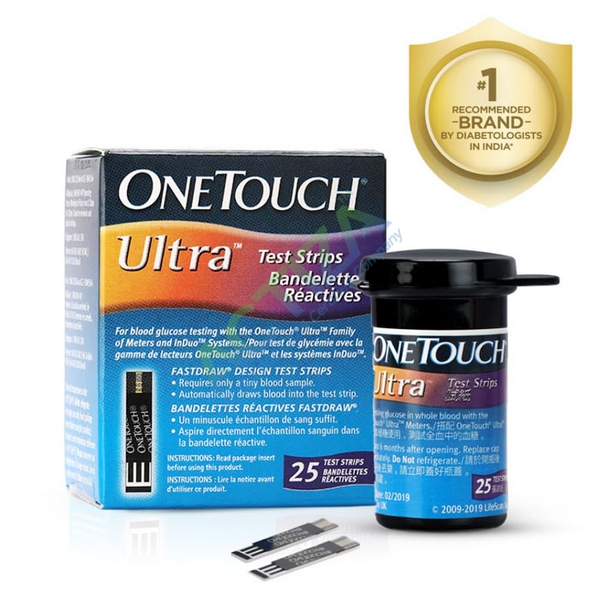
Strips are available in 25, 50 and 100 strip packs.
Larger packs reduce the cost per test.
Testing is permitted at the fingertip, forearm and palm.
Alternative sites help people who test very frequently.
The measurement range covers 20 to 600 mg/dL.
Strips remain usable for six months after opening.
Control solution testing lets you verify the system yourself.
Supply is widely available, which matters for a daily consumable.
Set expectations honestly:
These strips fit only the OneTouch Ultra family, and that single fact causes more wasted orders than anything else about the product. They monitor glucose but cannot diagnose diabetes and must not be used on newborns.
STORAGE INSTRUCTIONS
Store the vial in a cool, dry place below 30 degrees C.
Refrigeration causes condensation inside the vial.
Moisture degrades the reagent and distorts readings.
Keep strips in the original vial only.
Do not transfer them to another container.
The vial cap contains a desiccant that protects the strips.
Close the cap tightly immediately after removing a strip.
Do not leave the vial open.
That date is the date opened plus six months.
Discard any remaining strips on that date.
Do that even if the printed expiry is later.
Keep strips out of direct sunlight and away from heat.
Licensed pharmacist (B.Pharm) with 12+ years in clinical pharmacy and patient care. Reviews every article for evidence-based accuracy before it is published on ACTIZA Store.
Reviews
There are no reviews yet.
Be the first to review “OneTouch Ultra Test Strip” Cancel reply



Reviews
There are no reviews yet.