
Sorry, nothing in cart.
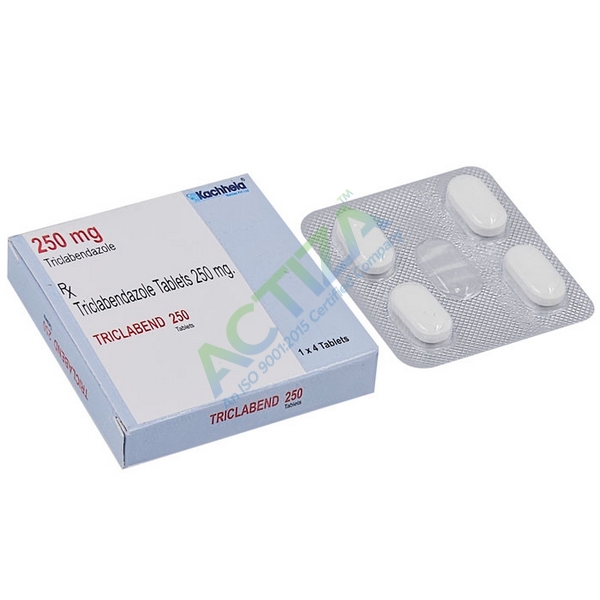
Triclabendazole 250 Mg (Triclabend)
| Active Ingredient | Triclabendazole |
|---|---|
| Indication | treatment of fascioliasis |
| Manufacturer | Kachhela Medex Pvt. Ltd. |
| Strength:- | 250mg |
| Packaging | 4 Tablet in 1 strip |
Triclabendazole 250 Mg (Triclabend) |
||||
|---|---|---|---|---|
| Pack Size | Price | Quantity | Add To Cart | |
| 40 Tablet/s | $66 | |||
| 80 Tablet/s | $118 | |||
| 160 Tablet/s | $200 | |||
| 320 Tablet/s | $340 | |||

What is Triclabendazole 250 mg?
Triclabendazole 250 mg is a prescription antiparasitic medication specifically designed to treat infections caused by liver flukes.
Some parasites, like Fasciola hepatica and Fasciola gigantica, cause fascioliasis, a sickness that can be very effectively treated with this medication.
Unlike many other antiparasitic drugs, triclabendazole is uniquely capable of targeting both immature and mature stages of these parasites, making it one of the most reliable treatment options available.
This medication stands out globally as the only treatment recommended by major health authorities for human fascioliasis.
The disease affects millions of people worldwide, particularly in regions where livestock farming and contaminated water sources are common.
Triclabendazole belongs to the benzimidazole class of anthelmintics, similar to drugs like albendazole and mebendazole.
However, its action differs significantly. While other drugs in this group primarily target intestinal worms, triclabendazole is highly effective against liver flukes at all stages of development.
Its ability to disrupt the parasite’s internal processes leads to paralysis and eventual death of the flukes, making it the gold-standard therapy for this condition.
Development and Regulatory Background
Originally developed in the early 1980s for veterinary use, triclabendazole was used to treat parasitic infections in livestock.
As fascioliasis became a growing public health issue, especially in endemic regions, the drug was adapted for human use.
Over time, it received regulatory approvals in multiple regions. It gained recognition in Europe in the late 1990s and was later approved in the United States under a branded formulation.
Additionally, global health organizations have included it in their essential medicines list, emphasizing its importance in treating neglected tropical diseases.
Programs have also been established to improve access to this drug in high-risk regions.
Fascioliasis is a neglected tropical disease that affects millions of people across more than 70 countries.
An even larger population remains at risk, particularly in areas with poor sanitation and close contact with livestock.
The disease is most prevalent in tropical and subtropical regions of Africa and Asia.
Uses and Indications
Primary Use: Treatment of Fascioliasis
Triclabendazole 250 mg is mainly prescribed for the treatment of fascioliasis in adults and children above a certain age. The infection is caused by parasitic flatworms that primarily affect the liver and bile ducts.
Fascioliasis is a zoonotic infection, meaning it can spread from animals to humans. It is commonly transmitted through contaminated food or water.
The two major species responsible for the infection are widely distributed worldwide, making effective treatment essential.
How Humans Become Infected
People typically acquire fascioliasis by accidentally ingesting contaminated food or water that carries the infective larval stage (metacercariae) of the parasite.
These larvae often attach themselves to aquatic plants or remain suspended in unsafe water sources.
Common routes of infection include:
The Parasite’s Journey in the Human Body
Once inside the human body, the parasite follows a complex migration path:
Two Clinical Phases of Fascioliasis
Phase 1 – Acute Phase (Weeks to Months After Infection)
This early phase occurs when immature flukes migrate through the liver, lasting weeks to months.
Symptoms are mainly due to tissue damage and the immune response, including fever, right upper abdominal pain, an enlarged liver, nausea, skin rashes, and elevated eosinophil levels.
Some patients may also experience fatigue, weight loss, anemia, and, in severe cases, fluid buildup or other complications.
Phase 2- Chronic Phase (Once Adult Flukes Inhabit Bile Ducts)
This stage begins when adult parasites settle in the bile ducts.
Symptoms arise from blockage and inflammation, such as recurrent abdominal pain, jaundice, bile duct infection, and gallstone formation.
Long-term infection may lead to liver damage, while some individuals remain asymptomatic for years.
How Triclabendazole Works (Mechanism of Action)
Triclabendazole is rapidly absorbed and converted in the liver into active forms.
These compounds disrupt vital parasite functions, leading to their death and making them highly effective against liver flukes at different stages.
Multi-Target Mechanism – How It Kills Liver Flukes
Triclabendazole targets multiple vital systems of the parasite, ensuring effective elimination:
These combined actions result in the parasite detaching from the bile ducts, becoming paralyzed, and eventually dying. The dead parasites are then naturally expelled from the body through bile flow and intestinal movement.
While drugs like albendazole and mebendazole are widely used for intestinal worms, triclabendazole is more effective against liver flukes.
It uniquely targets both immature and adult stages, making it the preferred treatment for fascioliasis.
Pharmacokinetics – What the Body Does to the Drug
Other Strength
Dosage and Administration
Recommended Dose – Adults and Children Aged 6 Years and Older
Detailed Administration Instructions
Take with food (ideally a full meal).
Swallow tablets with water; split if needed.
If unable to swallow, crush and mix with soft food (use within 4 hours).
Take the second dose 12 hours after the first.
Follow up with the doctor in 1-3 months.
Missed Dose
If you have missed a dose by chance, it can be taken immediately when remembered. Do not double the dose to make up for the missed one.
Overdose
In case of overdose, it is advised to seek immediate attention by consulting with a specialist.
Side Effects
Serious Side Effects – Seek Emergency Medical Help Immediately
If you are experiencing any of the above side effects, it is suggested that you seek medical attention to control the condition.
Cardiac Symptoms – QT Prolongation Warning
Neurological warning signs:
Eye and Vision Symptoms
Warnings and Precautions
Drug Interactions
Always inform your doctor about all medicines and supplements
Can raise the risk of serious heart rhythm issues
Works by prolonging the QT interval and affecting the CYP2C19 enzyme, which may increase levels of other drugs
MAJOR Interactions – QT-Prolonging Drugs (Avoid Concurrent Use)
MODERATE Interactions – CYP2C19 Substrates (Use with Monitoring)
Storage Instructions
Triclabendazole should be stored carefully to maintain its effectiveness and safety. Keep it below 30°C, away from sunlight and moisture, and never freeze it, as extreme conditions can damage the medicine.
Always leave tablets in their original packaging until use, keep them out of children’s reach, and check the expiry date before taking. If mixed with foods like applesauce, use it within a few hours, as stability drops.
Conclusion
Triclabendazole 250 mg tablets are an effective treatment for certain parasitic infections, particularly liver flukes. When used correctly under medical guidance, they are generally safe and well-tolerated.
However, attention is needed for possible heart rhythm risks, drug interactions, and special populations like children, elderly patients, pregnant, or breastfeeding individuals.
Proper storage, correct dosing, and informing your doctor about existing conditions or medications help ensure the best outcomes while minimizing risks.
FAQ
Q1. What is Triclabendazole 250mg used for?
Triclabendazole 250mg is used to treat fascioliasis (liver fluke infection) caused by Fasciola hepatica and Fasciola gigantica, and paragonimiasis (lung fluke infection) caused by Paragonimus species.
Q2. Why must Triclabendazole be taken with food?
Taking Triclabendazole with food, particularly a fatty meal, significantly increases its absorption in the body, making the treatment more effective against the parasites.
Q3. Is Triclabendazole the same as Egaten?
Yes. Egaten is the brand name for Triclabendazole, manufactured by Novartis. Both contain the same active ingredient and are used for the same indications.
Q4. Is Triclabendazole the same as Mebendazole or Albendazole?
No. Although all three are antiparasitic drugs, they belong to the benzimidazole class but work against different parasites. Triclabendazole specifically targets liver and lung flukes, while Mebendazole and Albendazole are used for intestinal worms and other parasitic infections.
Q5. Can Triclabendazole affect the heart?
Yes. Triclabendazole may cause QT interval prolongation, which is an abnormality in heart rhythm. Patients with pre-existing heart conditions, electrolyte imbalances, or those taking other QT-prolonging medications should be monitored with an ECG during treatment.
Q6. Can children take Triclabendazole 250mg?
Yes, it is approved for children aged 6 years and above with weight-based dosing. For children under 6 years, it should only be used under specialist guidance due to limited safety data in younger age groups.
Q7. How long does Triclabendazole treatment take?
The treatment course is typically short – usually one or two doses given on the same day, depending on the condition and the doctor’s recommendation. The exact dosing schedule is based on the patient’s body weight.
Q8. What if Triclabendazole treatment fails or symptoms return?
If symptoms persist or return after treatment, consult your doctor immediately. A repeat course may be prescribed after re-evaluation. In some cases, further diagnostic testing may be needed to confirm reinfection or treatment resistance.
Reviews
There are no reviews yet.